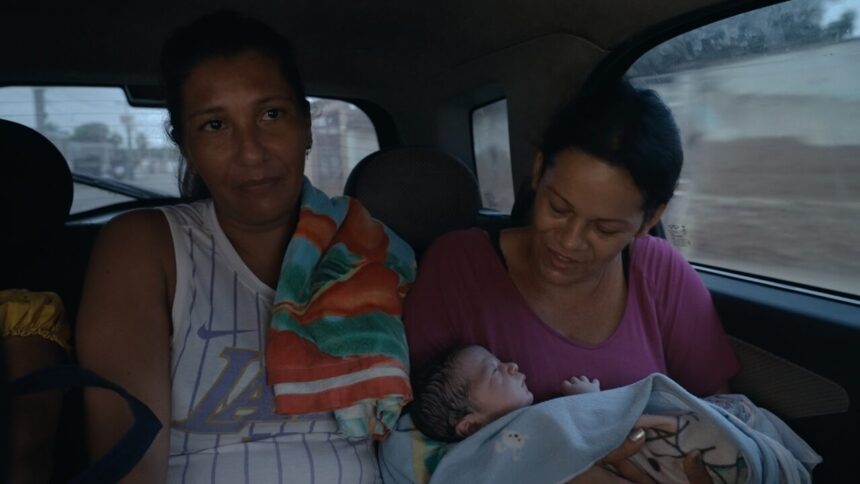
In the new documentary Rope (Le cordon), French journalist-turned-filmmaker Nolwen Hervé takes us to Venezuela and inside its “broken health system where life hangs by a thread,” as she describes the highlights of the documentary. “Carolina rises as a motherhood warrior. Drawing strength from her past, she relentlessly maintains the vital cord between pregnant women and their babies.”
After all, “giving birth had become a life-threatening act” for the country’s disenfranchised, as the film’s press notes explain. Karolina fights this crisis with seemingly endless energy and the network of resilience she has created in her neighborhood, “leading women in the struggle for bodily autonomy and safe birth conditions.” Her vision is to create a space where ancestral practices and Western medicine come together in a community-led model of care and “a place where women reclaim their autonomy over their bodies, their births, and their futures.”
Rope It has its world premiere on Saturday, March 14, in the main competition of the Copenhagen International Documentary Film Festival, CPH:DOX, which runs until March 22. Hervé worked as director and cinematographer, with Estelle Robin You producing the documentary. Grande Ourse Films is handling sales for the film.
Rope is one of six films featured in the second edition of Europe Docs!, an online showcase co-curated by European Film Promotion and CPH:DOX, designed to highlight outstanding European documentaries and improve access to the North American market.
Hervé first went to Venezuela in 2016 as a journalist when he was working on a French TV story about oil smuggling. “Venezuela was really in the middle of a crisis, and I was seeing Venezuelan women crossing the border into Colombia to give birth safely, because in Venezuela they were afraid of losing their babies or maybe dying,” she says. THR.
There she met a nurse who admitted her to a hospital in Maracaibo, the country’s second-largest city. “It is very symbolic, because this is the region that has made Venezuela so rich because of its oil,” explains Hervé. “I found the experience very shocking and crazy when she showed me the conditions in this public hospital. The children were suffering from malnutrition. This nurse was also selling sweets in the street because she could not afford them. [life] With her salary.”
She was “really moved, not only as a journalist, but also as a woman” by what she saw, which prompted her to embark on the journey of making her first feature film. “I wanted to tell this story, but not as a journalist. I wanted to have the freedom to tell the story from a subjective point of view and from an artistic point of view.”
Hervé says she worked on it Rope For more than five years. She first met protagonist Carolina in 2021 through a Colombian friend. She knew immediately that she had found a voice and a heart Rope After what she described as a “really moving meeting.”
In keeping with the warrior energy of motherhood, the film ends up not focusing solely on the scary and the negative. “It’s a very good example of how we try to change things when governments and countries fail, and how solidarity and brotherhood are the only things left to survive,” says the director. THR. “I feel goosebumps [when thinking about it]. It was a beautiful lesson for me to see all these women together feeling that yes we suffer a lot, but we are together. And I think that’s the most beautiful lesson from this experience, from this journey, for me personally and for the film as well.
The one thing Carolina told Hervé several times was something the document maker would never forget: how proud the healthcare expert was of his ability to make dying people laugh. “It’s full of energy, full of life,” she says.
This is what makes Carolina’s story a global story, the director asserts. “I found it to be a metaphor for our world, our capitalist world, which relies on gasoline for supposed growth,” she said. “We can relate [Venezuela through] Increased authoritarianism and conservatism [politicians] Reducing health budgets. We can also see the consequences in Western societies already. In France, for example, maternal mortality is increasing. “I think the message to keep in mind is: ‘Let’s stay together and let’s stay in solidarity,'” Hervé concludes.
The director and Carolina became very close throughout the creation process Rope. “I became godmother to Carolina’s youngest daughter,” Hervé says.
If you’re wondering about this, she realizes that one question might be asked when people find out Rope. “Some people might think I’m French, so what am I doing there in Venezuela?” says Hervé. “It was much more universal about being women and being together and talking and experiencing what life and death are.”