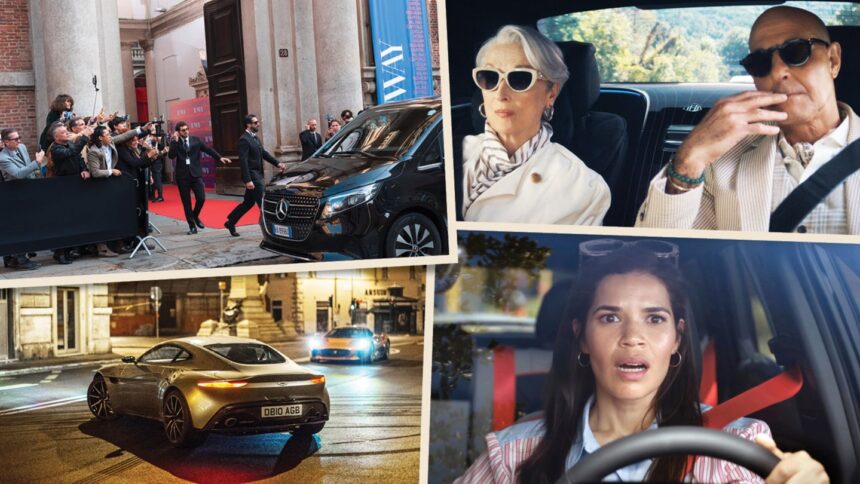
At the imaginary Miranda Priestly Runway Edit in The devil wears Prada 2, needs to get somewhere — a meeting, a photo shoot, a Met Gala-like party — so she drives a car befitting her Winturi status: a $300,000 Mercedes Maybach S-Class. This is not a coincidence. Mercedes placed the car there as part of an extensive promotional campaign it negotiated with Disney, which produced the film.
“We knew it was a perfect fit,” says Melody Lee, Mercedes’ chief marketing officer. Not only are the original cast returning, they’ve almost guaranteed a juggernaut at the box office (it’s risen over $400 million globally), and the film will be released simultaneously with the launch of the latest iteration of the range-topping Mercedes limousine. Also, the demographic bias of the movie. According to Lee, viewers of the original film, which was released two decades ago, “grew up and became our target customers.”
Automakers and studios maintain branded entertainment teams that stay in close contact to seek mutually beneficial opportunities. Ideally, the process starts well before production so that the product placement doesn’t look like a laughing stock but works on organically.
“Cars aren’t just background. They tell us as much about a character as their costumes and environment,” says Ty Irvin, vice president of marketing partnerships, creative and product placement at Disney.
Carefully planned collaborations “allow the integration to extend beyond the screen,” says Irvin. in case TDWP2this meant extensive advertising campaigns for Mercedes featuring the car and its cinematic association, as part of an effort to raise the profile of the sequel and help it – and its vehicles – become what Lee hoped would be a “huge cultural moment”.
Other car manufacturers use the same process. According to Sarah Sherrod, who heads GM’s entertainment marketing, Chevrolet has been working closely with the 2023 model year. Barbie To help introduce the 2024 Blazer SS and Hummer EVs, which were respectively driven by personalities America Ferrera and Ryan Gosling. It also revived Mattel’s “Dream Car” heritage by outfitting Margot Robbie’s titular character with a vintage pink Corvette.
But in the world of car product launches, no one can compete with James Bond. According to Alessandro Oselli, Ford’s global head of entertainment, Aston Martin, Jaguar, Land Rover and Ford have all worked with the Bond franchise to introduce new archetypes by providing vehicles for the super-spy, his coterie of beautiful conquests and his evil adversaries.
Not every position you see on the screen is for sale — or even safe for the road. According to Disney’s Irvin, Porsche collaborated on the design of the 2019 starship star wars spin off, The Rise of Skywalker. Lee notes that in the year 2025 F1, Mercedes served as an in-film sponsor for Brad Pitt’s fictional Apex racing team and provided a fleet of on-screen vehicles. The three-pointed star brand even featured two of its cars in hit cartoons recently A goat.
“You wouldn’t think Mercedes-Benz would be in an animated film, but it’s part of our strategy to reach the next generation,” Lee says.
Film partnerships create affinity, relevance, relatability and, ultimately, sales, Lee says. “In one study, three-quarters of viewers searched for a brand after seeing a placement, and more than half went on to purchase a product from that brand.”
Even, or especially, in an era of dwindling box office returns, such partnerships remain essential. “Product placement is non-skippable, non-blocking, and long-lasting,” says Shrode. However, with audience fragmentation, shorter attention cycles and lower attendance, placements need to be more popular. “The challenge is higher now,” she adds. “More often than not, I’m looking for an established IP or a new IP that is very innovative.”
These challenges have prompted automakers and studios to think more holistically about placement. “Instead of doing a one-time experiment, we build an ecosystem around it,” says Shrode. This includes social content, behind-the-scenes footage, partnerships with talent, and digital experiences that connect on-screen moments to the brand’s world.
“When it’s done right, we see incredible amplification,” says Shrode. “the Barbie The partnership with General Motors saw 10 times more social media engagement than any other post in the company’s history. This is a very powerful statistic.”
This story appeared in the May 20 issue of The Hollywood Reporter magazine. Click here to subscribe.