Logo text
[Thisstorycontainssomespoilersforthefirsttwoepisodesof[ThisstorycontainssomespoilersforthefirsttwoepisodesofDaring On AMC and AMC+.]
Daring It won’t be the thing that breaks Big Tech’s grip on our lives. This is not a judgement, but rather the belief of the show creator.
“It was a revolution, and I, too, say with great impatience and desire that they won,” Jonathan Glatzer said. Hollywood Reporter. “I can’t fight it with sarcasm. It won’t work.”
What Glatzer hopes the Silicon Valley-based AMC series, which debuted April 12, can do is “hold up the mirror and just say: Do we want this? Is this what we want? Because we operate on a human time scale versus computers, we’re slower, right? It takes a while for the scale to fall from our eyes, but you’re starting to see more pushback against technology.”
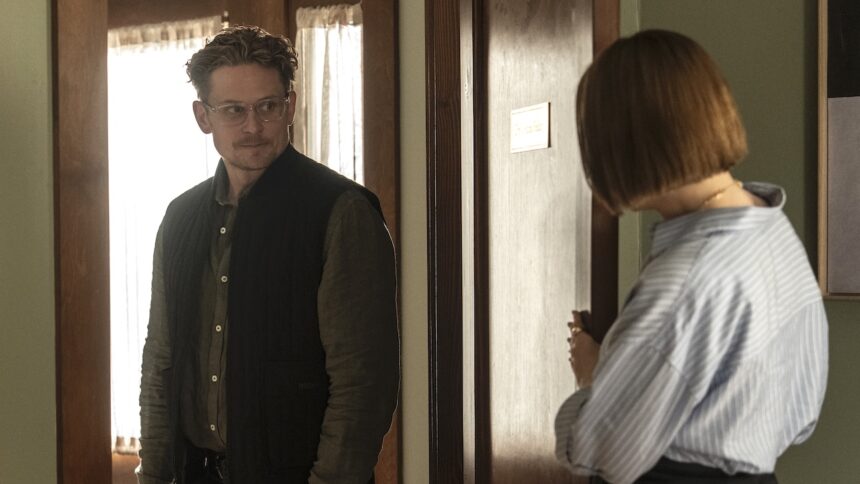
Daring Stars Billy Magnussen as Duncan Park, the CEO of a data mining company who desperately wants to join the billionaire class; Sarah Goldberg as Joan Felder, a psychotherapist who has Duncan and other tech executives as clients; Meaghan Rath as Bhattachera-Phister, an executive at the giant Google or Apple who has personal ties to Duncan; And Zach Galifianakis as Carl Bardolph, a Silicon Valley legend and one of Joan’s clients. Rob Corddry, Simon Helberg, Lucy Punch, Paul Adelstein and Jess Harper also star.
Glatzer – whose previous television credits include Succession, better call Saul and strain – I talked to THR About his research for the show (and why he ultimately cut it), why Goldberg’s character is so central to the story and what he hopes viewers will see in the characters. AMC has already ordered a second season of the show; The first season will last eight episodes. The interview below has been edited and condensed.
Watching this show made me think of Mike Judge Silicon Valley. It was very funny and poked a lot of holes in the Valley’s culture, and it wasn’t that long ago, but it seems almost quaint now. What is it about this moment in this world that you really wanted to explore? Daring?
I had the same experience. I rewatched it right before I started writing this – I wanted to make sure I didn’t tread on any ground that was well covered by them. There were some things where I was like, “Damn. I used to do this and now I can’t.” But overall, it was really encouraging to see that it was time to get back out there and look at it through the lens of how we’ve moved from a time of hope and “we’re going to change the world” — there was jubilation in the whole project, and it went from fun to jaundiced.
I think everyone in technology has a real desire to improve and expand communication, to tear down walls that prevent people from getting information and facts and knowledge, to increase tolerance, and all of those things. Obviously a certain amount of that was just talk. But I think it was real. Then they realized that what they had created, whether intentionally or intentionally, was something that was not conducive to communication. We kind of separated. There was a bifurcation. Tolerance for new ideas and other people had declined dramatically, tribalism was beginning to develop, and everything they set out to do was going in the opposite direction. But the problem is that they were making a lot of money by doing this. And I’m sure they were saying, “Well, maybe that’s what people want. And who are we to say how they should relate to each other, or how they should love or hate each other?”
I think that’s where we are now, technology has become so powerful. The ability to identify individuals and users is beyond anything we can imagine. It’s quite terrifying when you delve into the details of how much we’re being watched – how we interact with each other, how we pose for one photo versus another, how we shop, how we eat, how we masturbate, it’s all being monitored. It’s all recorded. I think once you look under the hood and see what drives the profit centers in Silicon Valley – there’s the hardware, to some extent, but mostly us. Personal data is often actually the profit center. Silicon ValleyThe show doesn’t deal with any of these issues.
I was really interested in how the show used JoAnne’s therapy practice as a way to meet and explore some of the other characters. Where did that idea come from? It also seems to me that a lot of these people in real life probably wouldn’t see a therapist unless they were court ordered or something.
There are a lot of life coaches, and a lot of in-house psychologists at companies. This treatment may be more pro-business than traditional treatment. But anything they hear is an improvement or did well for so-and-so billionaire and it can turn into a fad or something desirable very quickly. These two, Joan and her husband Gary [Adelstein]They are a kind of favorite healer in this community. I don’t think someone like Zuckerberg walks through their door, but I think a lot of these people have parental issues. Many of them have anger issues. I think a lot of them have things for which conventional treatment is still the best way.
The motivation for it came from growing up in a house that was basically this house. My mother was a therapist. My stepfather was a psychiatrist. I used to listen to sessions while I was growing up, and when you’re 15 and you’re rebelling against your parents, and you hear them giving life advice to strangers, you can hear how canned it was. This was my response to him [at the time]that all seems very inauthentic. I’m not casting doubt on therapy in general, but there’s also a faith aspect to therapy, which is that this is a sacred place. What you say here is completely private, and that is the professional nature of doctor-patient confidentiality. Meanwhile, there’s a 15-year-old listening and eating the honeycomb and saying, “Oh, that’s weird.” [JoAnne’s son Orson, played by Everett Blunck, eavesdrops on her sessions in the series]. That was me. So applying that to this high-stakes environment seems like a really interesting idea, as well as the idea of privacy and the illusion being an ongoing theme.
JoAnne commits what appears to be a very serious ethical violation by bartering the things she hears from her clients.
I think she feels, maybe rightly, that she’s helped these people make more money, make better decisions, and probably saved people’s jobs along the way, and she’s still getting paid hourly for it. Where is the justice in that? Money is the ultimate measure of success, and you should get a piece of it. You should get an agent fee of some sort. This really impacts her, and in this environment in that spirit, it’s not a leap to say, “Oh my God, how much money can I make with the knowledge that comes to me every day, if I invest smartly based on this information. Yes, it’s insider trading, but it’s also, I’m helping them make more money. I’m directly helping them make more money.”
What kind of research did you do for the show? Have you talked to people currently or previously working in the industry, and listened to many of the podcasts that CEOs do?
I spent time there, and I spent time with some of these people. Then I cut it off at some point, because I didn’t want to be an expert in that world. I felt, especially with satire, you need to be the person looking in from the outside. There’s a sense of comfort that begins to develop with your subject if you’re not careful. It’s like Almost famous – “These are not your friends.” There was a point where I felt like I got it. I’m fine. I’ve got what I need, and now, I hope that what I’ll apply to these characters is not just that they are creatures of technology, but simply creatures of life and humanity, and the trials and tribulations of being one of 7.5 billion. You’re just another person at the end of the day. That was really the guideline to make the technical side of it the background. The introduction was these characters and constantly humanizing them. And in some ways, I think I wanted to send a message to the Silicon Valley community, which is that we are all human. You’re just as likely to walk around with your plane down as anyone else.
This leads nicely into my next question, which is whether you think there will be people on the show that J. sympathizes with Dowries or sympathizes with them. For me, it was about the kids in the show being spoiled by their parents and Tom [Corddry]which is at least trying to make things better for the VA.
Yes, and Gary, the psychiatrist, is a good guy. Carl, Zach Galifianakis’ character, we always talk about being this swinging pendulum — he wants to leave a legacy of goodness, but he’s also a hungry, hungry hippopotamus. He’s not just a product of the valley. He is one of the authors of this spirit, because he was there early on. But that desire, that fork in the road that a lot of these people who are tech giants have gotten to where it’s like, either I can leave a legacy of goodness, or I can go to Dr. Evil.
I think if you’re writing or acting, you have no choice but to view your characters as fully formed human beings, whose ambitions stem from their insecurities, and whose desire for profit is to fill a gap that can’t be filled. It’s not like I’m necessarily fishing for the audience’s sympathy. But it is important.
If you have problems with where the technology is, if you have problems with how AI is enabled by these people to take over, if you have problems with the $3 trillion that they’re putting into data centers to advance technology that’s not fully understood and hasn’t really proven its greatest ambitions — the cancer is still there. They haven’t addressed that yet. Climate change is still a thing, and they’re making it worse. If all of this is a sliver in your mind, you may be reluctant to humanize the characters who seem to represent this world. But this is the only way forward to humanize them, remind them of their humanity, and remind them of their mortality.