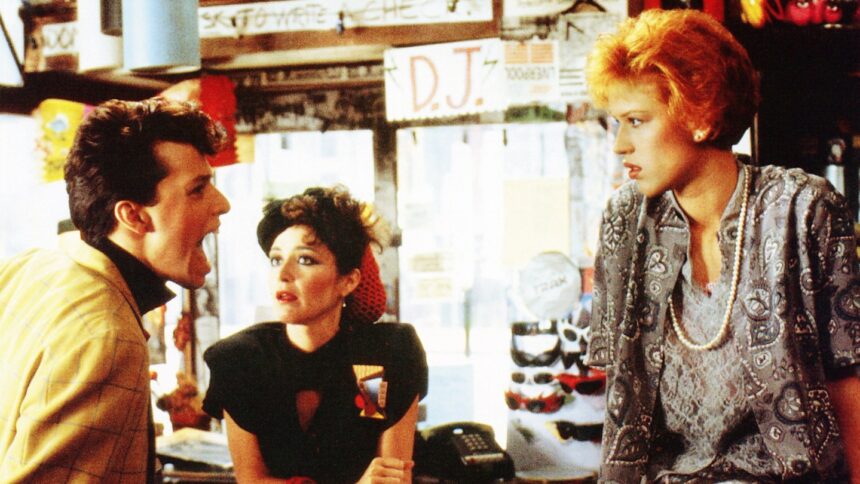
On February 28, 1986, Paramount unveiled John Hughes’ high school thriller Pretty in Pink in theaters, where it would gross $40 million in its run and become a major hit for Breakfast Club star Molly Ringwald. The Hollywood Reporter’s original review is below:
What do you say about a girl whose boyfriend declines his invitation to the party? If it were Molly Ringwald and you were Paramount, you’d say you’d probably be a box office hit. color Beautiful in pink Green for studio.
Ringwald and Andrew McCarthy star in John Hughes’s latest teen melodrama about a girl from the wrong side of the tracks and a boy from the country club who fall in love with each other. It’s not easy crossing boundaries at their class-based high school, and screenwriter Hughes very cleverly dramatizes the pressures and cross-currents of high school life.
As a diligent, self-reliant student, Ringwald cares for her chronically myopic father (Harry Dean Stanton), sews her own clothes and faces condescension from her aristocratic peers. She is a model of decorum and self-control but goes largely unnoticed by the opposite sex. Only an eccentric and smart friend (Jon Cryer) sees her worth, until one day, very remarkably, rich kid McCarthy takes an interest. This elicits all sorts of negative reactions, especially from McCarthy’s smug boyfriends and girlfriends, a tribe so materialistic and shallow that they make it popular. Less than zero-The species looks well rounded in comparison.
While Hughes exploits high school peer dilemmas with sensitivity and keen insight, his stodgy script tends to weaken the film’s obvious emotional appeal. As the poor girl, Ringwald appears to be a candidate for beatification. Disciplined, considerate, well-groomed and hardworking, she is the model young lady. It’s completely unbelievable that she’s constantly being attacked by sniping future sorority girl types—in real life, one suspects they wouldn’t even notice the demure, unobtrusive Ringwald.
However, the film shines with atmospheric nuance, and Ringwald’s life away from school (working in a record store, taking care of her father) touches on common teenage issues. Her easy, strange friendship with the hypertensive Cryer feels real. As an intelligent and amorous outsider, he is convincingly vulnerable and likable.
Characters that seem less sincere include Stanton’s role as a bathrobe-wearing father. He’s weary, pining for his long-gone wife, but as written here, the role is reminiscent of a beloved old Disney villain. The other stranger is Ringwald’s record store colleague (Annie Potts), a ’60s relic who looks about 15 years old, alternates between punk and beehive hairstyles and listens to society from all groups. It’s a cute, weird idea, but lines like “I loved The big cold“Make this fake 1960s section a distraction.
Ringwald and McCarthy are great in their roles, which is a credit to writer Hughes and first-time director Harold Deutsch. Ringwald’s grounded, restrained portrayal adds just the right touch of endearing bravado, while McCarthy, battling his own social demons, is a lovable rich kid with substance.
As two snotty rich girls, Kate Vernon and Emily Longstreth are positively princessy, convincing in their adorable malevolence.
Sure to be a touchstone for teens grappling with identity issues and prom this spring, Beautiful in pink Its color is changed through patting and a stunning finish. Hughes drafts a blonde instrumental to save the day. It seems that Molly’s latest choice was a surprise and will be a disappointment for many. Technical credits, all of them, get top marks. — Duane Berg, originally published February 7, 1986.