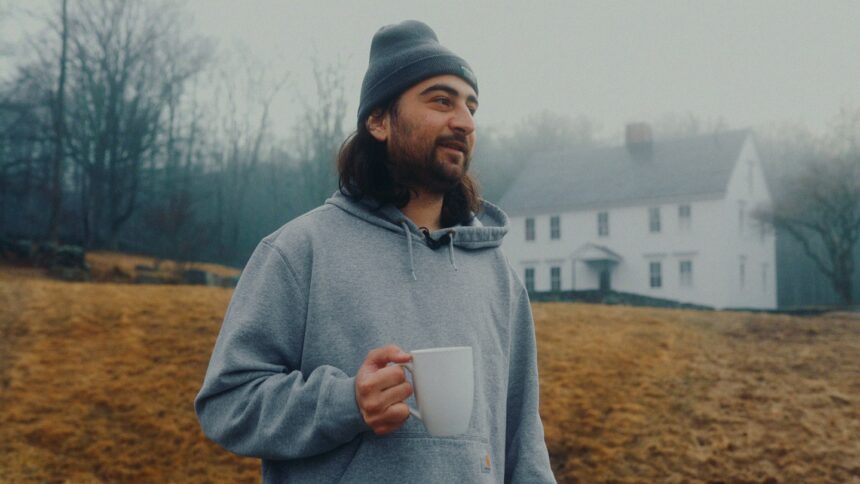
Noah Kahan gets more personal in his new documentary than he’s sometimes been comfortable with.
In the Netflix documentary directed by Nick Sweeney, the 29-year-old singer-songwriter talks about his relationship with his parents and his struggles with body dysmorphia, among other personal topics. He is serious throughout the movie and has a lot of fun with it Hollywood Reporter That he reconciled with it all by pretending that the Doctor would never come out.
Sitting on the balcony, the Grammy-nominated musician joins Sweeney on Zoom to discuss the new documentary, Noah Kahan: Out of the body. The 90-minute documentary, which will be released on Netflix on April 13, follows Kahan after his assent to mainstream stardom thanks to his 2022 album. Stick season.
“When we first started making the film, we had no idea what we were going to shoot,” Sweeney says. THR. “I thought if all we got was this extraordinary tour and Noah playing this very important show at Fenway, what a great movie it would be. When we started, [I] “I realized there was actually a lot going on.”
What could have been a straightforward documentary is instead an intimate look at Kahan’s relationships with himself, his family, and his beloved New England hometown. “When Nick came in and started filming, a lot came to the surface, and we started to realize that it was going to be something a little bigger than just a documentary tour,” Kahan says.

“The thing that really interests me is seeing people at a crossroads in their lives wrestling with these big questions,” Sweeney adds. “Once Noah and I started talking, it was very clear that he was dealing with these really important questions in his life about who he was, where his home was and what he was going to do after this huge album.”
Kahan sprinkled in his work on what would become the album The great divisionwill be released later this month, including a poignant moment in which the singer visits his childhood music teacher and ends up writing a song in space.
It also opens up about personal struggles. The singer shares that he has dealt with body dysmorphia and eating disorders. “[I] “I’ve always felt physically ugly, ugly-faced, mentally ugly,” Kahan tells the camera crew in the documentary. “‘I don’t know what I look like.’” No clue.
The Vermont native’s family is present throughout the film. One of the frequent compliments to Kahan’s work is how original his music is. and Kahan’s decision to share his family’s personal business Stick season Help make the album relatable. But in the film, the singer says he feels bad because he never asked his family for permission, recalling a text message from his mother after he made a joke about his parents’ divorce on stage. The text subtly told him that her feelings were hurt.
“I felt really bad about how my mom, in particular, felt in that moment, but I think it was very important to talk about it on camera because I’m not sure if I would have had the courage to bring it up otherwise,” Kahan says.

The singer says he was happy to hear what his mother felt in clear terms.
“I feel like watching this documentary was such a blessing because we got to see each other on camera. We got to face these feelings. We couldn’t all hide from them,” Kahan says.
“We had to watch it all happen, and it makes it seem smaller. It makes it seem more manageable, and it brought us closer together after watching the documentary.” “The first week we all felt like we were floating, especially things with my dad.”
Kahan’s father and their relationship are a major focus outside the body. The singer, who said his father had a life-changing accident when he was younger, says in the documentary that he wants to apologize to his father for “how selfish, short-tempered and judgmental” he was.
“His love for this documentary changed our relationship,” Kahan says. “Things could have been very difficult.” “He loves me and wants me to be happy.”
The singer says, deep down, he believes his story with his father was true in the documentary. “I always cry when I talk about my father,” Kahan admits. “I don’t know what he is.” “He didn’t want me to do it. It’s hard, but I never felt like I didn’t want to share it. Talking about it made me feel good.”
The film is based on Kahan’s sold-out shows at Fenway Park and his love for the home of Vermont and New Hampshire. Given the importance of the singer and his music in Vermont, Sweeney says he felt a healthy dose of pressure to portray the authenticity of the region. “The thing I really like is how honest the people in Vermont are. They’re really not bullshit,” he says.
The director points out that he and his small crew spent a lot of time driving around Vermont. “The seasons are really interesting in this movie. We saw Noah over the course of this year, and the way we were able to capture that was by just waiting,” Sweeney says.

Kahan, who grew up between Hanover, New Hampshire, and Strafford, Vermont, admitted that his relationship with Vermont was changing during the time of filming. “I was afraid that when I returned, I would feel like a tourist, or that I would not belong, or that I would reveal some secrets,” he says.
outside the body The film ends with Kahan in the recording studio, having rediscovered his creative inspiration over the course of the year the documentary was filmed. But beyond the music, Kahan and Sweeney hope the film will inspire some personal change in viewers’ lives. “It’s not about a magical fairy tale ending, it’s just trying to understand, name and deal with the things you’re going through,” Sweeney says.
“I hope you make that phone call or look in that mirror, and if you don’t like what you see, ask why and see if there’s something you can do to help change that idea about yourself,” Kahan adds. “[I hope you] Ask those initial questions and deal with those things that scare you.
THR Newsletters
Sign up to get THR news straight to your inbox every day
Subscribe subscription