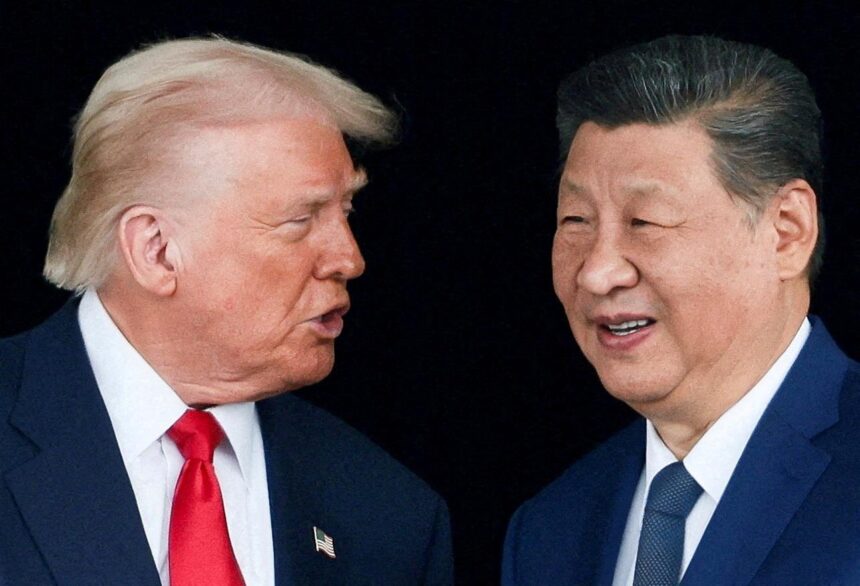

US President Donald Trump and Chinese President Xi Jinping speak as they leave after a bilateral meeting at Gimhae International Airport, on the sidelines of the Asia-Pacific Economic Cooperation (APEC) summit, in Busan, South Korea, October 30, 2025. Reuters-Yonhap
WASHINGTON – US President Donald Trump will travel to China from March 31 to April 2 to attend an upcoming meeting between the world’s two largest economies, following the Supreme Court’s decision to overturn sweeping tariffs imposed by Trump on imported goods.
A White House official confirmed the trip. on Friday, before the highest US court struck down several tariffs that Trump had used to manage sometimes tense relations with China.
Trump is expected to visit Beijing and meet with Chinese President Xi Jinping as part of a luxurious and extended visit. Trump’s last visit to China was in 2017, the last trip by an American president.
The main topic was whether to extend the trade truce that prevents the two countries from increasing tariffs. However, after Friday’s ruling, it was not immediately clear whether Trump would reinstate tariffs on imports from China, and under what legal authority.
Trump sees the trade imbalance as a national emergency
The administration said the tariffs were necessary due to national emergencies related to trade imbalances and China’s role in the production of illicit chemicals linked to fentanyl.
“This is going to be a wild visit,” Trump told foreign leaders visiting Washington on Thursday about the trip. “We have to put on the biggest show ever in Chinese history.”
The Chinese Embassy in Washington did not immediately respond to a request for comment. Beijing has not confirmed the trip. This visit will be the first talks between the two leaders since February and their first personal visit since their October meeting in South Korea. At a meeting last October, Trump agreed to lower tariffs on China in exchange for Beijing cracking down on fentanyl trade, resuming soybean purchases from the United States and maintaining the flow of rare earth minerals.
While the October meeting largely avoided the sensitive issue of Taiwan, Xi raised US arms sales to the island in February.
Washington announced its largest arms sales deal ever with Taiwan in December, including $11.1 billion worth of weapons that could ostensibly be used to defend against a Chinese attack. Taiwan expects more such sales.
China considers Taiwan its territory, a position rejected by Taipei. The United States maintains formal diplomatic relations with China, but maintains unofficial relations with Taiwan, which is the island’s most important arms supplier. The United States is obligated by law to provide Taiwan with the means to defend itself.
Xi also said during the February call that he would consider increasing soybean purchases, according to Trump. Struggling American farmers are a key political constituency for Trump, and China is the largest consumer of soybeans. Although Trump has justified many tough policy steps from Canada to Greenland and Venezuela as necessary to thwart China, he has softened policy toward Beijing in the past few months in key areas, from tariffs to advanced computer chips and drones.