Given how adventurous and exuberant Steven Soderbergh’s films are, it’s surprising to realize that his new film is his second of the year, after a black comedy. Christophers – marks only the third time he has helmed a documentary (after two projects focusing on Spalding Grey). He faced a particular challenge with this nonfiction outing: its primary source, the 1980 conversation that defines and drives the project, has no visual component. How do you turn a radio conversation into a movie?
Soderbergh has found a way, and while some viewers may be alarmed by the lack of ‘action’, the remarkable achievement of John Lennon: The Final Interview It is its immediacy. Backed by an engaging wealth of archival images and clips (and separately, a touch of AI imagery – more on that later), sounds captured half a century ago draw you in.
John Lennon: The Final Interview
Bottom line Harmonious and full of life.
place: Cannes Film Festival (Special Screenings)
exit: Steven Soderbergh
1 hour and 37 minutes
On the afternoon of December 8, 1980, John Lennon and Yoko Ono welcomed a quartet of radio people to their Dakota apartment for an extended interview, the former Beatle’s first in several years, to promote the couple’s recently released album. Double fantasy. The group’s first single, “(Just Like) Starting Over,” expressed the sense of artistic renewal Lennon was feeling 10 years after the Beatles’ breakup and after five years away from songwriting, spending time instead as a self-proclaimed househusband focusing on the couple’s son, Sean. On the basis of the flowing audio evidence and the warm memories of the interlocutors, the meeting went well, filled with a sense of purpose and engagement. Lennon and Ono then headed to the studio to work on more music, and upon returning home that night, at the entrance to their building, Mark David Chapman shot and killed John Lennon.
The main event interview has been judiciously edited from its three-hour length and framed with fresh commentary from three of the four people who conducted it: Dave Sholin (music director) of San Francisco station KFRC, Lori Kaye (on-air host) and Ron Hamill (engineer and producer). (A fourth participant, Warner Bros. Records executive Bert Kane, died during the production of the documentary.) Against a stark white backdrop, radio journalists recall how surprised they were when they had the chance to speak with someone they greatly admired. Of course the impact of the experience was deepened and changed by the horrific events that followed, but it is clear that in that moment they felt an exhilarating sense of connection with Lennon and Ono.
The interview finds Lennon, having just turned forty, in a reflective mood about himself and his generation (“the group of the sixties that survived”); He offers insights “not as a preacher, not as a leader, but as a reflection of how we all feel.” He and Ono talk about their marriage as a symbol of a changing paradigm for men and women. They imagined Double fantasy Like a song cycle dialogue. “Love,” she says early in the conversation, after noting the one-sidedness of the so-called sexual revolution — “is a powerful political weapon.”
Although Lennon’s commentary shapes the film, the interviewers spent some time alone with Ono while her husband finished the photo shoot with Annie Leibovitz. Ono’s importance as a conceptual artist is getting the attention it deserves these days, but it’s nice to hear her frank, intelligent, and sensitive voice at this point in her career, just as it’s nice to hear Linda McCartney’s voice in the final film. Man on the runwhich focuses on Paul McCartney’s post-Beatles transformation. Both women withstood some ridiculously unfriendly scrutiny. Lennon’s account of his meeting with Ono at a show of her work in London, and the shy flirtation that followed, is one of the most tender and revealing parts of the interview.
The rule of thumb for interviewers that day at the Dakota was “no Beatles questions,” but for Lennon, the topic arose organically. It is noteworthy that in the wake of their pop stardom, both McCartney and Lennon rebuilt their musical careers with their wives as creative partners. “It’s fun working with your best friend,” Lennon says of his collaboration with Ono, but he also talks about his years with McCartney.
The interview was captured using state-of-the-art equipment for 1980: a stereo cassette recorder and high-frequency chrome tapes. As for the 21st century technology Soderbergh is using, it includes “the Meta’s AI tools,” according to the production notes, and as he noted well before the film’s premiere. Given that Meta and AI won’t rank highly in the overall popularity poll, the pre-announcement is a pre-emptive clearing of the decks. As for the on-screen results, AI tools were used in 10% of the film, and were not applied to any of the archival images, films, and videos deep within the document. It never feels intrusive. The “objective surrealism” that allowed Soderbergh to achieve it includes some stunning images – particularly an animated sequence of an unfolding rose that may be a wild new version of Mandala, although Soderbergh’s letter apparently cited Busby Berkeley. There are also playful illustrations of some of Lennon and Ono’s ideas, and more subtle, non-AI graphic elements (by BigStar Motion Design) that include color washes at the edges of some of the visuals. The feeling is organic and involving, just as the sounds of the vocals are intimate and enveloping.
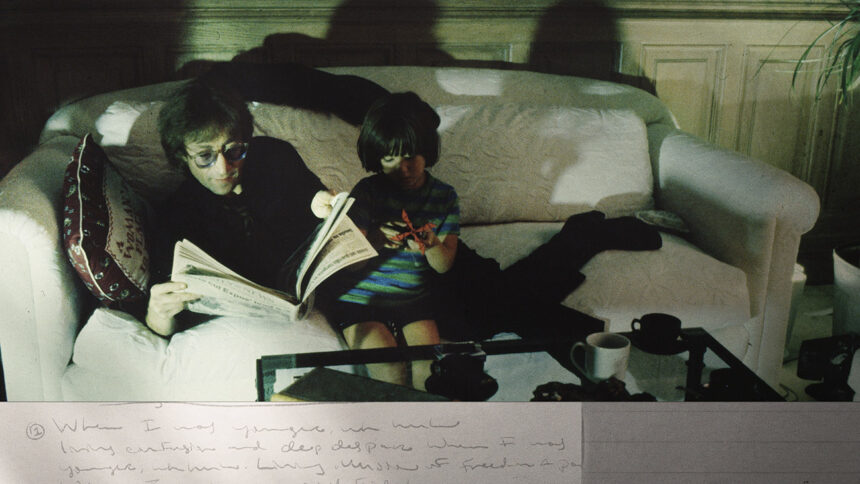
Soderbergh and editor Nancy Main combined more than a thousand still images and clips (he handles DP duties under his name, Peter Andrews), and The last interview Includes excerpts from 64 songs. Although it never feels unnecessarily busy, there is a lot going on, which lends itself to the exuberant and thoughtful energy of the conversation. Lennon’s elation at marriage and fatherhood, his enthusiasm for recording new music and the possibility of touring again, and his continuing love affair with New York (the subject of Kevin Macdonald’s book) One-on-One: John and Yoko) made the looming shadow of his death even more horrific.
The radio interview will be broadcast as a special memorial. Howard Cosell will announce the news of Lennon’s death on this day Monday Night Footballan audio clip included here by Soderbergh, with his usual confidence and maudlin aversion. This network television moment is fitting for a number of reasons, especially since Lennon was passionately drawn to American popular culture. It’s fascinating to hear him quote an interview with Barbara Walters, or point out that Yoko Ono’s vocal gymnastics preceded the moves of Len Lovitch or Cindy Wilson of the B-52s, or declare his love of disco.
The fact that he had no use for categories and divisions—whether regarding music, religion, nationality, or gender—goes to the core of his identity, his anti-war politics, and his forward-looking optimism. “Let’s try to make the ’80s good,” he said at one point, hours before the ’80s became unbearably painful. Stronger than an argument or thesis, The last interview It is an immersive experience. It will serve as a reminder to some and an eye-opener to others about why John Lennon meant to people, and why his murder was so devastating.