Logo text
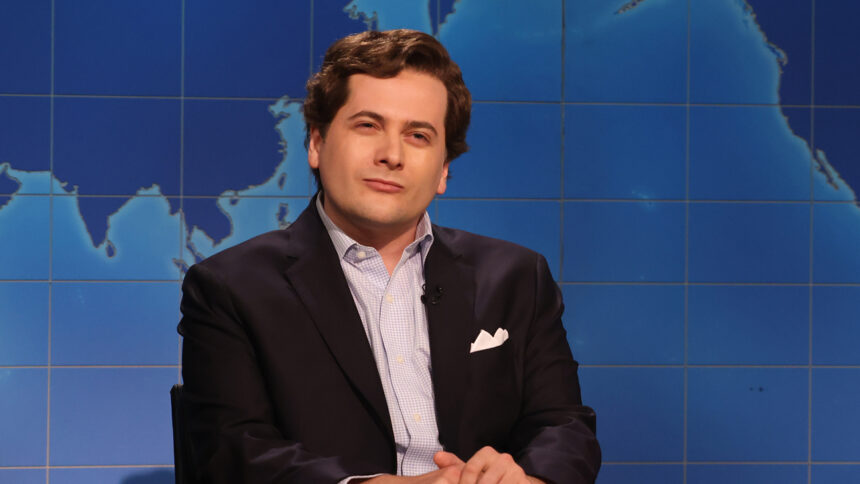
when Saturday Night Live Newcomer Jeremy Culhane made his debut with Tucker Carlson on Weekend Update last month, and the response was immediate. The impression — built around Carlson’s growing skepticism and his raspy, brittle laugh — quickly spread across the Internet, drawing praise for its poignancy and timing.
But within hours, a second conversation was taking place in comedy circles.
“All Tucker Carlson impressions are just Nick Mullen’s Tucker Carlson impressions,” one widely shared post read.
The comparison pointed to Mullen, the comedian who spent years developing Carlson’s exaggerated persona on shows like Cum City and Adam Friedland Show. His version relies heavily on a specific comedic beat: confusion escalating toward anger.
Culhane’s take, though not identical — he added the manic laugh, a more recent Tucker style — hit enough of those same beats to spark a debate in stand-up and sketch comedy: Where is the line between observation and imitation when it comes to impressions?
There is no clear answer, at least not legally.
Previous “You can’t own anything.” SNL Star Darryl Hammond, one of the most prolific impressionists in the show’s history, tells me from the road (he still tours most of the year in stand-up). “But if you do it on TV enough, people will think it’s yours.”
This distinction between ownership and perception is at the heart of how comedy manages itself.
Unlike written jokes, impressions exist in a vague space. They’re built of real people, their voices and behaviors available to anyone who pays attention. But the most distinct impressions are rarely direct imitations. They are exaggerations, shaped by specific comedic choices. The adage Hammond heard has spread SNLThe film’s passages sum it up bluntly: “The impressions aren’t funny. The characters are funny.”
Hammond points to his portrayal of Bill Clinton as an example. His physical twitches — which he described as “thumb and lip” — became a hallmark of the impression, even though Clinton himself never did one. He road tested it one night at the Comedy Cellar. The place exploded, bringing him uptown SNL The book. Tics have become a staple. The competition quickly noticed how successful it was.
“Then you see other Impressionists doing it,” Hammond says. “But I was doing it SNL For two years. It’s pretty much mine at that point. People will think so.”
The same dynamic played out over and over again SNLwhere a single artist’s interpretation can effectively determine how a public figure is caricatured. Dana Carvey’s George H.W. Bush and Will Ferrell’s George W. Bush have become so dominant that subsequent attempts to play those characters have had difficulty succeeding.
“It became impossible for anyone to do what George Bush did after Will Ferrell did his version so aggressively,” Hammond says. “They wanted me to follow him. I said to myself: ‘I can’t do that.’”
What distinguishes these shows is not accuracy but perspective – the “shot,” as comedians call it. Hammond spent a year in the Comedy Cellar trying to take down Al Gore and never laughed. Then, on the afternoon of the live broadcast, writer Jim Downey came into his dressing room and did a line reading. Downey decided that Gore was an arrogant teacher. Suddenly Hammond had his own personality. It wasn’t much like Al Gore, but the crowd responded every time.
“Al Gore doesn’t really look like that,” Hammond said. “What I was doing is [Al] Hirschfeld drawings.
He describes the process as closer to caricature than imitation – and says that once a caricature is solved, others can reproduce it with relative ease.
“If you see a sculpture at the Museum of Modern Art, you can probably imitate that statue pretty easily,” he says. “But you can’t create David.”
The idea that once an impression is “resolved,” it becomes easier for others to reproduce it, helps explain why debates like those over Culhane and Mullen are so frequent.
Mullen’s version of Carlson, developed over years in podcasting, tends toward long periods of escalating confusion. For some, the story is more specific. It uses frequent reliance on the phrase “What’s going on?” As a kind of anchor for Carlson’s confusion. Sportscaster Paul Gallant put it bluntly on social media: “Just like my terrible impression of Nick Mullen playing Tucker Carlson, this is also my impression of Nick Mullen playing Tucker Carlson. It’s all about ‘what’s going on?’”
But in comedy, the medium is the message. While Mullen’s work circulates primarily through podcasts and online clips, SNL It remains one of the most powerful funny speakers. The impression broadcast on the program can quickly become the default version for a wide audience, regardless of where similar thoughts may arise.
Hammond acknowledges this flaw as part of the reality of work.
“There was a comedian who would steal jokes and then tell Letterman,” he says. “Once he does that, people will say, ‘Okay, the joke’s over. It’s his now.'”
Neither Culhane nor Mullen have publicly addressed this comparison. Representatives for both did not respond to requests for comment. In comedy, this silence is not unusual. There is no formal system for resolving disputes over impressions, and performers, Hammond among them, often avoid escalating them publicly.
“Why give them a fight that could lead to anything, including legal disputes,” he says. “Legal disputes are no fun, and they are very expensive.”
Instead, the conversation tends to take place informally, among audiences and peers. And the audience, as Hammond understood, is ultimately the one who decides.
“It’s not that you have it,” he says. “It’s just that the public thinks you’re doing it.”