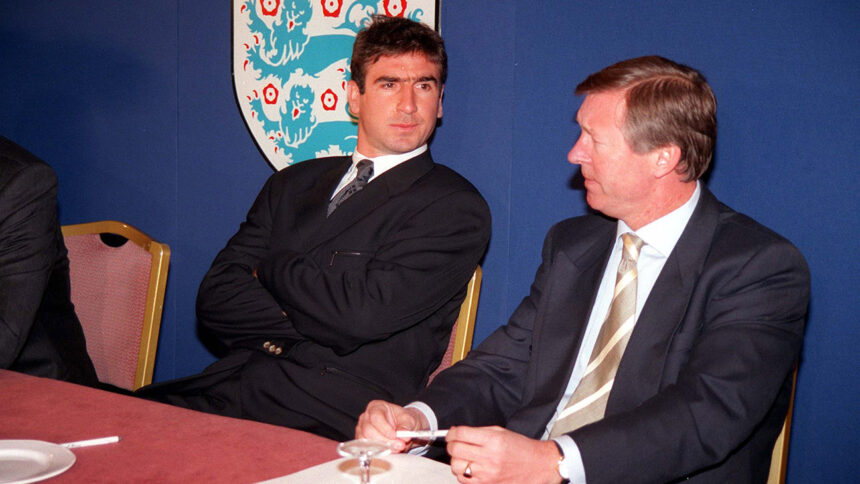
Football star Eric Cantona, the French striker, poet and boxer who played his best for English club Manchester United in the 1990s, gets the full man, myth and legend treatment in this stark if aptly titled documentary. Cantona.
The latest from sports filmmakers David Treehorn and Ben Nicholas, who co-directed a similar take on the subject of One Football Pellet Besides The Figo case: the transfer that changed footballthis lively package combines plenty of recently filmed interview excerpts with Cantona himself, feisty but charismatic as ever, with tributes from three of his most important teammates: Manchester United manager Alex Ferguson, French mentor Guy Roux and teammate David Beckham. In addition to his parents. Interspersed throughout is a veil of archival material, including Cantona’s famous footage of the karate kick to the chest of a heckler, which temporarily derailed Cantona’s career. For sports fans, especially those who worship King Eric, this is pure cinematic cocaine, carefully cut, and initially electrifying although too much of it may leave you feeling jaded and exhausted.
Cantona
Bottom line Cinematic catnip for football fans.
place: Cannes Film Festival (Special Screening)
with: Eric Cantona, Alex Ferguson, Jay Rowe, David Beckham
Managers: David Treehorn, Ben Nicholas
1 hour and 55 minutes
actually, Cantona Fans are generously served with plenty of great clips of our hero scoring extraordinary goals and assists, protesting to the authorities, and best of all, taking off his shirt in his younger years. But there are big nits to pick. For starters, his early years and family background are covered in a quick montage, as are his post-Man U years with the exception of some fun clips from some of the films he made as an actor, including the time he played himself in a Ken Loach film. I’m looking for Eric.
In the press notes for the film, the directors stated that they had interviewed many more people than the six mentioned above, but decided to exclude others because “Eric’s character did not fit the cast”, choosing to prioritize his voice. Of course, that’s their prerogative, and with a strong character like Cantona, it somehow makes sense.
But it also skews the final product in a hagiographic direction and arguably overly downplays the importance of teamwork in Cantona and Manchester United’s success. For example, contemporary players such as Ryan Giggs, Roy Keane, Lee Sharpe and Andy Cole were integral to the team’s machinery, and fit in as tightly with Cantona, as Beckham always has – but may not have the same talent as Beckham, especially for fans abroad. Indeed, in many ways Beckham’s star has risen as Cantona’s has waned, and it will only take a few judicious tweaks and exaggerations to make their story look the same. All about Evebut with jockstraps and eyebrows.
But what? Cantona He chooses to do, he does well. The star of the show, who turns 60 on May 24 this year, has matured only marginally with age and, for the most part, is, like Edith Piaf, unrepentant. The film begins with a quote from the poem L’Héautontimorouménos (The Self-Tormentor) from Charles Baudelaire’s collection. Flowers of evilAbout how the speaker is “the wound and the knife… the blow and the cheek”; This duality is emphasized throughout, as Cantona refers to himself as both an angel and a devil, views he expresses while sitting in church.
In less lofty terms, this means that his playing instincts and ball control were outstanding, a once-in-a-generation talent. But his temper and arrogance were unparalleled, constantly leading him into arguments with authority figures, from referees to his managers. He changed clubs an unusual seven times between 1983 and 1992 before finally settling with Manchester United. Likewise, he lost the captaincy of the French national team in the UEFA Euro 96 due to a kung-fu incident that prevented him from playing, and he was not selected again for the French national team in the World Cup.
But those who love him are loyal to the bone, and they express it here, even if in a stifled, indistinct masculine way, as with the famous taciturn Scot Ferguson. What’s most interesting is the way Ferguson talks about the game as if it were a show, and how he knew in 1992 that he needed someone “with some flare and brilliance to light up the stage”, and that’s what he found in Cantona. It’s not about strike rates and penalty kicks; Shine is also important. That charisma is evident here, as well as in new interviews, where Cantona’s intelligence and integrity are as evident as his anger.
As if to dampen that fire, classical selections are used to cover large swathes of the film, with electronic grooves that harken back to the heyday of acid house from Paul Hartnoll, co-founder of the British rave scene Orbital. Even the editing beats feel like they’re straight out of the ’90s, which no doubt helps this appeal to older millennial parents nostalgic for their wilder years.