The risks were impossibly high, but the long-awaited results seemed to have been achieved.
Nearly four years after K-pop group BTS stepped away from the public eye to fulfill mandatory military service in South Korea, the world’s biggest band reunited in Los Angeles last summer to begin the high-pressure task of crafting a comeback album. The resulting BTS fifth studio LP, Arirang — a mix of bold new pop experiments and assertive Korean national pride (the album samples and takes its name from a century-old folk song that serves as the country’s unofficial national anthem) — arrived on March 20 and instantly became the most-streamed album in a single day on Spotify this year, as well as the most-streamed K-pop album in the platform’s history. The following night, BTS performed together for the first time in nearly four years in front of tens of thousands of fans at Seoul’s historic Gwanghwamun Square, in a concert broadcast live by Netflix to 18.4 million viewers around the world.
Behind the scenes documentary BTS: Backwhich arrives on Netflix today, tells the story of the creation of… Arirang With a degree of reach that even ARMY – the official name given to the group’s many loyal fans around the world – might sometimes find surprising. Directed by Bao Nguyen – the Vietnamese American director behind the Netflix production The greatest night in pop — The film marks one of the rare occasions when HYBE, the parent company of BTS BigHit, entrusted an outsider and a non-Korean filmmaker to tell a vital chapter of the group’s story.
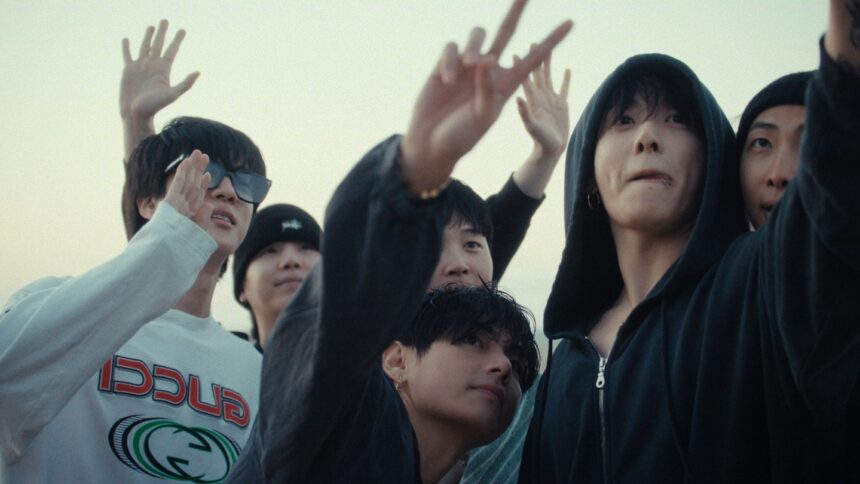
It is produced by Jin Cha of Sony’s This Machine Filmworks, whose recent work includes the Sofia Coppola-directed film. Mark from Sofia and Netflix’s Martha Stewart doc, the 91-minute film follows the seven members as they live, work and reconnect in a rented house in Los Angeles, before returning to Seoul to finish the record and prepare for their world tour. Filmed with a surveillance-based intimacy and bathing in the hazy Southern California light that Nguyen treats as an eighth character, the Los Angeles sequences find the band members at their most unguarded—cooking together, discussing lyrics over soju, swimming in their pool and on the beach. There are also moments of candid contemplation, in the back of a car or alone in Seoul, as the members take stock of the weight of their fame and the pressures of returning to a new, uncertain place in the global pop scene.
Hollywood Reporter We sat down with Nguyen and Cha in Seoul shortly before BTS took over Gwanghwamun Arena to discuss the documentary’s most revealing moments and their reflections on spending several months with the band members during one of the most high-pressure periods of their careers.
Tell me about the expectations and storytelling framework you had in mind when you started the project, and how these evolved as you got underway.
Nguyen Yes, I came to this topic with some form in mind, but it was more like a compass – and then it was just a matter of seeing what we would discover in the process. Before we started the project, I had gone to see BTS at SoFi Stadium in 2021, and I remember the whole show had this mythical feel to it — about the story of their passing, and the emotional way they spoke and interacted with ARMY. I like to think about mythology and how it relates to the way we live our lives today. So I started thinking of their departure and return like the Homeric myth of the Odyssey, with BTS as Odysseus, and ARMY as Penelope waiting for their return from the army. That was my framework, but you know, it’s also the story of making the comeback album. They each returned to their bandmates and families, and to their identities as artists and members of this universally beloved group. There was a pressing question for them: Will you return as you were before and have not changed, or will you return as something new? Turning points are a challenge for anyone in life, but imagine the pressure of facing those things when you’re the biggest band in the world. So, initially, I thought this would be about that creative process, and the world that waits and reacts. But then, in the editing process, it also became a story of brotherhood and what it means to be able to carry the weight of a country on your shoulders — and realize that as individuals, this is too heavy a crown to bear, but as a team of seven, it’s something they know they can do together.
What were you given in terms of access? Are any limits set? How did this shape the way you told this chapter of their story?
Cha It was a very fast and furious process. We were told that they were coming to Los Angeles, and that they would be working and living together for a month, which was not their normal situation at all. So we were really thrilled to have access to their home. Once we got there, we had more access than we expected. Sometimes we were allowed to film in their bedrooms during real downtime moments. So it was all just a very collaborative conversation, like, “Hey, can we film this?” In most cases the answer was yes. So in Los Angeles we had access to the house, the recording studio and points in between. Once they returned to Seoul, we followed them into the recording studio, and for each member, we asked them to choose one meaningful activity to serve as their personal photography day.
Tell us about the development of the film’s aesthetic? I was struck by the way the film functions as much as a love letter to Los Angeles as it does to the band. The sunny aesthetic and handheld cameras feel like a nice touch – the way they give the film old Hollywood charm, but also intimacy and a palpable sense of nostalgia, even though you’re shooting in the present tense.
Nguyen I mean, I’m originally from the East Coast. I moved to Los Angeles during the pandemic, and I’ve come to really love what Los Angeles represents in cinema history and in the global popular imagination — as a place of freedom and what 300 days of sunshine will do to you. I wanted the audience – whether they’ve spent time in Los Angeles or not – to feel what it means to create in Los Angeles. As V says early in the film, Los Angeles is like an amusement park to them. Why did they decide to come to Los Angeles for this moment in their career? It’s this feeling of freedom and apparent destiny.

In terms of the film’s aesthetic, there are a few things we can talk about. I didn’t want to feel like we were running around trying to follow them all the time with handheld cameras. In the studio, we really sought a feeling of stillness and a quality of observation, like a fly on the wall. It was an aesthetic choice but also a practical one – not wanting to interfere with their creative process. I totally understand how important it is when you’re getting into a good creative flow and having a camera around you constantly moving can obviously be really distracting. But if you’re on a tripod and standing against the wall in the corner, you can use a zoom lens and find your angle. You’re generous with creators, and they respect that. Then, over time, once they feel more comfortable being vulnerable around you – or start to forget you’re there – you can get a little closer with your camera.
For the VHS look, the idea of giving each of them a little digital video camera came when I was thinking about how I really wanted the movie to feel like it was told from their point of view. We knew we wouldn’t have access to the band members 24/7, so I thought, what if I had them film each other when we weren’t around? But if they do it with their phones, it’s a very specific visual language, which we’re all used to, and maybe a little tired of now. But camcorder footage brings a completely different feeling, doesn’t it? It’s automatically nostalgic, because you feel like you’re on a family vacation with your dad – it feels raw, innocent and intimate. So, my bet was that if we could get them to film each other with that kind of camera, we’d get that raw image and their personal perspectives at the same time. Fortunately, it worked really well. Because when I was watching all the footage, it was There is a steep learning curve for some of them as they figure out how to use these cameras (He laughs). But they were very open to it, stuck with it and enjoyed it. I think it gave us a somewhat different perspective than some of the other BTS documentaries that have been produced.
The moment they return to Seoul marks a dramatic and stylistic break. Everything becomes darker and more flamboyant, and the atmosphere becomes more serious – you can immediately feel that they have left their creative escape and returned to reality for them, in Korea.
Cha Yes, this is one of my favorite transformations in the movie. From Los Angeles to Seoul, you can go from the hazy California sunshine to seeing the members visiting a Korean palace. Los Angeles is a very young city, in a young country, and when you come to Seoul, there is this amazing modernity that clashes with the old. I thought it made a really nice transition.
Nguyen Just speaking of aesthetics, one of the films that was really inspiring to me, and kind of the color palette and cinematography of the LA sequences, was Sofia Coppola’s film somewhere. By the way, Jen had just filmed a documentary with Sofia Mark from Sofia -So getting together with her seemed like it divided her in many ways. somewhereFor me, it shows the daily reality of being a celebrity with great precision. The way she captured Los Angeles was an inspiration. So Sophia gets thanks.
One of the most effective scenes in the movie has to be the moment where it has the members watch videos together from when they were kids and just starting out in BTS. Their reactions to that footage are truly touching. But I thought it was especially cool about how he got so many fans. Because BTS has been gone for four years, and K-Pop has continued to evolve in their absence. How does this scene come together?
Nguyen In their rented house in Los Angeles, they had a screening room. And I said, it would be fun for all of you to sit back and watch the videos – and why don’t we put some stuff from the early days of BTS. It serves a function in the documentary to show how they evolved and grew over time. I mean, they had baby faces back then. They’re still young, but within the scope of a K-pop group, they’re sort of elder statesmen now. Again, it worked with the handheld footage aesthetic we’ve used elsewhere, to give that feeling of nostalgia and pain you get from watching home videos. It’s one of my favorite scenes, watching them react to their entire career path, and this incredible journey they’ve been on together. You see them go from playing in front of a small crowd at the Troubadour to rocking a sold-out SoFi stadium. The scale of it all is unbelievable.

Cha It’s a favorite scene of all of us. They start out kind of bantering in the screening room, like laughing at how cute they all look, but then it gets really emotional, you know? I think it’s the same for anyone who has a chance to look back on their past – but for them, they go from these kids trying to impress each other by doing flips on the dance floor, to the biggest band in the world. It’s a unique story.
What were some other moments during filming where you were like, “I feel better now”?
Nguyen (He laughs.) Honestly, every scene had a little something that I would be surprised by. I previously made a movie called The greatest night in popAbout recording the song “We Are the World”. There you had literally over 40 of the greatest singers in the world, so of course there was a real tension surrounding that recording. With this documentary, we had come to this very late in the process of making the album, and I thought this was a really close-knit, professional pop group – these guys would know exactly what they needed, and they would kill it when they got into the recording booth. But the amount of pressure, stress and anxiety they were feeling about not knowing what the songs and the album were going to be about yet – that completely surprised me. But, of course, that’s completely human and the essence of being an artist. They’re the biggest band in the world, but they still have a tremendous amount of stress and anxiety about this comeback album. Their humility and genuine humility was really exciting to show.
Another moment I loved was when we took them out to the beach in Santa Monica. They had been doing this intense ritual of going to the studio all day, every day, so to see them come out of that and be free and have some fun as a group of friends – playing soccer in the sand and swimming in the ocean – that was a beautiful moment.
It’s amazing they haven’t been recognized. Is the beach closed somehow?
Cha No, it’s Santa Monica. It is a public beach. No production can do that. We had people on the beach of course, and we went in with very small cameras. But there were a few people who approached and were like, “Who is this? Is this who I think it is?” And we were like, “Oh no, it’s just a bachelorette party. We’re shooting a wedding video.” And they were like, “Oh, okay.”
Nguyen Obviously we wanted to protect their privacy and make sure they were safe, but I was honestly hoping for a full-on Beatlemania moment where they would rally. (He laughs.)
How involved were HYBE and BigHit in shaping the story and how you told it?
Nguyen Well, to the brand’s credit, this was one of the very few times they’ve allowed someone outside the company – and outside of Korea – to tell a story in a film about the collection. There was some hesitation, but in the end, our vision was very clear about how we were going to tell the story. They gave some basic framework — like, it’s going to tell the story of their comeback and the making of the album — and I was OK with that, because I like to have some guidance as a director, as long as I know I can play relatively freely within that sandbox. So, it was an ongoing conversation with the company, where I was explaining to them, topic-wise, why this or that was important. Somewhat surprisingly, I found it to be a really cool collaboration.
Cha There were so many things we wouldn’t have known if it weren’t for their openness. For example, they gave us access to that meeting with President Bang (Si Hyuk). [founder of BigHit Music and the chairman of HYBE, known as the richest man in the Korean entertainment industry] Where they were deciding which version of “Body to Body” to use. They certainly would have been free not to invite us to that meeting. They were great partners in that sense when it came to figuring out what was actually an important development in shaping the album and trying to get it into the movie.
So there weren’t moments in the edit where they asked for specific changes?
Nguyen Well, I never try to make movies on the people. I’d rather do that with the people. I treated this as a collaboration, and there were moments where one member would say, “I look a little weird in this shot.” But then, you tell them the artistic intent, and why that scene made sense thematically, and then they’ll understand it. But I can honestly say there wasn’t anything as important as “get him out of there.”

One moment that I found really telling and moving — and a touch painful but very real — was the scene with Jimin near the end, where he’s home alone, cooking, washing dishes, and playing video games. He begins by talking about the isolation that comes with fame and how he found himself spending more and more time alone. He insists, however, that he is living his dream as an international actor. But he admits that some may find his increasing isolation a bit strange, and there is a touch of sadness to the scene.
Nguyen For me, within the structure of the film, that moment was about showing the weight of fame. There’s also a moment shortly before that where Jung Kook says that he sometimes wishes he was just a singer, instead of this huge international pop star. We get glimpses of several of them talking about this individually, as the film progresses. RM says how the crown is too heavy for any of them, and the only way they can get past this is to come together as a group.
Cha As Bao mentioned, we told the members that we wanted to do a photo day with each of them in Seoul, and asked them, What do you want to do? Jimin was the only one who said, come visit me at my house. This was another moment where the level of access was unexpected. There are funny moments in the visit. I’ll never forget where he used to wash the dishes and he mentions how he got the dish cloth from his mother – so cute. But I understand what you’re saying. There is an air of melancholy when he talks about fame. But he talks about it in a very thoughtful way, and the documentary is also about them getting older — that’s part of getting older, right? Seeing that there are trade-offs behind everything.
I liked the complexity of that moment. And I can imagine for fans the song will play well, like, “Oh my God, he’s so cute — and he’s lonely!”
Nguyen It also shows how special they are, you know? Outside of the military, I think a lot of people view them as just a monolithic group. But each of them has their own personality, and they have very different opinions and perspectives on how they make their music, and how they relate to fame and celebrity. For example, in one scene, we have V having dinner in a skyscraper with some of the biggest celebrities in Korea, and in another, Jimin is eating alone and playing video games. But together, they’re still BTS, right? They are unique individuals who belong to this cluster.
That’s the other aspect of your photo that’s really striking: how cute they are with each other, almost all the time. Did you feel like they were just professionals and knew how to play in front of the camera? I mean, could it really be true that there is no conflict at all between a seven-star squad? Or will we get a behind-the-scenes re-edited version of this doc in 50 years, revealing that someone actually tried to quit while making the film? ArirangLike George Harrison?
Nguyen (He laughs.) You know, honestly, from the months we spent with them, I didn’t see anything that rose above the level of a polite discussion about some trend in music. There was a scene where they were discussing the song “Body to Body” and the use of the “Arirang” sample, and who likes it and who doesn’t. They have their own views, and when they disagree, they are often really funny about it. I think they’ve been together so long that the conflict might play out in a different way. Because they really had a lot of respect and admiration for each other, and this was a unique situation where they were living together again for the first time in many years. What I saw made me think of them as brothers. You may get into it a little with your brother, but you never hate your brother – you make fun of him. This was something that actually happened while filming the movie. Living together again was meaningful to them, and kind of beautiful. In fact, Jimin said at the end of his LA experience, “Maybe we should do this again sometime.”

There’s your sequel.
Cha This is funny. This is the first thing everyone in my life has asked me: Are they really as cute as they look? As far as I can tell, that’s true. They are as polite and kind as they seem.
Nguyen I mean, as a director, sometimes I wish there was more conflict or drama, because that’s great on screen, of course. I think there were some outside forces that they were dealing with — that’s the title — but within them, there wasn’t any drama.
Cha They almost warned us not to enter the project, saying they were not fighting; They are not dramatic in any way. They are very polite guys.
Nguyen I was like, uh, uh, is this going to be boring? (He laughs.)
So, like many Korean men their age, they also appear in the film as heavy drinkers. Bao, have you ever joined them in a soju session?
Nguyen Man, one of the biggest challenges of this movie was those amazing meals they always had together at home. As an exercise to create more intimacy, I played the role of one of the cinematographers. So I’ll be behind the camera, watching them cook and eat all this amazing Korean food and wash it down with soju. There were a few times where they heard my stomach growling, and they’d say, “Paw, come on, man, join us.” I thought to myself: “I really want to, but I have to keep photographing men – I’m doing what I want here.” Finally, when they were almost done and we stopped shooting, I would come home and have some Korean BBQ delivered to my house right away.
Isn’t there a chance to hang out with them properly?
Nguyen Well, it’s BTS! It wouldn’t be a low-key comment for me. But I mean, sometimes after we’d finish, I’d have a shot or two of soju with them. And there’s that scene where Jin is playing tennis. I’m pretty weak at tennis, but I said, okay, this is my chance to hit the ball with a world star. We hit it off for a while – and he kicked my ass.