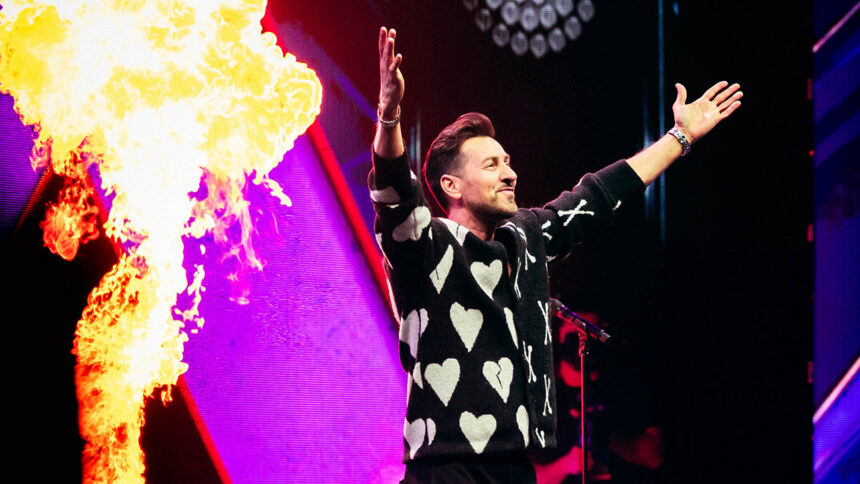
“The immediate feeling is that it’s a huge relief,” says Max Amini. The Iranian-American comedian films his footage from his home in Los Angeles the day after news broke that Donald Trump’s ultimatum to Iran – that “an entire civilization will die tonight” – would not come true, and that the United States would attempt (ultimately unsuccessful) negotiations with the country it began bombing at the end of February.
Although he was born in Tucson, Arizona, Amini, 45, is the son of Persian parents who immigrated to the United States after the 1979 revolution. When he was 8, they returned to Iran until Amini was 17. The family later moved to Southern California, where Amini attended high school and then UCLA. “I’m very Iranian and very American depending on different situations in life.” When it comes to family? “I’m very Iranian,” he says. Dating and lifestyle? “Very American.”
“Regardless of the politics, it would be very painful to see bombs falling on a country that I am emotionally attached to,” Amini says over Zoom. “Last night, when we heard the news, we said, ‘Thank God, there is an opportunity for a different, more effective way to change than was the case before.’” [Trump] “Which led to Iran being expelled from planet Earth.”
Towards the end of his latest YouTube special, Double threat“, released in late 2025, Amini tells the audience: “I come from two sworn enemy countries – Iran and America. All they want is to kill each other. But personally, I have inner peace. “I have love.”
Amini has also had success, although not the kind that happens overnight. He’s been at it since the late ’90s, but last year saw his big breakthrough. According to a 2026 report (based on first-party data from the platform’s original analytics) provided by its cast, another comedy special, randomly selected, Produced through his company Abstraction Media, the comedy special was the #1 most viewed comedy special across all digital platforms in 2025, and the ninth most viewed special of all time on YouTube, with 17.6 million and counting. His Instagram and YouTube views have reached an all-time high of 9 billion, and he has 27.8 million social media followers, including 7.4 million on his MaxxPersian Instagram channel, where he performs stand-up in Persian. He has a live match too. According to the same report, he performed shows in 60 cities in 19 countries during his 2025 world tour and sold more than 200,000 tickets. This year, he sold out his February concert at Madison Square Garden as well as upcoming shows at the Kia Forum in Inglewood, Calif., and the Netflix Is Joke Festival in Los Angeles.
Amini describes his comedy as “observational, original, and inspired,” and his sweet spot is to compare the mores of the two cultures in which he lives. He even coined a guttural and made-up term, “huh-huchch,” an umbrella term for the Persian method.
in Double threatHe talks about his difficulties in dating the kind of “good girl” his family prefers. After weeks of pursuing the eligible person, Amini makes her move, finding a “safety box with a code” to secure her underwear. “What is the code?” He begs. “She says, ‘I don’t know. My father has this disease.’

In the same special film filmed before the attack on Iran, Amini tells his audience: “There is only one element that can end this disaster that we are experiencing in the world. It is love,” adding: “I hope we realize that we are all one race, and that is the human race.”
However, Amini explains on the Zoom call that he is aware that “people come to the theater because I am Max Amini, not Tony Robbins.”
I have a friend in Iran who, when he manages to circumvent the internet ban, exchanges messages with me. When the US attacks first began, he told me there was a lot of optimism that regime change would come next. But the last time we texted, he wrote that with that goal off the table, Iran’s brutal repression of its own people will only get worse once this conflict is over.
I totally agree. As an Iranian, you only want a better life, and a better life means a country taking that country’s resources and investing them in the country’s economy, education, health and other sectors. What we have seen in the past 47 years with this regime is that they believe in investing in Hezbollah and terrorist groups in Syria and surrounding countries. Through this war, we understand how many billions of dollars were invested to build these defense mechanisms that allowed this [Iran] To stand so strong so far.
The system remains.
This system remains. It’s very sad. God knows how many more years it will take to rebuild all these military defense systems. Ideology is the issue. In Iran, you live with a very dark and very extremist mentality. It is a very religious mentality, nothing against religion, but my personal belief is that it is no way to govern a nation. Iran’s youth need to discover their identity, discover art, discover humanity – and have the opportunity to make mistakes to find the path that is right for them. These are the things we have in America; Things that Europeans blessed. When you say “freedom” here, some Americans respond sarcastically: “freedom? What freedom? We shouldn’t take that seriously. For example, a gay person cannot even remotely live a life in the Middle East.
I spent some formative years in Iran. I faced those limitations.
I don’t take any day of my life here for granted, and not necessarily because of the comparisons with Iran. I travel the world, and I still find America very special no matter what many people think. The opportunity to work hard and live with your family in a decent environment is still available and is a blessing.
Do you honestly believe that Iran’s current ideological rulers will ever loosen their grip?
I think so, and it happened. She thinks of it like water and oil. The ideology was not able to penetrate the culture that the people there had in their DNA for centuries. Go back to the attacks of the Mongols, to the attacks of the Arabs to the Greeks, and so on. These different ideologies and invasions have affected the country, the people and the culture. But the foundation cannot be destroyed. The entire being of Iranians – the essence and soul of their survival, celebration and family orientation – depends on the poetry of Rumi and Nowruz. [the start of the Persian new year]music. It’s impossible to wipe this away. The moment Iranian youth get a chance to show themselves, I believe the world will see a very friendly, kind and enthusiastic nation that loves to smile. Iranian culture works and lives for joy, family and gatherings. Look, despite 47 years of this Islamic Republic mentality, every family still has its parties and gatherings. They have art shows, the music they listen to – they are very open. You have social media and the younger generation is moderate. Over time, I think it will decline. When I was in Iran, you weren’t allowed to have a cassette tape, and you would get arrested for listening to music. Today, the same system allows concerts to take place – with many clear guidelines – but progress has been made. It’s inevitable.
Were you thinking about a career in comedy when you lived there?
I had never thought about the opportunity in Iran, but when I returned to America, the real feeling of freedom — that I could do all these things I couldn’t do in Iran — was the spark. Performing, acting, singing. I will go to a high school where there are boys and girls in the same school. In Iran, I was not in the same class as another girl. In America, I’m in a course class with the girls, and we go to the gym and train together. I thought to myself, “Wow, I’ve been given a second chance in life to experience something really great.” Performance has always been very attractive to me. I started out singing in a choir. I came in second place in my high school’s talent show.
What was the moment you said, “I want to be a comedian”?
When I started college, I decided to major in theater and pursue acting and comedy. You were so funny when you did By improvising with my classmates. I discovered stand-up comedy through that.
To what do you attribute your popularity?
Everyone is waking up and dealing with challenges. I have more energy to fight these challenges and continue to grow because my vision has become a reality. For many years, I was disappointed that the industry did not recognize my talent. There is no director, producer, director; No projects or comedy festivals. But I’m one of the lucky people because social media has given me the opportunity to let people choose who they love. I feel like the universe gave me the opportunity to build my character, build confidence, integrity and understanding of the business, versus the industry taking me and giving me all the opportunities. I had to build everything myself, but once things started happening, it escalated.
A lot of your comedy deals with Iranian culture and your upbringing, but you also make it relatable to a wide audience.
Comedy has to connect. I’m lucky to be able to travel for my shows and meet so many different people and learn about their cultures and realize that we all have a lot in common.
in Randomly selectedasking the audience to applaud according to their nationality: Persian, Greek, Arab. How would you describe the composition of the crowds that come to see you?
I have people from all over the world: Albanians, Russians, Ukrainians, Arabs, Persians, Americans, blacks and Spaniards. I do [those callouts] Every show because it’s important for the audience to know who’s there. As in Chicago, each show featured people from Kazakhstan, Mongolia, France, Germany, Ukraine, Russia, and Greece. We had a huge audience. I’ve never had Mongolians. There is a Mongolian population in Chicago. Who knew? I thought, what’s the message here?
What is your conclusion?
I have to make some trip here to unite people. At the end of the show, I always say I hope people understand how we laugh together, and how we’re all searching for love and happiness. Let’s get out of this room and make the world a better place by spreading this joy, love and acceptance. To me this is what art should be.
I saw a clip online of a crying Russian bodybuilder who said her comedy saved her life. You were very respectful, but I loved that you ended your conversation by saying, “I’m going to fuck you.” You never let things get happy.
exactly. I never want to get too cheesy. I want to stay funny first. I’m very aware of moments like that and how vulnerable people are. I feel like I can give thanks but then find comedy to shake things up and energize the room. With a bodybuilder, it was very easy to take him to a very hard place, very quickly. You’ve got a woman who’s got a lot of muscle and there’s a lot of directions you can go in and have a good laugh — you’re a girl, you’re a guy, whatever. This is an easy sentence. On stage, I’m thinking, let’s dig deeper. Let’s find humanity. Let’s make her feel special and laugh hard.
I’ve done both of these things and I loved it.
She came back the next day again.
Do you know if people in Iran watch your comedies?
definitely. At this moment, the Internet is shut down, so they are having a very difficult time connecting. I kept my roots. I made a promise to myself six or seven years ago that no matter how big my career as an American comedian becomes, I will continue to nurture my Iranian roots, and I will keep my comedy alive with Iranians. This is very important to my mission. Passages in Persian are widely distributed. I’m excited to do this because there is no comedian in Iran or from Iran who has my experience, platform and voice. I feel it is a great motivation for the younger generations in Iran to have this example, and start doing stand-up.
Does it work?
In the past four or five years, many young people have participated in the media in Iran. They do open mics, and they have their own little comedy cafés. This did not happen [previously] Located in Iran. I feel like if I stay out there and do stand-up in Persian, it will pave the way for Iranian comedians, in the future, to be able to tour and build from there.
Given your popularity, are there any Netflix specials or other major streaming shows in the pipeline?
Some good conversations happen. There was a time when I was sitting on pins and needles waiting for this news. Now I know for sure it’s coming. I just want to make sure mine is special.
With all the craziness going on with Iran and the world, this upcoming special should have a special touch. I’m working on building that material.
You have a production company, Abstraction Media, that has done some very serious projects – which you have directed – e.g Diaspora: Untold Stories of American Immigrants.
Is this the path you will continue to take?
I started Abstraction Media in 2010 because I knew I needed to start building my career. I went to UCLA for television and film. In college I was very passionate about directing and producing. So, it’s always been a big part of my passion. I would describe myself as the ultimate storyteller. I tell stories through stand-up comedy, directing films, or short-form content. I have sold seven TV shows and produced and directed my first feature film. James II. I am developing a book I have chosen. We’re not here forever, so I want to choose projects that are meaningful. I have a great team of people, and we will continue to do projects like this.
What book are you developing?
It’s called In the shadow of the lion [by Abdol Hossein Sardari]. It’s about an Iranian diplomat who was in Paris during the Holocaust and saved 1,500 Jews by issuing fake passports. What I love about the story is that Iran has always been a multi-religious country. We have had many different religions living in harmony. Today, we have Jewish communities and Christian communities living in Iran. When I found this true story, I said it had to be told. I was a struggling artist at the time, but I kept updating it—taking money here and there, copying and pasting things together—so as not to lose this story. Finally, I found some people interested in making this happen.