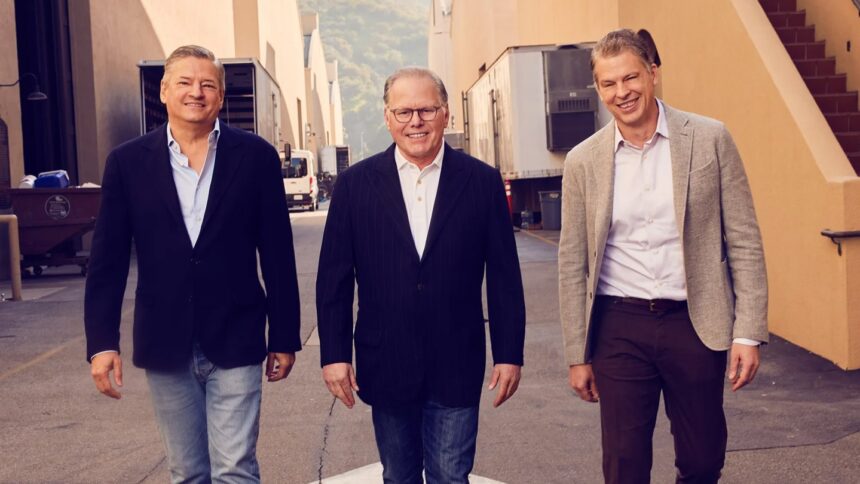
After raising prices to chase Netflix, David Ellison pulled off a coup in late February with a $111 billion deal for Paramount to gobble up Warner Bros. Entertainment. Discovery. Until then, criticism of the sale had run on parallel tracks. Would the historic studio be better off in the hands of a streaming video giant that has no interest in movie theaters or in the clutches of a tech billionaire heir who aspires to reshape the entertainment industry in the age of TikTok?
With Ellison declaring victory, all those whispers about Paramount’s negatives became the sole focus. Will it eliminate a lot more jobs than Netflix? Can the combined studio keep its promise of 30 films a year? How does HBO stay on HBO in a cost-cutting climate? Can CBS News and CNN live under the same roof without political interference? How close is the Ellison family really to Donald Trump and has President Sarandos pushed back? Can the entertainment industry really afford to lose a major studio bidder for projects in an already tight market for buyers?
This month saw growing mobilization in Hollywood against the deal. Theater owners are rallying against the deal at CinemaCon in Vegas, Democratic members of Congress are using all their official tools with strongly worded letters to Paramount’s policy team, and grassroots groups like the one led by Jane Fonda are mobilizing prominent names to put pen to paper in a show of solidarity against the deal. Would Ted Sarandos’ team have been easier? two Hollywood Reporter The editors have varying views.
Eric Hayden: The open letter appears to mark a new escalation in opposition to Paramount’s acquisition of Warner Bros. And that drumbeat is steadily increasing from what seems like all corners of the industry except the deal makers who work on this type of M&A. Alex, was this inevitable for any buyer?
Alex Weprin: I think some level of resistance was inevitable for (almost) any buyer, but I think there are a number of factors here that will likely make the pushback against the Paramount deal louder, at least in volume if not effectiveness. The three big things I’m thinking of are:
This deal will combine two historic Hollywood film studios into one company, and previous mergers have not resulted in more business or better results for the company. Two major television production companies will be merged together. Ditto there. Additionally, everyone is anticipating significant layoffs, which could mean that longtime employees with talent relationships lose their jobs without any clear landing point.
I’ve found very few people in Hollywood who believe Paramount will keep many of its promises (30 films a year, continue to be a buyer and seller of television, etc.). Maybe they will! But there’s real skepticism there, while aside from Netflix’s theatrical commitment (which the industry didn’t buy into either), I think people get their argument.
Then there is the politics of it. Colbert’s ill-timed cancellation days before the FCC approves the Paramount deal, the company holding a party to honor President Trump days before the White House Correspondents’ Dinner, and Secretary Pete Hegseth’s comments about how the sooner David Ellison takes over CNN, the better. This is all in keeping with the discomfort of an industry that is decidedly left of centre.
Eric Hayden: Let’s take the first one first. Under Netflix’s offer, Warner Bros. could still be accommodated. In the streaming giant even if Discovery is separated. Ted Sarandos was meeting with White House and Trump officials, and was trying to tread a very narrow path to avoid angering him. Ultimately, the line of attack from Republicans in Congress was that Warner Bros. could not be sold. Because Netflix was too progressive-leaning, in their view. Netflix would have too much of a place in the marketplace of ideas, as was the narrative, versus simple talk about the jobs of the Hollywood industry. In some ways, that’s the opposite of what we’re seeing now with some of the Democratic senators and the Ellison family, right?
Alex Weprin: I think they were blathering on about the perceived politics of Netflix, but in practice the arguments against it legally were more about the largest streaming service taking over the third largest (which is a perfectly legitimate and dare I say strong antitrust argument). I agree that it’s somewhat the other way around now, but I think that’s because opponents realize that the antitrust issue is the only issue that really matters. While politics may bother them, it won’t stop the deal. The merger argument at least has an outside shot.
Eric Hayden: Leaving aside the inevitability of the deal (or not), will there be many names in bold signing a letter if Netflix wins the bid? I tend to believe so. Even some of the signatories (call it the “Mark Ruffalo wing” of Hollywood) may have been quicker to make their voices heard, because Ellison publicly aligned himself with political allies like Senator Lindsey Graham and attended Trump’s State of the Union address this year.
Alex Weprin: I have no doubt that there will be open letters signed by notable names (James Cameron wrote a letter criticizing the Netflix deal!), but I doubt the list will be as long or as star-studded as this one. Any merger would generate heat, but I think the sheer size of these two film and TV studios would generate more than Netflix. And I think politics played a role, as I mentioned earlier. When David Ellison met with Warner Bros. on their lot in Burbank, he was asked about CNN. This was not a jobs issue, it was a political issue. However, politics never stopped Rupert Murdoch from convincing Hollywood to work with him. Whatever happens, I expect each signee to be happy working with Paramount or Warner Bros.
Eric Hayden: As for your second point, about whether Paramount is being upfront with the industry about all the movies it can make and whether it can actually create new jobs (particularly in Los Angeles), I think what’s interesting is the suggestion that the Ellisons haven’t shown their cards yet at all on the plan. A standard “to be fair” here regarding Ellison is that he is limited in what he can say since the deal has not been closed.
Alex Weprin: And this is true. My suspicion is that there will eventually be some sort of binding commitment, by the EU, the UK, and perhaps even the US, that promises a certain level of production, though the details will matter there (to what extent? for how long? etc.). But it’s entirely reasonable for Hollywood to be skeptical, given Disney-Fox’s recent history, the company’s high debt load, and financial commitments made to others like the NFL and UFC.
Eric Hayden: Let’s say we’re in April on Alternate Earth, where Ted Sarandos has finalized a deal to buy Warner Bros. Television. Unlike Ellison, Sarandos has already appeared before the Senate (as he did in early February when he spoke broadly about viewers being 40 percent conservative, 40 percent liberal and 20 percent “don’t know”). But my guess is that the political opposition is probably more aligned at this point against Netflix than it was when it was against Paramount given that Republicans hold the reins of power. Whether that translates into grassroots energy…
Alex Weprin: There is no doubt that political power exists, but I am not convinced that elected officials were as willing to make the noise we are hearing now. That’s the problem, signal versus noise. There are perfectly legitimate antitrust arguments against both deals, and rational arguments in favor of both. And with Hollywood reluctant to get involved in politics at places like the Oscars, this seems to be where the industry is congregating.
Eric Hayden: The noise is getting louder, even if it’s just something. Damon Lindelof expresses his weary resignation, saying: “My opposition to the inevitable merger would be meaningless, and… “Signing a letter that would evaporate in the storm of a relentless news cycle would be even more absurd” — and yet he signs the open letter.