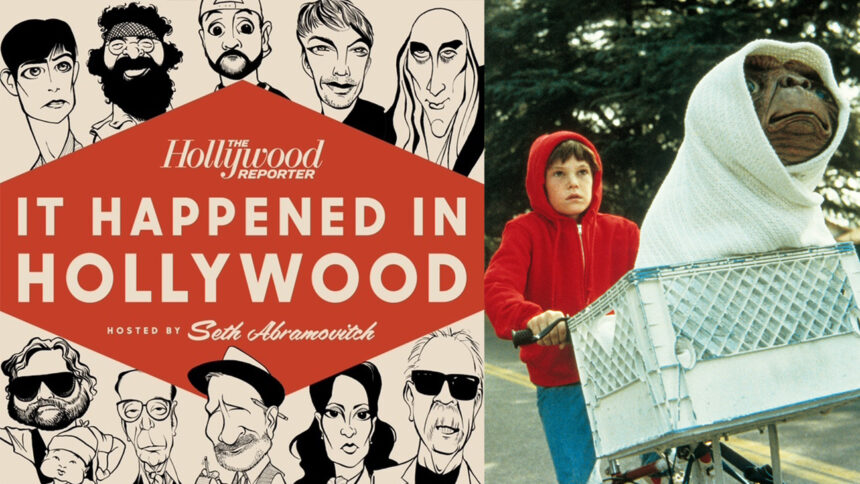
before ET extraterrestrial It became the most beloved space movie of all time – before it was dethroned star wars At the box office – before kids everywhere were pointing glowering fingers at each other in suburban backyards – Henry Thomas thought he’d already lost the role.
“I felt like I did the worst possible job,” Thomas says on The Hollywood Reporter. It happened in Hollywood Podcast. “I thought I blew it the minute I opened my mouth.”
What happened next is now the stuff of Hollywood legend. Steven Spielberg, not satisfied with reading the script, pivoted. Forget the sides, he said. He gave the 10-year-old actor a scenario: Your best friend will be taken. And so Thomas did not act, but remembered.
He thought about his own dog — which his neighbor’s dog had killed in front of him when he was a child — and it broke down into something raw enough to make Spielberg cry. “This is what you see,” he says now. “I just communicated that.” Spielberg didn’t hesitate: “Okay, kid, you got the job,” he said, casting Thomas as Elliot, the film’s suburban kid hero.
The performance that followed would define a generation. But at the time, almost no one believed it, not even people ET extraterrestrial It will be a hit.
“It was like, ‘Go ahead and make this little movie.’ The prevailing wisdom, that shaped me,” Thomas recalls Alienis that audiences wanted monsters, not something cute and homesick. “They assumed the average alien would do better,” Thomas explains, referring to John Carpenter’s long-awaited film. The thingreleased two weeks later at On June 25, 1982.
The thing It will flop – though it won’t become a much-admired classic. but at He made $793 million — $2.5 billion in today’s dollars — enough to dethrone him star warsThen the box office record holder with ticket sales of $775 million.
The film appealed to audiences young and old because Spielberg made a film about loneliness, childhood, and loss, and based its emotional core on a kid who didn’t even think the script sounded exciting. “No lightsabers, no space battles,” Thomas remembers thinking. “My 10-year-old mind was like, ‘This doesn’t sound exciting.’”
On set, Spielberg tried to do something radical: maintain the illusion. He filmed largely serially, keeping technical details hidden and encouraging the young actors to treat ET as real. For Drew Barrymore, who played Elliot’s little sister, it worked. She was wrapping the moving creature in a scarf so it wouldn’t get cold.
For Thomas, it was harder. The illusion fractured under the weight of mechanics – multipliers, inflatable bladders, multiple versions of the creature. This breakthrough came from somewhere else entirely: an actor named Caprice Roth, who performed athands.
In the film’s devastating farewell, Thomas isn’t acting in front of a puppet. He was saying goodbye to her. “That’s what made it real,” he says. “It’s always a human connection.”
That human connection is what he’s made of at He’s struggling. That’s also what made it devastating. Spielberg pushes the film to the brink of something most family films avoid: death.
The famous “death” scene, in which E.T. turns pale and lifeless as Elliot weeps over him, remains one of the first scenes in which many viewers encounter grief. And then, suddenly, resurrection. The flower revives. Heart glows. Flood relief in.
Spielberg, the great manipulator, did it. But while the audience was processing grief and catharsis in the dark, the film’s young star was about to experience a far more disorienting aftershock.
“I wasn’t ready for fame,” Thomas admits. “I never thought about being famous.” For a week, agencies did not return his calls because he lived in Texas. Two weeks later, after at Press 1, “My phone started ringing.”
He stayed in Texas anyway, a decision that probably saved him. While some of his co-stars rose under the weight of early fame, Thomas drifted in and out of the industry on his own terms, building a career that was anything but conventional.
“There were times when everything was fine, and times when you couldn’t be arrested,” he says. “You realize it’s all cyclical.”
After more than four decades, at It didn’t fade. If anything, it has grown. The first generation of merchandising may have been an afterthought — “little things they could produce quickly,” he says — but the emotional imprint was lasting.
It’s still the rare film that feels so handcrafted, so intimate and personal. A story about a boy and a creature, yes, but it’s really about absence, longing, and the fragile magic of connection. Or, as Thomas says, clearly someone who lived through the delusion and its consequences.
“We’re all born and we all die,” he says. “You don’t get a rule book.” Somewhere in between, if you’re lucky, you’ll create something that lasts forever.
Main topics of conversation:
You’ve said you don’t expect ET to be a huge success. But it was Spielberg. Doesn’t that indicate something big?
It was a big deal working with Stephen, of course. He did Jaws, Raiders, Close encounters. Everyone knows who he is. but at It felt like a smaller, more personal project. The studio basically said, “Go do this with your friends,” and gave him $10 million. At the time, the idea of an alien movie meant something like alien, something scary. I think they assumed that an average alien would communicate more than a nice one. No one really knew how the public would react to something this tender.
Your quiz has become legendary. What really happened in that room?
What people see online is only the second half. At first I read the imaginary aspects and felt like I completely blew it. If I watched the tape, I would look down at first because I thought I missed the part. Then Spielberg and the cast suggested we try improvising: I had a friend who was being taken away by the government. The only thing I can relate it to is losing my dog when I was a child. I saw it happen, and it hurt. So I went there emotionally. When Stephen said, “Okay, kid, you got the job,” I was shocked.
Did you even know what the movie was about at that point?
No, I didn’t know anything about the story until two weeks before filming. They kept everything very secret. When I finally read the script, I remember feeling a little disappointed. There were no lightsabers and no space battles. My 10-year-old mind was like, “This doesn’t sound exciting.”
Spielberg famously tried to maintain the illusion of ET for children. Was it real on set?
That was the intention, and it worked to some extent. Drew Barrymore was young enough that she really believed in ET sometimes. She was going to wrap a scarf around him so he wouldn’t get cold. For me, it was more difficult. I knew it was construction. There have been multiple versions of ET, a lot of mechanics, and it can be annoying and distracting. What made it real for me was a mime named Caprice Roth, who performed with his own hands. In the farewell scene, I was really saying goodbye to her. That human connection is what sells it.
What do you remember about working with Spielberg as a director?
It was incredibly practical. He was constantly talking to me, even during takes, and adjusted things quickly. It was so ingrained that when I first saw the finished film, I thought I could still hear his voice in it. I said to Kathleen Kennedy, “You have to get Stephen out.” “Henry, he’s not there,” she said. But it felt like it was.
You became one of the most famous kids in the world almost overnight. How did you deal with that?
Not very good. I was not prepared for this and I never expected it to happen. When someone first recognized me, I felt strange. And then there was this pressure to follow it. I was in Texas for a long time, which probably helped in hindsight. I didn’t approach my career strategically. It was always about the experience or the people. Sometimes that worked, sometimes it didn’t.
I’ve had careers Remarkably stable. Was that intentional?
Not real. I just kept moving forward. There were periods when things were great and periods where you felt like you couldn’t be caught. You eventually realize that it’s all cyclical. You won’t get a rule book. You just keep showing up.
Looking back now, what does he do at I mean for you?
It’s weird because it’s so far away from me now, but it’s also something people have never stopped loving. It remained in theaters for more than a year around the world. This type of connection is rare. I think it’s because at its core it’s about something very simple and human. This is what people respond to.
Listen now and be sure to subscribe on Apple Podcasts, Spotify, or wherever you listen to podcasts.