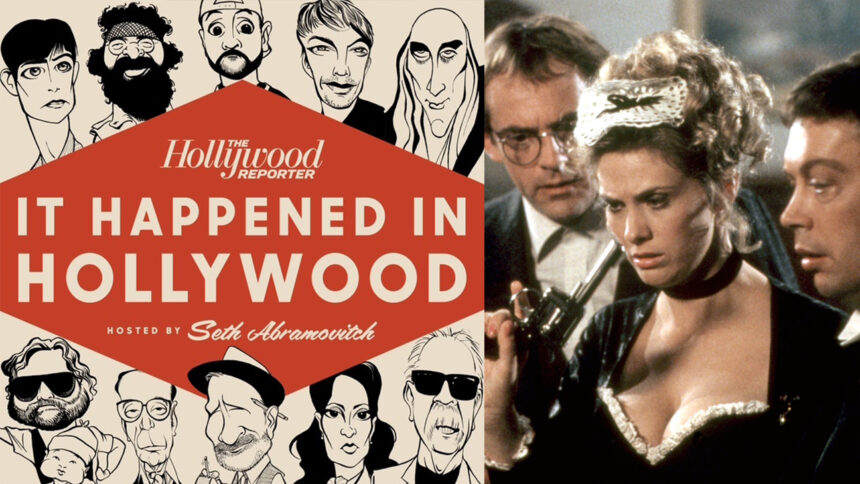
When Jonathan Lane was called to Hollywood to write the screenplay an ideaHis first reaction was that it was the silliest idea he had ever heard. Feature film based on a board game? But he had never flown first class before, and he had a free week. So he went.
Forty years later, the film has become a veritable cult phenomenon – delivered live by The Shadow Cast The Way Rocky Horror It has been rewatched endlessly on stream, and quoted with near-religious devotion by multiple generations of fans. In the last episode of It happened in HollywoodI sat down with Lin for a wide-ranging conversation about how one of the most complex comedies came to be. (It almost didn’t happen.)
Lane arrived in Los Angeles as the sixth writer to be approached about the project — after Tom Stoppard, who accepted the commission and then mailed the check with a note saying the whole idea was hopelessly old-fashioned. Lean met with producer Peter Guber and director John Landis, with the latter presenting his vision for the film in a demonstration that involved jumping on office furniture and running in circles for ten minutes straight.
“Then the butler said, ‘I can tell you who did it!’” Lin recalls. “I said: Who did?” He said: I don’t know. “That’s why I need a writer.”
Lane checked into the Chateau Marmont — which looked like the foreboding chateau he was about to invent, and which had recently hosted his untimely death in the form of John Belushi’s overdose — and spent the night trying to figure out if there really was a story here.
The breakthrough came when he realized that characters named after colors could not be their real names. Which meant that they were all pseudonyms, which meant that they all had something to hide.
“He was the backbone of the whole thing,” Lin says.
From that one logical problem, the entire clock mechanism an idea – Blackmail, secrets, serial murders – were born.
The film’s casting is one of the great Hollywood sliding door stories of the 1980s. The role of Miss Scarlett was originally cast with Carrie Fisher, who came in and was, by Lane’s account, a real joy in the room.
His wife in London was somewhat less enthusiastic when Lynn called to share the news.
“She said, ‘Are you? Nuts“I said, ‘Why?!’ And she said, ‘She’s a drug addict!’ So I said, ‘Really?’ Sounded good to me.” Lynne later met Fisher for lunch and remained unconvinced — even when she plopped down in a chair on her way to the table.
Days before rehearsals began, Fisher called to say she was at Cedars-Sinai Rehabilitation Center and would need to move around every day. Insurers took a dim view of the arrangement. With four or five days to go, Lynn took on the role of Lesley Ann Warren. He says Warren went out and gave a great performance.
The film’s most famous trick — three different endings, spread across different stages — was someone else’s idea, and Lynn was nervous about it from the beginning. The thinking was that the audience would come back three times to see each decision. Instead, he said, people who couldn’t decide what ending they wanted to see simply didn’t go at all.
“The ending is what people remember,” Lin says. “It’s what they came out with just seeing it. If you can’t tell what the last two hours were about, critics tend to say, ‘They couldn’t even decide how to end it.’ So that was a disaster.”
When the film moved to home video and cable television, the three endings were joined together and played sequentially; This is the format that most viewers are familiar with today. Lin says this version finally revealed the full ingenuity of what he had built. It had done damage at the box office, but a cult following was just beginning to form.
One detail I’d never heard before the interview: Lane and Tim Curry went to the same school in England. Lane was 14 years old when Curry was 12 years old. They weren’t close, but they knew each other — and he later told Carrie Lynn that seeing him pursue acting showed him that it was possible for someone from their conservative, Methodist-founded establishment to go into business.
Decades later, at Paramount, and both were veterans at that point, Lane cast Carrie as Wadsworth the butler — the role on which the entire film is based.
“I don’t know that I can honestly say I got that job from him,” Lin says. “I think he did the job.”
The film’s most famous line — Madeleine Kahn’s confession of “fire…fire on the side of my face” — was improvised. Khan asked Lin if she could undo what he wrote at that moment and try something of her own.
“Sure,” he told her. “If it doesn’t work out, we’ll do the speech in the script.” They never shot the script version.
The only other notable ad was Michael McCain’s final line — “I’m going home to sleep with my wife” — and even then, Lynn wasn’t entirely sure McCain invented it. “He thinks he animated it and probably did it, even though I thought I wrote it.”
The script was, by necessity, fundamentally tight: with three separate endings that required careful design by whoever was off-screen at that moment, a single line change could bring down the entire structure.
The entire interior of the film was shot on the Paramount sound stage where Alfred Hitchcock built the apartment complex for him. Rear window. The set was so convincing that after production wrapped, strain They say he bought it and repurposed it as the Carlisle Hotel – which I looked up online and found to be true.
Lynn met John Landis for the first time on the day Landis was mixing stir. In the mixing suite — a spacious room with a ping-pong table, a pool table, and no chairs — a friendly young man came over to ask if Lynn wanted pizza. It was Michael Jackson.
“Very nice fellow,” says Lin. “Yes.”
Now 83, Lin says he has been retired from filmmaking for some time. He remains amazed that anyone still wants to talk about a film he directed 40 years ago.
But it’s no mystery: this movie consistently kills.
Listen to the full episode of It happened in Hollywood – Featuring Jonathan Lin an idea – Wherever you get your podcasts.