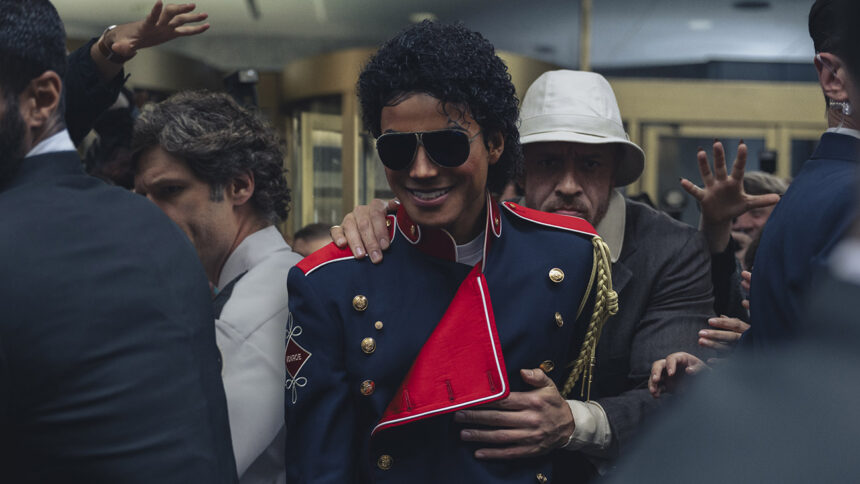
Jafar Jackson’s portrayal of his uncle Michael Jackson in the film bearing his name Michael It will certainly be a talking point among film viewers for months to come, as the younger Jackson offers an impressive take on the King of Pop, from his look to his mannerisms, smile, dance moves and – yes – his voice.
As far as speaking voices go, that’s it, Jaafar and Giuliano Valdi, who play Jackson V-era 10-year-old Michael in an equally convincing performance. But getting Jackson’s iconic vocals required clever audio editing, as the team mixed Jaafar and Valdi’s live vocals, which they performed on set, with Michael’s original recordings.
The actors’ voices are heard in the musicals when there is no actual recording of Jackson, such as the scenes in which Jafar wanders into the studio during the recording of “Don’t Stop Till You Get Enough” or when Valdy does the initial verse of “I Want You Back.” Michael’s voice becomes more dominant when the pure recording is allowed to take over.
“We had a lot of discussion, could we ask Jaafar and Giuliano to go into the studio and record those songs, and the answer was yes,” he says. Michael Music Supervisor John Warhurst. “They were able to get those voices across. But then the overall philosophy becomes when people go to see the movie, do they want the real Michael to be a part of this movie, or do they want it to be just 100 percent Giuliano and Jafar? Every movie is different, but here we think people want Michael to be a part of it.”
Warhurst has worked on many of the most notable musical films of the past decade, including… Bob Marley: One Love, Whitney Houston: I Want to Dance with Somebody and bohemian rhapsody, The latter which earned him an Oscar. Below, he explains the overall process on how to do this Michael Deal with singing.
Let’s start from the top. How did you guys actually do it?
I’ve worked on quite a few musical films over the years, and there are a few different ways you can approach singing. But the best way I’ve found is to treat it like a live musical. This requires the actor to be on set and perform the pieces himself. Ignore how we’re going to put it together in post-production at this point. When you’re using recordings, one of the first things you need is what I call a visual palette. You can’t put an incredibly powerful voice on a face that doesn’t seem to exhibit that kind of power. Actors need to learn the songs so they can sing them with the same energy and power as the original artist and then perform them.
A lot of times, in these scenes, we’re pretending we’re in a recording studio, meaning we can actually record. The actor is wearing headphones. We have a huge microphone in front of them. We have to be able to capture it exactly as if we were recording it for an album. The next important element is as many live shots as you can get without music.
It’s more complicated when we perform on the field. It’s not like a recording session. There’s more off the record. You see Jafar doing more bits and pieces and announcements of his own. And when you have a collection that big, you need to liven it up a lot. You want the ground to shake. You want everyone to feel that in the room, and have that kind of atmosphere.
It’s like you’re basically getting their vocals.
– Yes, from their performance. Once we get the visual palette right and the recordings, when we get into post-production, we have 15 to 20 shots of Jafar or Giuliano and the one shot of Michael with his recording. This is where the combination comes in. In this scene when Jafar is playing Michael and he’s recording “Don’t Stop Til You Get Enough,” he’s doing these scattered things. I call this “dialogue.” We don’t have Michael doing that. That’s Jaafar.
Or that scene where Giuliano does the opening lines of “I Want You Back” and where Berry Gordy has to stop Michael and tell him he’s moving too much. If we use Michael in the first shot, when we use him again in the final, it will look like a carbon copy. So, the first time it’s just Giuliano, and then the second time when we’re supposed to be closer we add some Michael.
How long does the process take?
The process begins once someone is selected. Especially when it comes to singing, the one thing my ears always pick up right away is the power of the voice, the power of the voice, and that’s not something you’re going to do in two or three weeks. You need a lot of vocal training.
Then there’s always the back and forth in post-production, and it’s never one version of the film. Everyone wants to experience everything in every different way possible. You are constantly reworking. And then you’re really happy with the sound, and they’re like, “No, we’re going to re-edit this scene.”
How similar the process is to it bohemian rhapsody? I know vocalist Mark Martel was very involved there to get Freddie’s vocals.
It was a very similar process [to get the visual canvas]. The difference with Freddy and Ramy was that Freddy was a singer, and Ramy was more baritone, and had a much deeper voice. This is where Mark Martel comes in. We understood the differences, he sounded like Freddie and we could get the sound if we didn’t have a proper original recording.
With Jaafar and Giuliano we didn’t need that. They were both very close. Jafar is Michael’s nephew. Physically, his voice is very close in range to Michael’s, which made my job much easier. In post-production, we had several conversations about whether we could use just Jafar and Giuliano or whether we needed Michael. They were so close, they made it work. We ended up deciding that it made sense to stay with Michael. It kept it more consistent across scenes.
If we were to analyze the DNA so to speak, especially with the final product, it seems to be basically Michael’s voice., Hence, Jaafar and Giuliano are the broadcasters to whom the audio will be linked.
I think it’s the opposite. It’s their performance, with Michael on top of it.
To be clear, there is no artificial intelligence?
No, I’m pretty much an audiophile. Once you have the best possible recording, you can take the fewest steps away from that recording. We apply like EQ, then we apply compression, then we apply reverb, then we stretch it. These AI tools are amazing, but there are parts that are good and then suddenly it can seem cheesy.
Obviously, working with actors’ vocals requires a lot more work than lip syncing. How difficult would it be to let the actors just lip sync instead?
There’s no one in the world who can do it so well, so well, that you won’t spot something when you see it on the big screen. You will feel a slight difference between the picture and the sound. People forget this too when you’re on set, we don’t just do this song once. We’re going all day, and it’s exhausting.
When Michael was on tour, he would go to the set that night and sing the song once. We’ll sing it 24 times for every different angle we can shoot it from. We have to maintain that intensity that you see on stage during that first take. When you lip sync, what happens is that the visual performance also decreases. He tends to turn into something resembling a goldfish, with the face appearing to mimic as well. You lose the visible part, and then it doesn’t work.