Logo text
Amazon Studios should at least be thankful that JRR Tolkien is no longer around.
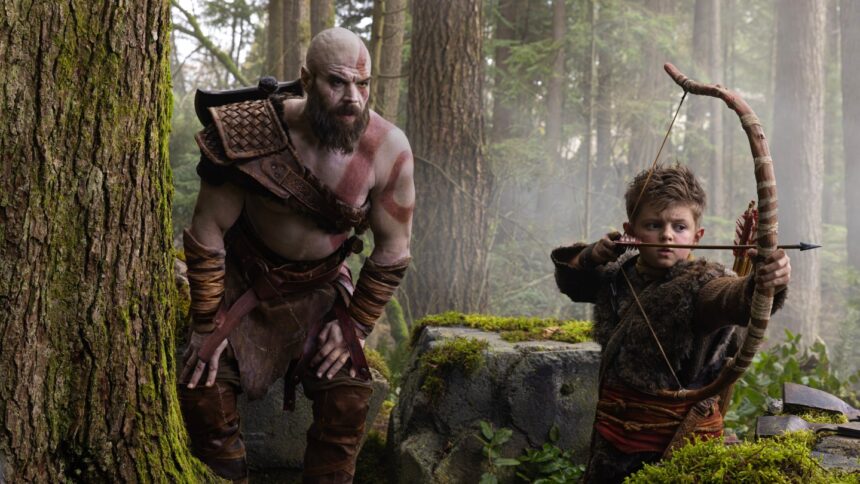
First, the studio came under fire from best-selling fantasy author Brandon Sanderson for it Wheel of time adaptation (“I had my issues with the show,” Sanderson said last year. “I wouldn’t miss being largely ignored; they wanted to put my name on it for legitimacy… It had a fan base that deserved better”). Then last month, builder God of war Video gamer David Jaffe teased a first-look image (above) from Prime Video’s upcoming big-budget remake (“It’s pretty bad in a lot of ways,” Jaffe said on YouTube. “None of these characters seem very interesting or appealing. If this God of War: Dumb and Dumber Edition, that’s what you’d expect.
To be fair, Jaffe was critical of others God of war The occasional effort has been over since he got involved in the game nearly two decades ago, and he added that he has confidence in it Prime Video producer Ronald D. Moore will present. But considering all the fan controversy surrounding Amazon’s first two seasons Lord of the Rings previous series, Power ringsThe lack of Tolkien’s angry tweet about the Harfoots in the show must be a blessing.
Prime Video isn’t the only one that has made the fictional creator target an adaptation. The witcher Creator Andrzej Sapkowski has repeatedly hurled harsh criticism at the troubled Netflix series, saying things like “He never listened to me” and “I can’t praise the show, it wouldn’t be decent” (The witcher It is also known that it lost its star Henry Cavill amid circumstances that remain mysterious, with the actor hinting that fidelity to the source material was a key issue for him).
George R.R. Martin – After years of sincerely holding his tongue about some things game of thrones He was not happy – he unleashed Drakarys On the prequel Dragon House Because of his deviation from his book, Fire and bloodAmidst a dispute with showrunner Ryan Condal. (“We’ve reached Season 2, and… [Condal] “She stopped listening to me. I was taking notes, and nothing was happening,” Martin said. However, Martin sang the praises of the new series Knight of the Seven Kingdomssaying the show was “as sincere as a reasonable man could hope for” and joking: “And you all know how incredibly reasonable I am on this very subject”).
HBO recently had a slightly similar problem with an acclaimed series Green Lantern Comic book writer Grant Morrison, who sided with angry fans who disagreed with the incoming showrunner Lanterns Series jokes “green is stupid.” Morrison wrote: “What is this comic rejection of superhero conventions meant to prove anyway?” Showrunner, Damon Lindelof (who was certainly enjoying the “jock” moniker) offered a sincere apology.
Another HBO fantasy project, The last of usA split occurred when the game’s developer, Neil Druckman, left as co-director after the second season. Druckmann didn’t say anything negative about the show but noted after he left, “[The way] The best I can contribute is to make sure [season three] It was very faithful like the first season. Because I feel like that’s the gold standard for this type of adaptation. There’s that word again: believers.
Ironically, the world’s biggest fantasy author, JK Rowling — perhaps one of the most controversial names in media for her shifting viewpoints — has nothing but nice things to say about HBO’s upcoming adaptation of her novel. Harry Potter books. “I’m so happy about it,” she said excitedly. (Rowling is an executive producer on the project.)
Common themes are that authors feel angry about edits that – in their view – do not closely respect the source material, or they feel that their views are not taken into account.
Authors feeling this way about their adaptations is nothing new, of course, and is not necessarily an indication that the adaptation has done anything wrong (Stephen King famously hated Stanley Kubrick’s adaptation of a Stanley Kubrick novel). The bright onewhich is nonetheless considered one of the best horror films of all time). But authors feel empowered to speak out about their concerns while their software is currently released — or until before It’s been released, even if it’s related to the project, it feels new.
Two factors prompted the authors to push back, suggests Professor Amanda D. Lutz, a researcher in digital media and trends at Queensland University of Technology and author of After Media: Storytelling for Young Audiences in the 21st Century.
First, there’s a reason that’s probably obvious: authors have a closer relationship with their fans — and a huge megaphone — thanks to social media. “Just the parameters of how one performs as an author — especially with a strong fan base — that relationship has evolved a lot over the last couple of decades along with the way they can connect and experience the people who read their work,” she says.
But also, cinematic storytelling has changed dramatically in the past few years. The combination of audience fragmentation (since studios no longer need to attract the largest possible viewership with each show) and streaming services that collectively serve hundreds of long-form titles a year now allows these stories to be adapted with a level of specificity and loyalty to the source material that was not previously true.
“Segmenting the audience made it possible to retain the interesting parts of the novels rather than trying to dilute the difficult parts for a broad audience,” says Lutz. “Netflix is trying to force a lot of different people with different tastes to keep paying for it — that’s a very different mandate than trying to produce a miniseries. [adaptation of a novel] That you will be trying to force a lot of people to watch at the same time in a way that will attract a lot of attention that you can sell to advertisers [like in the past]”.
The rare exception in the non-streaming space was something that looked like a large Peter Jackson screen Lord of the Rings trilogy – which was nearly 10 hours long and considered a huge gamble at the time. Rings It is perhaps the best example of a very faithful fantasy adaptation that wasn’t afraid to make smart and important changes that improve the story.
But streamers are trying to balance creating wide-ranging content with pleasing a hardcore fanbase that often has an almost religious view of “canon” — and now it’s possible that creators will break ranks to join fans in their criticism, too.
One benefit of the old way of doing things was that because adaptations had to change radically to fit the format of a two-hour movie or TV miniseries, there was greater acceptance of the idea that the changes would be significant. There is no film-length version The bright one It would have depicted Jack Torrance’s very slow descent into madness as well as King’s novel. But an eight-hour version that can be streamed online might just do that — and if it did, there wouldn’t be much excuse for ignoring other fan-favorite parts of the novel as well. Fidelity would suddenly be possible, and then expected.
“I don’t envy studios trying to negotiate these things,” Lutz says.