Logo text
[Thisstorycontainsmajorspoilersfrom[ThisstorycontainsmajorspoilersfromtranceSeason 3 finale.]
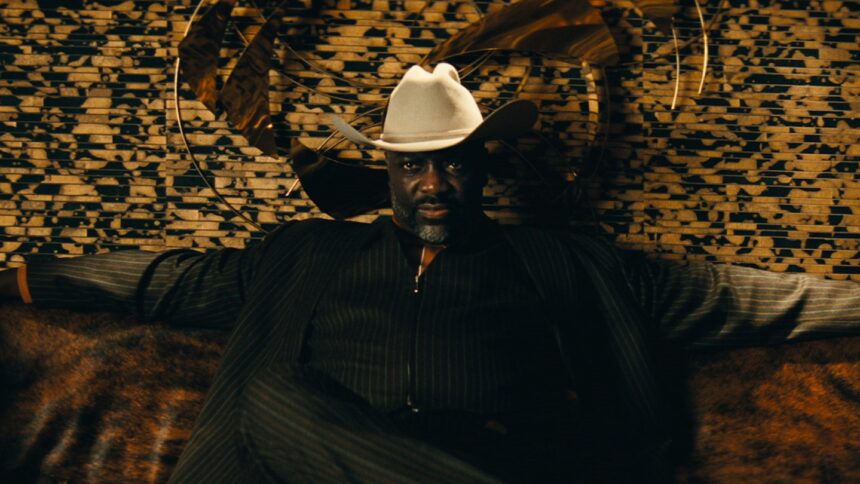
Adewale Akinnuoye-Agbaje dies in the film’s dramatic final scenes tranceIt wasn’t supposed to happen this way. In the first iterations of the script, his character, the strip club manager and Season 3 Big Bad Alamo Brown, walked out while on top of the world — he’d just taken down drug kingpin Laurie (played by Martha Kelly), defeated the DEA, and was in the midst of celebrating taking out another of his adversaries (Zendaya’s Rue; more on that later) when his final moment came. But then Akinnuoye-Agbaje and creator Sam Levinson spoke, and they realized the moment needed something more impactful.
“We asked ourselves, was his journey really just about chasing money and women?” Akinnuoye-Agbaje says. “We thought it would be more important to have a moment of reflection where he realizes that he has everything, but nothing. And he has to think: ‘Is this really what it’s all about?’
Levinson then wrote the scene the audience saw Sunday night: Alamo watches everyone party at the strip club, feels too sick to eat his steak, and then declares his desire to find love and start a family. It was a far cry from the harshness that dominated the season, but Akinnuoye-Agbaje is happy with the reflective arc. “When we first meet my character, he claims to be the King of Pussy, and thinks he’s mastered the game of exploiting women,” he says. “But in the end, he realized that he wanted to surrender to the power of women.”
The actor, a veteran of prestigious projects over the past 30 years, has roles in projects such as lost, Bourne identity and His Dark Materials (And also blockbuster movies like The mummy returns and Suicide squad), makes it a habit to be curious about his roles. His high-level character analysis earned him a breakout role geesethe groundbreaking HBO series about life inside a maximum security prison. (Levenson’s father, Barry, also happened to be involved in its creation.) During an audition, it was suggested to Levinson and co-creator Tom Fontana that the character, who had been written as an American gangster, was actually African. The duo loved the idea, and the character of Simon Adebisi was born.
“They had never written for an African character before, so they would write in American vernacular and then I would translate it, and that’s where you get these wonderful nuances in it,” he says. “You have to read the room before you do something like I did, but both the Levinsons create a space where an actor can be really creative, which is why they get such great performances.” Later, after the younger Levinson and Akinnuoye-Agbaje worked together, Sam revealed that he was so afraid of Simon Adebisi when he was younger that he believes that is what kept him out of prison.
When he got the call that HBO was looking for its main antagonist in season three, and was “casting a wide net” in the search, Akinnuoye-Agbaje immediately became interested. He had long been impressed by the way Levinson was able to elicit high-caliber performances from new (and even other) actors, and was desperate to play the modern-day cowboy he had read about in the script (even though he knew that meant he would need to learn how to ride a horse—and fast). His self-tape led to a meeting with Levinson, and he decided, based on a well-researched hunch about the character, to try something different at the audition. “I was trying to figure out why Alamo was in the strip club, so I told Sam about my idea that Alamo has a theory that everything on two legs comes from a woman, and we spend the rest of our lives trying to get back there,” he says. “And if he can put a cash register next to that, it’s an eternal cycle of money.” Levinson liked the idea so much that he not only gave the actor the role, but implemented the theory into the show (the viral Alamo episode became one line of “ca-ching, ca-ching, ca-mother-fucking ching.”)
Once Akinnuoye-Agbaje arrived on set, he was impressed by how camaraderie the young actors were (“They’re really tight, and you feel it”), but decided to keep himself as detached as possible in order to maintain his tone and the darkness that Alamo required; Kind of a lite method approach. He stuck to it even when the elder Levinson, along with Sam’s mother, came to visit the set — an encounter he described as a “beautiful, full-circle moment” — and when Coleman Domingo went to work filming the scene in which Domingo kills Akinnuye-Agbaje with a sawed-off shotgun. They only got two chances to shoot the shootout, thanks to the fake blood mess and how long the reset would take, so their schedule was tight. “Our first appearance as actors and as people was fighting with each other,” he laughs. “We found it really funny, and when we broke up, we got a chance to introduce ourselves. It was very light-hearted, given the seriousness of the scene.”
However, he broke character on Zendaya’s final day. Akinnuoye-Agbaje wasn’t on the call list, as the actress’s final scene was with Hunter Schafer at Jules’ apartment, but he wanted to be part of her send-off and pay his respects. They finished filming at 1 a.m., and her family and friends joined the cast and crew for champagne and cake. It was much more of a finale than their characters’ relatively disappointing final scene together, in which Alamo gives Roe a bottle of what the audience later learns is Percocet laced with fentanyl. “This is exactly the way the Alamo moves,” he says. “He loves the game of chess. When he knows Rue is a snitch and a traitor, he’s already made up his mind that he’s going to deal with her in a way that best serves him productively, but also serves his sadistic nature. If he could force her to kill herself, that would be much more poetic. If he could tolerate it, it’s an excuse.”
Throughout this season, the longtime character actor has felt more audience interest than ever, and from a very different fan base than his other projects. “This show is the voice of Generation Z, and most of them don’t know I’ve been doing this for 30 years or that I’m British,” he laughs. He also knows that he is the face of the man responsible for the protagonist’s death – even if that man is brought to (very bloody) justice. “Zendaya has created this character that’s beloved by a generation, so it’s personal to them. And I think the way she’s going about it will spark a lot of dialogue. Alamo was a great character, but I was happy to say goodbye to him, and now I’m happy to leave him with his voracious fans.”