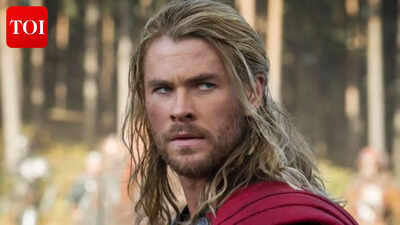
Chris Hemsworth didn’t just become an actor. He has become a symbol of what a hero looks like when he finally stops running from himself. From “Thor” to “The Avengers” to “Extraction” to “Thor: Ragnarok” to “Avengers: Endgame.”
He has been in some of the most commercially successful and culturally defining films of the 21st century. He presided over one of the most beloved franchises in cinema history. He did the work. He did comedy. He did raw, dramatic work. He reinvented the same character multiple times over the course of more than a decade and made each version feel fresh, human, and earned. He went from a relatively unknown Australian TV actor to one of the biggest stars on the planet with a combination of physical commitment, surprising comedic instinct, and real emotional depth that few would have expected.
And through it all, one line of his most famous performance captured something essential not only about the character he’s playing, but also about the philosophy that defines what it actually means to be brave. Thus, Thor Odinson declares in Thor: Ragnarok, “I choose to run toward my problems, not away from them. Because that’s what heroes do.”
Quote of the day by Chris Hemsworth
“I choose to run toward my problems, not away from them. Because that’s what heroes do.”
Chris Hemsworth uttered those words as Thor Odinson in Thor: Ragnarok, the 2017 film directed by Taika Waititi that fundamentally reimagined what the character could be. This was not a fast line of action. It came at a pivotal moment in the story, when Thor had lost his hammer, lost his home, and was facing a threat he had no clear path to defeat. He had every reason to back down. All logical arguments pointed to survival at the expense of sacrifice.
Yet he chose to approach the problem anyway. Not that he was sure he would win.
But because staying away from him wasn’t something a hero would do. The line is delivered with conviction and the kind of quiet, unwavering clarity that makes it much more difficult than its simplicity might suggest.
What does it actually mean?
The line is built around one radical choice. Choose direction. towards or away. What makes it so powerful is that it does not frame heroism in terms of the absence of fear or doubt, but rather as a decision made in spite of them.Most people, when faced with a real problem, feel like walking away from it. This pull is not a weakness. It’s biology. It’s a survival instinct. The mind naturally seeks safety, comfort, and the path of least resistance. In everyday life, this instinct serves a purpose. But there are moments, in any life, when the problem in front of you cannot be solved by retreating from it. When the only way is through straight.
When you walk away it only ensures that the thing you fear gets bigger, closer, and more inevitable.What Thor describes is the conscious overriding of that instinct. Deliberately choosing to confront rather than flee. He offers her the most direct justification: because that’s what heroes do. Not because it’s convenient. Not because the result is guaranteed. But because the definition of heroism, at its core, is the willingness to move toward difficulty when everything inside you is screaming to move away.This is not limited to the battlefield or the extraordinary circumstances of a superhero story. This applies to the conversation you’ve been avoiding. The health appointment you keep rescheduling. The hard truth you haven’t told someone you love yet. The creative project you’ve been kicking around for years without starting. The apology you know you owe. In each of these situations, the problem doesn’t get any smaller when you look away from it.
It’s gotten bigger. And the act of turning toward it, choosing to run toward it rather than away from it, is the only thing that actually begins to solve the problem.There is also something important in the word “choice”. Thor did not say that he had to solve his problems, or that duty forced him to do so. He chooses. It is volunteer work. This framing is important because it maintains the full weight of the decision. A hero is not someone who has no choice.
A hero is someone who has all the options, including the option to walk away, and deliberately chooses the harder path anyway.
Who is Chris Hemsworth?
Chris Hemsworth was born on August 11, 1983, in Melbourne, Australia, and grew up partly in the Northern Territory before returning to Melbourne to pursue acting, according to IMDb. He built his early career in Australian television, most notably on the long-running series Home and Away, before moving to Hollywood in search of bigger opportunities.His breakthrough came when he was cast as Thor Odinson, the Asgardian god of thunder, a role he first played in 2011’s Thor. What followed was one of the franchise’s most sustained periods of success in modern cinema. He reprized the role in “The Avengers,” “Thor: The Dark World,” “Avengers: Age of Ultron,” “Thor: Ragnarok,” “Avengers: Infinity War,” “Avengers: Endgame,” and “Thor: Love and Thunder,” building a character across more than a decade whose emotional journey is truly compelling alongside his spectacle.Away from the franchise, he starred in the thriller “Extraction” and its sequel, gave a widely acclaimed comedic performance in the “Ghostbusters” remake, and has consistently demonstrated a range and self-awareness that elevates him beyond the demands of the blockbuster format.He’s also been open about his personal approach to health, fitness, and mental resilience, and has spoken publicly about discovering that he carries genes associated with a higher risk of Alzheimer’s disease, a discovery he confronted in a characteristically direct way. In this sense, the line he delivers as Thor is not just a piece of fictional dialogue. It reflects something true about the man who gave him a voice.
He chose to run towards his problems. Because that’s what heroes do.