During the scary and lonely days of the pandemic, the Spanish TV series aired Veneno – Biography of a famous trans singer – She arrived in the United States and warmed the days of those who encountered her. The series was created by Javier Ambrosi and Javier Calvo, a creative duo (and former spouses) known in their native country as Los Javes. Their style is lively and passionate, but not afraid of edge and darkness. They are, in some ways, children of Pedro Almodovar, fascinated by memory and melodrama but also individual, offering something refreshingly youthful and certainly their own. This developing craft is on abundant display in their new film Black ball (La Pola Negra)a gay saga spanning decades and intertwined with a particularly bleak time in modern Spanish history.
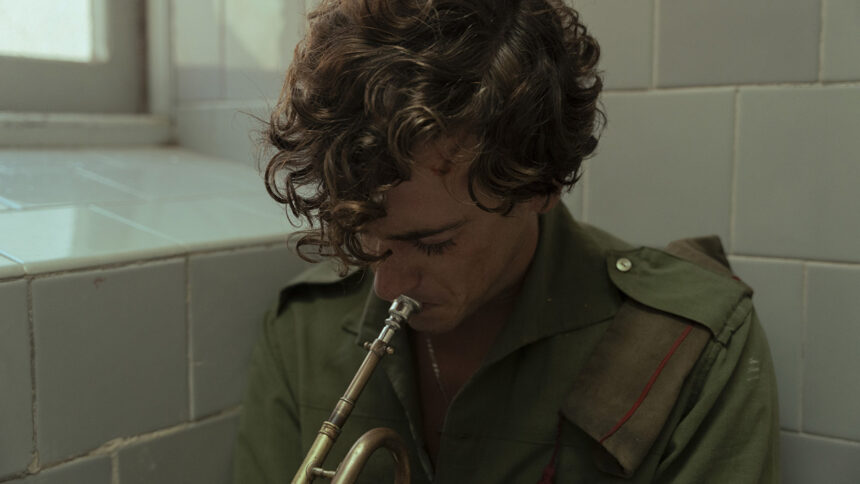
Black ball The film begins in 1937, where a rural village loyal to the Nationalist rebels is holding a celebration to welcome their Italian allies. Only when planes fly overhead do they rain bullets on the villagers and send bombs into the buildings. Many are killed, but young Sebastian (singer Guitar Ricadillafuente, making his acting debut), rushes to safety, only to be conscripted into the fascist army.
Black ball
Bottom line A dazzling blend of contemporary pop sensibility and classic filmmaking.
place: Cannes Film Festival (competition)
ejaculate: Guitar Ricadillafuente, Miguel Bernardo, Carlos Gonzalez, Milos Cueves, Lola Dueñas, Penelope Cruz, Glenn Close
Managers: Javier Calvo, Javier Ambrosi
Screenwriters: Javier Calvo, Javier Ambrosi, Alberto Conejero, based on his play, La Piedra Oscura
2 hours and 35 minutes
Five years ago, with revolution looming, another young man, Carlos (beater Milo Cueves), drowns his sorrows after being kicked out of his father’s social club due to inappropriate rumors about his sexual orientation.
In 2017, Alberto, a gay writer and historian (the wonderful Carlos Gonzalez), learns that a grandfather he didn’t know left him something in his will – a document that will crucially connect his story to the past. How these three plots intersect is the film’s mystery, a connection that is explored convincingly.
The 1937 section is the center around which the other two parts revolve, a sad, almost violent romance between Sebastian and a leftist prisoner, a handsome former footballer and actor named Rafael (Miguel Bernardo), who will almost certainly be executed once he gives up the information the investigators are looking for. Sebastian is tasked with befriending Raphael so he can start talking, but it’s clear from Sebastian’s furtive glances at Raphael’s wounded but still beautiful body that there’s another motive guiding this soon-to-be accidental soldier.
Whatever the connection between the two forms, it has more to do with the unspoken than with anything spoken out loud; Los Javes keeps their conversations brief and evasive. But a wealth of feeling clearly passes between them, with Bernardo poignantly conveying Rafael’s resignation to his fate, and Ricadillafuente’s guitar vividly illustrating Sebastian’s informed awareness of his own sexuality, and the kind of people his side of things – which he did not choose – is brutally working to eliminate.
The film is a meditation on so much lost gay history, an acknowledgment of what it must have been like for men in a dangerous and oppressive era to find themselves helplessly drawn to each other, to the war and other atrocities that fuel their lives but fail to destroy all that is so strong and innate within them. While watching the film, I thought of Alan Hollinghurst’s wonderful novel Sparsholt casewhich traces the lineage of gay men across a century, noting the vast societal differences between the eras while highlighting the enduring similarities and, perhaps, the universal and timeless joy of love and the flourishing of community in the margins.
Los Javes executes this mighty vision with exciting artistic courage. Almost every shot in the film is a carefully composed marvel, either an eye-catching still life painting or a breathtaking bit of camera movement, all done in rich, extravagant detail. It’s a dazzlingly assured film, offering the intense satisfaction of seeing something ambitious actually succeed in its nervous attempt.
One comes to festivals like Cannes in part to witness the arrival of major new filmmakers Black ball It is just such an event. Los Javes moves deftly and gracefully between timelines and knows when to add a sly, surprising joke, lest the scene turn into a mystery. (There’s a particularly funny and saucy tone in the line from Titanicfor example.) The film achieves its high drama by immersing us fully and convincingly in its world and its ideas, drawing us in with a paean to those who lived fully even in the darkest of circumstances. However, the collateral damage that self-assertion can cause is also taken into account – the image is not forgotten by women.
As close as the film’s three plots are thematically, Los Javes risks a certain kind of arrogance. The ghost of Federico García Lorca, the gay leftist writer who was assassinated at the beginning of the war, looms over the film’s horizon like a wise and benevolent moon, like a symbol of the patron saint of all the film’s beauty and struggle. We learn that one of the three sections is actually a manifestation of an unfinished play the author was writing just before his death. Los Javes boldly seeks to create a new Lorca text in order to complete this work. Some might call that arrogance. But they fooled me with conceit, and they succeeded in conjuring Lorca’s own poetics to connect the film’s big fantasy with the heavy stones of real history.
From that grounding, Black ball Creates a huge collective cinema. The music blares around these men as they totter and totter on seashores and mountaintops, in bustling cities and stark military outposts. Los Javes fills the frame with generously beautiful faces – the curtains of Carlos’ hair partially covering his tortured, angelic features; Rafael’s tough, attractive, clean masculinity — and add a pair of gay cameos in the form of Penelope Cruz, as a bawdy nightclub performer, and Glenn Close, as an American historian who speaks what sounds like fluent Spanish. The Grindr joke immediately punctuates a scene of military drama. In a film about a national nightmare that crushes the minds and bodies of young lovers, dreamers and artists, comedian Julio Torres plays a supporting role.
This beguiling blend of contemporary pop sensibility and classic filmmaking has an intoxicating power, carrying us away on a sweeping, heart-wrenching, and often hilarious journey of recollection and imagination. It’s about time we had a gay war epic of this scope, emotion and invention. And sure enough, at the last minute, this tough, dreary, and often disappointing competition gave us something vital and deeply moving, a reminder that extremism doesn’t have to be limited to Hollywood blockbusters. Los Javes proudly planted their flag in those sands and declared it their land, too.