Australia defied the odds and established themselves as surprise favorites in Thursday’s Eurovision semi-final while three previous winners – including 2024 champions Switzerland – failed to progress.
Switzerland joins Latvia and Luxembourg as previous holders and will not have the chance to win another Eurovision title as the final 25 nations prepared for the weekend’s big showdown in Vienna.
The 70th annual tribute to the songs’ loud and sometimes ridiculous production will nominate a winner on Saturday, ending a months-long saga that saw five countries boycott over Israel’s annexation. The Middle Eastern country did not violate any rules, but its presence in the competition prompted Spain, Slovenia, Ireland, Iceland and the Netherlands not to compete in protest against Israeli military actions in Gaza and Lebanon. Israel earlier in the week advanced to the final in the first semi-final.
After wars, turmoil, infighting and Celine Dion, Eurovision is still going strong for many decades, watched by more than 150 million people across the continent – despite the financial difficulties caused by the boycott, it is on shakier ground than it was a year ago.
The Austrian acts sought to put on a brave — or at least sequined — face at Thursday night’s semifinals, complete with the usual country hoots and terrible puns. This has led to some big gains for small countries.
Malta, a quiet powerhouse that twice finished second in the 2000s and has a reputation for putting up a good showing, took the lead in the Austrian capital’s Stadtthal. Aidan’s “Bella” had a mix of jurors and public broadcasters determining the winners. A lounge song sung by a man dressed as a cowboy with a leather jacket in English and (some) Maltese, and Bella will try to bring back her Maltese mojo; The country will compete in only its second final in five years.
Denmark also unsurprisingly moved ahead with Søren Torbygaard Lund’s ‘Før Vi Går Hjem’ – a gorgeous, rock-flavored ode to forbidden love backed by rock music – sitting in fourth place on most betting markets.
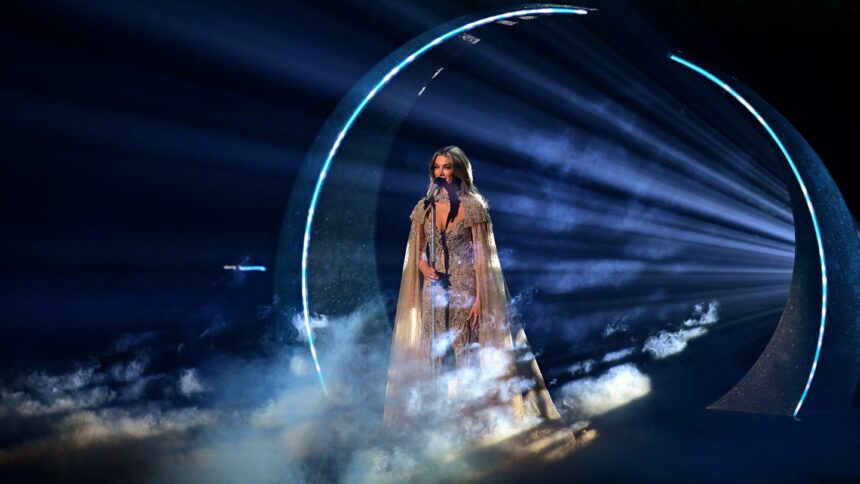
But the biggest winner on the night was Australia, which after flying under the radar emerged as front-runners in the betting markets, falling to third place after a strong showing on Thursday. Delta Goodrem’s soaring pop song “Eclipse” will attempt to give Downunder its first ever win since joining Eurovision in 2015.
Not every country has had such good luck. Latvia, which won in 2002 with Mari N.’s “I Wanna”, failed to make the cut because Atvara’s melancholy single “Ena” did not make the list.
While on the bubble to get through the semi-finals with the Contrarians, Swiss Veronica Fusaro gave a powerful performance with her bluesy, fireworks-filled song “Alice,” but she was unable to get over the hump with the jurors and broadcasters. The country will not repeat its feat of two years ago, when Nemo’s poignant transgender anthem “The Code” came in at number one.
Perhaps the most notable omission – or at least the greatest evidence of the contest’s disconnect from the US pop scene – came in Luxembourg. “Mother Nature,” an English-language top-forty number from 20-year-old Eva Maria, somehow didn’t sway European voters and juries. The small, landlocked country once dominated the Eurovision competition, winning it five times in the 1960s and early 1970s. After refusing to participate for 30 years, Luxembourg returns in 2024 but is still searching for its first top-10 finish.
The top two contenders for the betting ahead of Australia and Denmark had already qualified for the semi-finals on Tuesday. Finland takes first place thanks to the tormented love song “Liekinheitin” by Linda Lambinius and Piet Parkkonen. And Greece sits right behind her with “Vertu,” a nonsense ode by rapper Akilas about the good life while dressed as a tiger.
Israel currently rounds out the top five with “Michelle,” French-Israeli-French singer Noam Bitan’s trilingual tribute to a lady with a very rhyming title. But even with the intense competition ahead, the country has become the subject of intense interest.
Israel placed second in last year’s Eurovision contest, and the nation is likely to compete strongly again, with its entry featuring a charismatic artist singing a feel-good love song, while the European Israeli diaspora and their allies whip out their phones in support. However, comparisons to 2025 may be inaccurate: last year’s Israeli performer was Yuval Rafael, a survivor of the Nova massacre, singing “A New Day Will Rise,” giving the performance a theme of resilience that Bittan can’t match.
Israel is a surprising force in Eurovision – one of only seven countries to have won the contest at least four times, with its last win coming in 2018.
The final will take place on Saturday night in Vienna with melisma, wailing, crescendos and gunfire expected outside the theater for no reason at all.