Countless exceptional films have been made in which voyeurism – whether practiced by the protagonist or the audience – is an important element. Think Hitchcock Rear windowPolanski TenantHaneke cacheCoppola Conversation And Powell Peeping Tom For starters, or at the cooler end of the spectrum, De Palma The body is double and Dressed to kill. Asghar Farhadi is elegant but frustrated Parallel stories (Parallel histories) treats voyeurism as a starting point for thinking about the uneasy relationship between fact and fiction. But the movie keeps spinning around, with the pull diminishing.
The director and his writer brother Saeed Farhadi based their script loosely on the sixth chapter of Krzysztof Kieślowski’s great 10-part project for Polish television, Decaloguean episode that was expanded to include its full length and released theatrically in 1988 as A short film about love. Spanning 86 minutes, this masterful work of storytelling follows the love of a young, isolated Warsaw post office employee for a beautiful promiscuous woman who lives in an apartment directly across the street, whom he watches every night through a telescope.
Parallel stories
Bottom line An interesting premise becomes convoluted and boring.
place: Cannes Film Festival (Competition)
He slanders: Isabelle Huppert, Virginie Evera, Vincent Cassel, Pierre Nini, Adam Bessa, India Hair, Catherine Deneuve.
exitAsghar Farhadi
ScreenwritersAsghar Farhadi, Saeed Farhadi, free on basis Decalog 6
2 hours and 20 minutes
In a lethargic two-hour-and-20-minute film, the Farhadi family retains only the musical settings and composer Zbigniew Presner’s precise but achingly sentimental score. However, even that wonderful score can’t extract much emotion from this severely underpowered film, which feels more like a full-bodied live-action story than a bloated scholarship assignment in metafictional writing.
Oscar-winning director separation and SellerAsghar Farhadi is an international artist who has put his distinctive stamp on the moral melodrama of marital and family conflict.
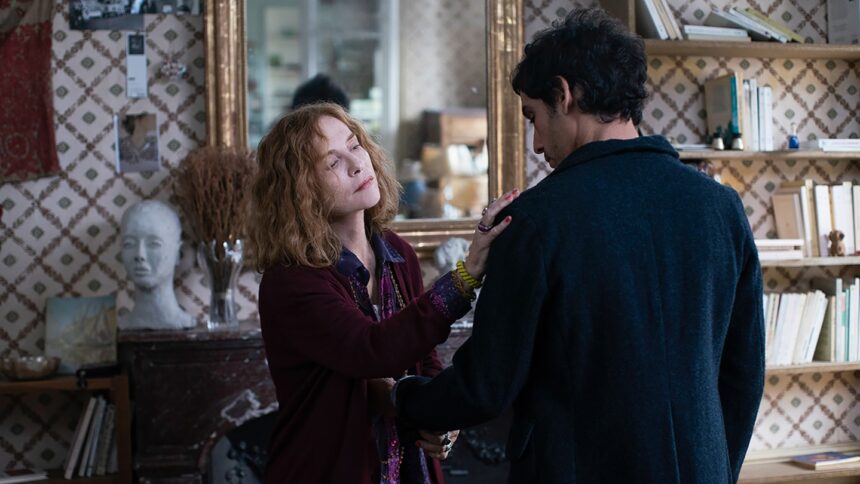
His new film reaches for psychological complexity, but after an intriguing start, it stumbles into an overly convoluted plot as it follows the escalating entanglements of perverted novelist Sylvie (Isabelle Huppert), who draws inspiration for her next book by training a telescope on the domineering beauty who works in a Parisian apartment across the street. In her fictional setup, Sylvie names the woman Anna (Virginie Efira) after her late mother.
The problem is that all the different threads – the parallel stories – weaken our access to the characters, and limit their dimensions. One of the many strengths of Kieślowski’s film is its tight focus on just two people, the viewer and the watched, with two secondary characters hovering around the edges. When the voyeur and his subject begin to interact physically, there is a slight suspense, a hint of danger and a fatalistic romantic undercurrent fueled by their growing mutual curiosity. Before evolving into the more dream-like poetry of his later successes, The Double Life of Veronique and Three colors triple, Decalogue Revealing that Kieślowski is an impeccable craftsman in the fine art of narrative distillation.
Two or three more drafts of distillation is exactly what is impractical Parallel stories It could have been used. Sylvie is set up as the fulcrum of the story, but that role is largely usurped by Adam (Adam Bessa), a homeless young man hired by novelist Celine’s niece (India Hair) to help pack up the apartment they own and prepare it for sale. Sylvie is as irritable and isolated with Adam as she is with her niece. Her single-minded focus on her work has allowed the place to become hopelessly messy and dirty, and Sylvie has no interest in doing anything about it.
The most interesting new element that Farhadi introduces is the focus on sound, something that long-distance voyeurism often misses. Anna works as an old-fashioned analogue artist, alongside a handsome young man the author calls Christophe (Pierre Nini), adding sound effects ranging from a squeaking mattress to footsteps on the sand to the gentle flapping of a bird’s wings. The sound engineer at the mixing unit is named Pierre (Vincent Cassel).
In Sylvie’s story, Kristoff madly misses Anna, even though she keeps pushing him away. But she occasionally gives in to the entreaties of the married Pierre, with whom she seems to have a history. This romantic triangle is as delicious as a weeknight baguette.
When Adam sneaks off to read Sylvie’s pages, he becomes obsessed with Anna, orchestrating ways to continue meeting her and starting conversations. He also begins writing his own version of the story, which inevitably falls into Anna’s hands, and learns their real names. Efira’s character is Nita, while Cassel and Nene are Nicholas and Theo, two brothers who are not immune to sibling rivalry. When Theo/Kristoff notices Adam’s interest in Netta/Anna, he reacts with hostility in a great melee scene on a subway platform.
But mostly, the tangled threads just sit there, never coming together in any satisfying way or holding on to their own story within the story, despite how hard the writers work to show that reality can inspire fiction but that fiction can also bounce back to influence reality.
Just to make things even more chaotic and over-planned, Sylvie notices a light on for five straight days in an upstairs apartment, and reports her concern to the cops that the old man who lives there might be dead.
Certainly this old man had once been the dashing young lover of Sylvie’s mother, and when seeing them together through the window across the street proved too much for her father, he made a suicidal leap from the balcony, in full view of his wife. Her screams still haunt the building, according to some, which explains the faint sounds of a sad woman that Pierre had been picking up on his headphones earlier. This may seem like a stretch for Sylvie’s novel, but by then, I’d stopped really caring.
Parallel stories The film has Farhadi’s signature polish, and DP Guillaume Deffontaines, who has worked frequently with Bruno Dumont, beautifully lights the interiors, adding subtle golden tones to the fantasy scenes. Of course, having such a magnetic cast is a big plus as well, with particularly strong work from Efira in dual roles. Catherine Deneuve appears in one scene (barely more than a brief cameo) to bring some arrogance back to Hubert, playing Sylvie’s publisher and not bothering to hide how bored she is by the new novel’s outline. Girl I feel you!
Plans are said to be in early development for all ten Decalogue Chapters (revolving around the Ten Commandments) will be reworked. Let’s hope the level improves.