NEW DELHI – The Indian economy registered 7.8% growth in the January-March period, as strong investment, sustainable agricultural production and expansion in the construction and services sectors led to strong demand, offsetting the expected negative impact of conflict in West Asia.Data released by the National Statistical Office (NSO) on Friday with a revised base year of 2022-23 estimates 2025-26 growth at 7.7%, compared to 7.6% in the second advance estimate released in February. This is relatively higher than the 7.1% growth recorded in FY 2024-25.The economy grew by 8% in the December quarter, and 7% during the period from January to March 2025.“Our government, led by Prime Minister Narendra Modi, is committed to continuing to drive “rapid reform” by taking decisive policy measures to ensure positive economic momentum amid global challenges.” External Affairs Minister Nirmala Sitharaman said in a social media post.Earlier on Friday, the Reserve Bank of India cut its FY27 GDP forecast to 6.6% from 6.9% estimated in April, citing rising energy and other commodity prices, as well as continued supply disruptions caused by conflict in West Asia, which are likely to weigh on economic activity. It also raised inflation expectations in the retail sector for the period 2025-2026 to 5.1% from 4.6%.Manufacturing sector growth in the fourth quarter moderates to 7.3%“Our government, led by Prime Minister Narendra Modi, is committed to continuing to drive ‘rapid reform’ through decisive policy measures to ensure positive economic momentum amid global challenges,” Foreign Minister Nirmala Sitharaman said in a social media post.
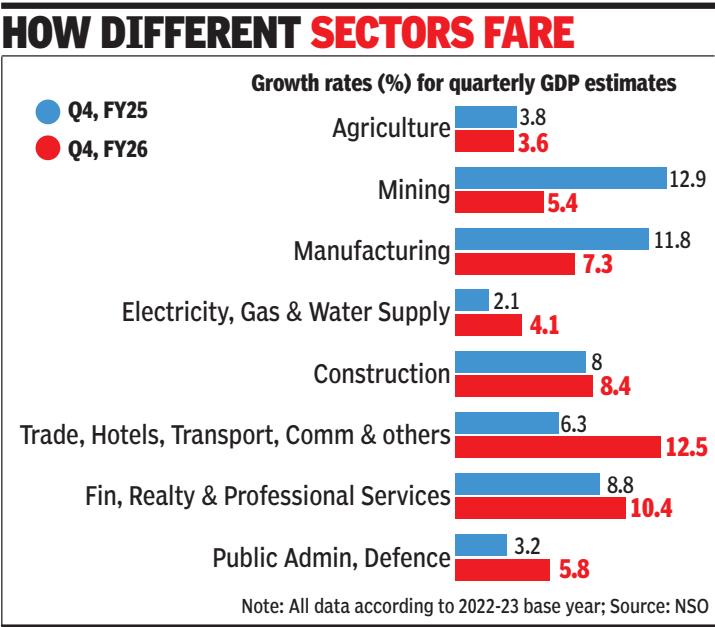
The data showed that gross value added, which excludes volatile components such as indirect taxes and government subsidies, grew by 7.9% during the fourth quarter compared to 7.1% in the corresponding quarter of 2024-2025. The data showed that among the tertiary sector – trade, repair, hotels, transport and communications (12.5%) along with financial, real estate and professional services (10.4%) recorded double-digit growth. However, growth in the manufacturing sector (7.3%) declined during the quarter from 11.8% in the fourth quarter of 2024-25.
Production in the agricultural sector maintained its growth at 3.6%.
On the spending side, gross fixed capital formation (GFCF), which represents the level of investment activity in the economy, grew by 10.8% in the fourth quarter of 2025-2026 from 6.2% in the fourth quarter of 2024-2025. Likewise, spending on private final consumption rose by 7.1% compared to 5.6% in the previous year.CEA V Anantha Nageswaran said that with the upward momentum of retail inflation, nominal GDP growth in FY27 is expected to exceed Budget estimates. “Nominal GDP growth will be higher than the figure used by the budget estimates,” he said. He also added that even if growth falls below 7% this fiscal as RBI forecasts indicate, “macro stabilization measures and supply guarantees will get us back on the 7%-plus growth path in FY28 or once external conditions improve.”