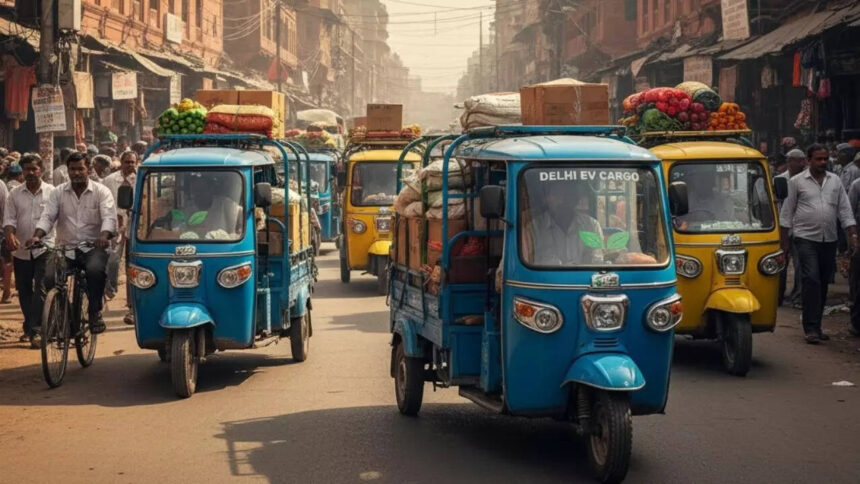

Image generated by artificial intelligence for representational purposes.
This article is written by Aayush Lohia, CEO, YOUDHA.India is currently on the verge of a mobility revolution. Not the kind that is powered by huge cars or expansive infrastructure, but the kind that is propelled silently and powerfully by small electric cars.
It is becoming more and more clear that compact, efficient and smart electric vehicles made for urban India will be the foundation of this prosperity as our nation emerges as the world’s fastest growing digital and delivery market.Over the past five years, India’s economy has grown dramatically, producing everything from food to medicines, and from groceries to tools. There has never been a greater need for fast, sustainable and economical travel as e-commerce settlements expand to Tier 2, Tier 3 and even rural areas.
And this is exactly where compact electric vehicles, especially electric three-wheelers, become true game-changers.
Why small electric vehicles are important for India’s new economy
India’s delivery ecosystem works differently than it does in places in the West. Streets are narrower, distances are shorter, and demand density is higher. Low operating costs, high uptime and ease of maneuvering are critical to the economics of fleet operators, gig workers and logistics aggregators.
This standard is ideal for small electric vehicles. They use less energy, reduce dependence on gasoline, and provide drivers with significant monthly savings, often up to 60-70% in operating costs compared to vehicles with internal combustion engines. Increased employment, higher wages, and improved last-mile efficiency all feed directly into this cost advantage.However, compact electric vehicles address India’s urban friction, which goes beyond economics.
Congestion, pollution, and unregulated flow of people and products plague cities today. Switching to small electric vehicles is the only sustainable course of action, not just a wise business move.
2026 Tata Punch review: Updated, upgraded and improved? | Toi Auto
Digital Economy EV Link
Whether the online order is worth INR 50 or INR 50,000, it all comes down to efficient last mile transportation. Additionally, mobility should grow at the same rate as India’s millions of daily deliveries and billion digital transactions every month.This is the booming new mobility economy, where digital infrastructure and mobility are intricately linked systems rather than distinct sectors.• Demand for mobility arises through digital commerce. • The quality of digital services is determined based on mobility efficiency. • Throughout the digital supply chain, sustainable mobility reduces environmental costs. These two worlds are connected by small electric vehicles.
A once-in-a-century opportunity for India
India’s population size, adoption of digital technology, and entrepreneurial workforce are unmatched by any other country. Delivery partners, electric vehicle fleet owners, and micro-entrepreneurs operating electric rickshaws are just a few examples of how the growth of small electric vehicles is creating previously unheard of income opportunities at the grassroots level. One well-made three-wheel electric rickshaw can enable:• In order for the driver to earn more money than using the alternative to gasoline, • Small fleet operator to create long term small business. and • The family achieves steady financial progress. This is mobility as economic progress as well as transportation.
Technology is at the heart of the growth of small electric vehicles
The adoption of electric vehicles is about creating a new architecture for mobility, not just replacing the motor with the battery. These days, small electric vehicles have real-time diagnostics, cloud-tied telemetry, Regenerative braking, IoT-based performance and safety monitoring, and efficient Li-ion battery solutions. This provides predictability and visibility to logistics companies.
This means less downtime and reliability for drivers. For India, it requires an integrated ecosystem where cars “talk” to transportation service providers, platforms, warehouses and charging stations.
Charging infrastructure: the next imperative
For small electric vehicles to properly drive India’s plug-in boom, the next wave of innovation will have to come from charging infrastructure. Instead of large public charging stations for cars, India needs small charging stations in the markets. • Rapid battery swap kiosks, batch-based charging for fleet operators, and regular workplace/home charging options. This infrastructure will increase fleet productivity and reduce operators’ cost per kilometre. As an industry, we must urgently work together to build this backbone.
India is cleaner, quieter and more efficient
Small electric cars are not just an economic solution, they are a climate and public health solution. Every electric three-wheeler that replaces a diesel car reduces tailpipe emissions to zero and improves air quality in our most congested cities.
Noise levels decrease, creating quieter neighborhoods. Energy dependence is reduced, which enhances national efficiency.India’s urban areas could be transformed within a decade, not by mega-projects, but by millions of small electric vehicles that are quietly reshaping everyday transportation.Disclaimer: The views and opinions expressed in this article are solely those of the original author and do not represent any of the Times Group or its employees.