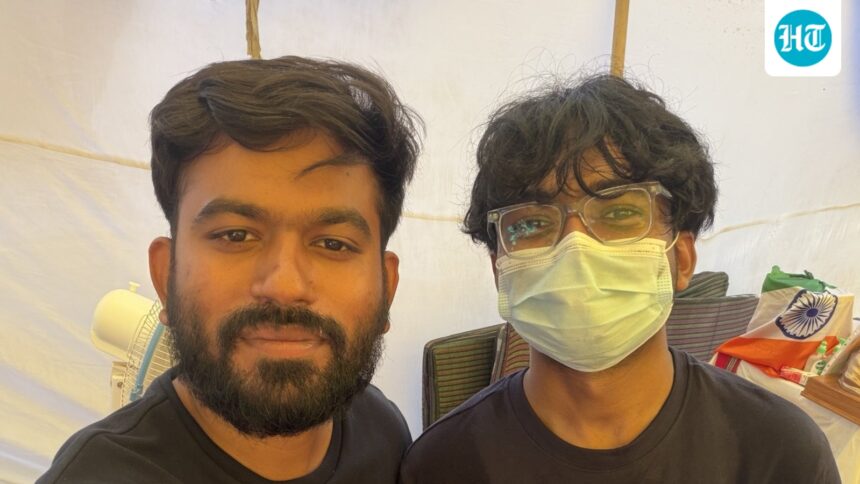
Nisarga Adhikary, the 19-year-old cybersecurity researcher whose revelations about CBSE’s on-screen marking (OSM) portal fueled a series of controversies this year over exams, on Friday joined the Cockroach Janata Party (CJP) protest at Delhi’s Jantar Mantar.
On X, he posted a photo with CJP founder Abhijit Debaki and Congress Party (SP) spokesperson Anish Gawande. “The energy here is really crazy,” he wrote.
His appearance prompted celebratory comments from fellow Gen Z protesters that “The hacker is here now!”.
This comes as the protest enters its seventh week, with a government delegation and APC representatives holding a new round of talks on Friday, and a stalemate over the demand for Education Minister Dharmendra Pradhan to resign.
From cracking CBSE to working for IIT
Adhikari said he began examining publicly accessible OSM code in February, flagging what he called the government agency’s encrypted “master password” CERT-In — as ethical hackers or whistleblowers would do.
He went public in May, saying the flaws allowed him to bypass the OTP or authentication step and access the examiner’s dashboard, where scores can be viewed and edited. CBSE’s initial response was that its screenshots came from the exam URL, separate from the live assessment portal; The board later said the identified vulnerabilities had been “contained.” These revelations brought him into the national spotlight, and in interviews he explained what he had done, never revealing his face. He wore a mask at the CJP site as well.
Director of IIT Kanpur, Manindra Agrawal, after reading Adhikary’s blog post, brought him to C3iHub, the institute’s cybersecurity centre, as a threat intelligence engineer, under a contractual appointment. Adhikari described the salary as “decent” but less than what he earned in dollars freelancing for American clients.
He even publicly sparred with Agrawal over the government’s ban on Telegrammessing app ahead of the NEET-UG re-exam, arguing that it was targeting the wrong issue.
How an OSM class turned into a NEET rage
The OSM controversy occurred as Union Education Minister Dharmendra Pradhan was already under fire over NEET-UG papers leak.
The CJP itself began as a satirical reaction on social media – founded and named after some comments made by India’s Supreme Court Chief Justice Surya Kant in May – before evolving into a street movement. It has been organizing the Jantar Mantar protest since June 20, demanding Pradhan’s resignation and wider reforms in the examination system.
Activist Sonam Wangchuk’s hunger strike, which began on June 28, escalated nationwide unrest, attracting declared support from the TMC, the KDP, and the National Progressive Party (SP), as well as Congress and others on a parallel track.
Since then, the government has replaced top CBSE officials, and changed the Union Education Minister this week as well.
One of three teenagers, Rahul praised them
Nisarga Adhikary was one of three teenagers at the center of the CBSE controversy, along with Vedant Shrivastava, who received a mismatched answer sheet, and Sarthak Sidhant, who investigated the CBSE tender process and collaborated with Adhikary online.
Congress leader Rahul Gandhi met Shrivastava and Siddhant personally and shared their accounts on X, crediting them with exposing what major media houses did not. Adhikari was also praised in the same post as Siddhant’s ‘assistant’.
Conversations continue, and the picture remains fluid
As for the CJP and its demands, Friday’s meeting between Union ministers JP Nadda and Jitendra Singh and CJP spokespersons Sourav Das and Ashutosh Ranka lasted for nearly two hours. This is the second direct clash between the two sides this week.
Then there were different accounts from both sides about what was talked about and agreed upon. The CJP said the government has not yet agreed to the resignation request, although two other demands have received “agreement in principle.”
Meanwhile, Prime Minister Narendra Modi promised speedy courts and tougher penalties for paper leaking crimes.