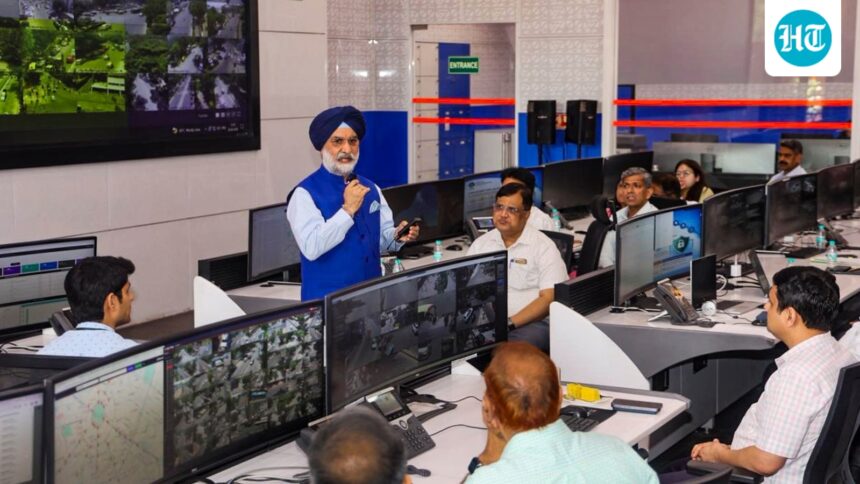
When COVID-19 struck, the Integrated Command and Control Center in Jabalpur, like the centers in many of India’s 100 smart cities, became the operational lifeline of the city. It was repurposed as the District Covid Command Center, tracking cases in real time, coordinating between departments and handling citizen distress calls. During the vaccination campaign, the same digital backbone supported the rollout efforts.
The ICC also commissioned Jabalpur’s Intelligent Traffic Management System (ITMS), detecting red light violations and other traffic violations through cameras installed under a joint Madhya Pradesh government project covering Bhopal, Gwalior, Jabalpur and Ujjain.
Read more: Madhya Pradesh bans foreign trips for officials to cut costs
Sixteen months after the Smart Cities Mission (SCM) officially ended in March 2025 with central funding halted, the digital backbone is under severe pressure. The grievance redressal platform in Jabalpur has been experiencing frequent server issues. Its ITMS system remained closed for more than a year due to lack of funding. A temporary government grant has kept some operations alive, but officials say the money will likely run out by September. Technical staff who maintained 46,000 smart streetlights and other digital systems were laid off.
Nearly 1,600 kilometers away, the city of Shivamogga in Karnataka state faces a similar challenge. Its ICCC is designed as a digital nerve center for the city, integrating traffic management, GPS-based solid waste monitoring, RFID tracking of garbage vehicles, surveillance at waste collection points, smart water meters, sewer alerts, parking systems, LED street lights, police kiosks and smart classrooms.
Today, only the traffic management component remains in operation.
These cities reflect a broader trend. A review by HT based on interviews with officials from more than 10 smart cities across multiple states found that just over a year after the center completed its 10-year mission, the future of the international smart centers – arguably the largest technology legacy – is becoming increasingly uncertain.
What are ICCCs?
Built with part of the center $The Rs 48,000-crore Integrated Control Centers (ICCC) in 100 cities are designed as integrated command rooms that connect cameras, sensors and IoT devices on a single dashboard for traffic management, flood monitoring, waste management, grievance redressal and emergency response.
But keeping these systems running is expensive.
“It is estimated that simply running the command center costs approximately that $10 lakh every month, or approx $1.5 crores annually. He risks turning into a white elephant. “Only the traffic control system is working while other components are gradually dying,” said a municipal official supervising the international traffic control center in Shivamogga.
In Jabalpur, Balindra Shukla, project officer at Jabalpur Smart City, said, “None of them have maintenance contracts for servers, firewalls, network routers and video walls anymore.” The five-year contract with the major systems integrator expires in August 2024 and there are no funds allocated for software upgrades, license renewals, camera maintenance or annual service contracts.
“We don’t even have money to clean the house or guard,” he said.
In Dehradun, CCTV cameras generated approx $40 crore worth of traffic challenges, but only in the neighbourhood $Rs 11 crore has been recovered, according to an official. The city demands now $Rs 16-17 crore annually just to maintain ICCC operations.
“Most of the devices were purchased in 2019 and will be obsolete within seven years. Without dedicated funding for software licenses and hardware replacement, the entire system — which hosts data for multiple departments and supports the Unified Civil Code Call Center — is at risk of shutting down,” the official said.
Officials in Shivamogga said their automated traffic enforcement system has been set up $Fines range between 45 and 50 crores, but none of this revenue is shared with the agency that maintains the infrastructure.
Read also | CHANDIGARH: Court rejects anticipatory bail application filed by MC accountant in smart city funds case
Financial pressures also led to an exodus of skilled employees. “Nearly 25 technically qualified employees who worked on the project have been laid off from the beginning. The municipal staff does not have the necessary experience to manage the disruptions,” an official associated with the Chhatrapati Sambhajinagar smart city project said. He added that delayed electricity payments had previously led to a power outage from the city’s surveillance camera network and traffic cameras.
Where it works and how
Rajkot, Vadodara, Bhopal, Ujjain and Chennai have developed different models to maintain their digital infrastructure.
Read also: Officials of the bank and management college in Bhopal have been booked for embezzling scholarships
Rajkot is expanding its ICC rather than shrinking it. “We are installing additional cameras equipped with analytics to better monitor implementation, mobility and municipal services,” said Chetan Nandani, CEO of Rajkot Smart City. The city is also consolidating servers into a central data facility to enhance cybersecurity while adding a central streetlight monitoring system.
Vadodara expects to remain financially self-sufficient until at least 2029 through smart pole partnerships, vendor sanctions and traffic enforcement revenues.
Bhopal relied on monetization of its 342-acre land bank to fund operations after central grants expired, although officials admitted that staff numbers had declined significantly.
In Chennai, the International Center for Climate Change has been absorbed into the main municipal administration and now functions as a primary center for disaster management and city monitoring rather than as a standalone smart city asset.
The role of the center is limited
The Union Ministry of Housing and Urban Affairs (MoHUA) did not respond to queries on the operational status of Integrated Communication Centers (ICCCs) across 100 smart cities. A ministry official said the center knows that all cities are still operating “at some level” but lacks consolidated data to assess the extent of operations.
The official said that no smart city has achieved financial self-sufficiency because recurring expenses on electricity, data storage and software and hardware replacement remain significant.
According to the official, the center’s role is currently limited to issuing warnings encouraging countries to share revenues generated through smart infrastructure and conducting workshops.
For many cities, the challenge is no longer building digital infrastructure, but finding a way to keep it alive.