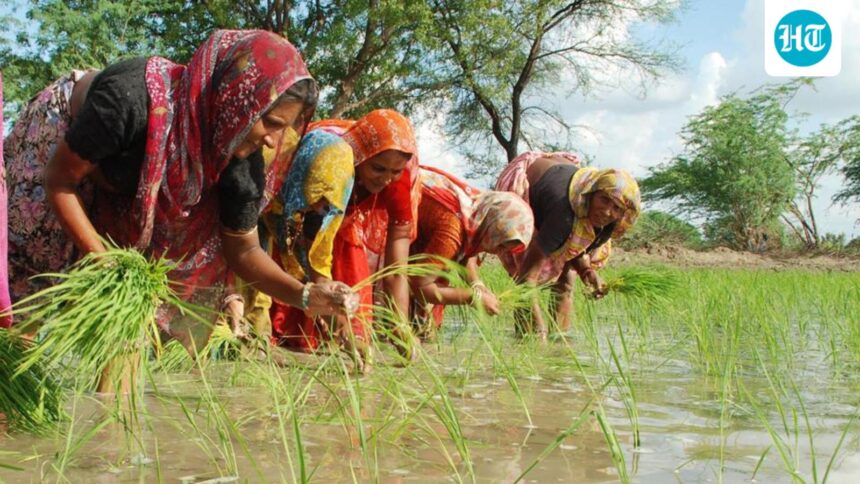
Crop cultivation in the current kharif season has rebounded modestly over the past week, driven by strong monsoon winds in parts of the country. The data showed that the weekly space deficit shrank to 20.8% as of July 5.

The corresponding figure for last week was 22.7%. Experts expect the planting process to accelerate further during the week, even as the India Meteorological Department (IMD) expects rainfall in key growing areas over the next five days.
Data from the Ministry of Agriculture showed that as of July 5, the kharif crop occupied 44.3 million hectares of arable land. The delayed onset of the southwest monsoon and uneven progress across the country has slowed planting early in the season. The area under all major kharif crops, including rice, pulses, coarse grains, oilseeds and cotton, remained below last year’s levels. The area cultivated with rice recorded a decrease of 13%, reaching 6 million hectares. Oilseed cultivation recorded the largest decline of 40%, with 6 million hectares cultivated. Soybean, India’s largest oilseed crop, was responsible for most of this decline, with the amount of seed planted falling by almost 40% to 4.8 million hectares.
Economist Ramesh Chand noted that crops with high irrigation coverage, such as rice, recorded smaller declines, while largely rain-fed crops such as soybeans and legumes were hit more severely. “About three-quarters of the area planted with rice is irrigated, compared to only 9% for soybeans,” he said. “The area planted figures reflect this difference. The same relationship applies to legumes.” The legume crop recorded a decrease of 22% compared to last year.
Although the IMD expects July rainfall to be 94% of the long-period average, experts said the timing and spatial distribution of rainfall will be more important for crop planting than the monthly total.
“So far, about 340 districts are rain deficient, while 64 districts are significantly deficient (below 60 to 99% LPA). For many crops, what is needed is a round of rain that can bring moisture to the soil before planting, and then some intermittent rain. Even those areas that are still rain deficient will do well as a result. With about another week of rain to go, I also expect many of the 64 large districts to be covered, which will continue,” the former agriculture minister said. Devesh Chaturvedi: “It provides an opportunity to compensate for delays in cultivation.”
The cotton crop also recorded a 23% decrease in the cultivated area. The area cultivated with sugarcane increased by 1.5% to reach 5.8 million hectares.
This June was the fifth driest month in more than a century in India, with an average rainfall of just 99.5 mm. The driest June on record was in 2009. However, the monsoon rebounded in July, with the country’s rainfall deficit narrowing to about 20% of the long-period average as of 6 July.