
NEW DELHI: Most of the talk about artificial intelligence has been about the jobs it could disrupt. What technology has also sparked, and less obviously, is an unprecedented rise in demand for some skilled human talent.
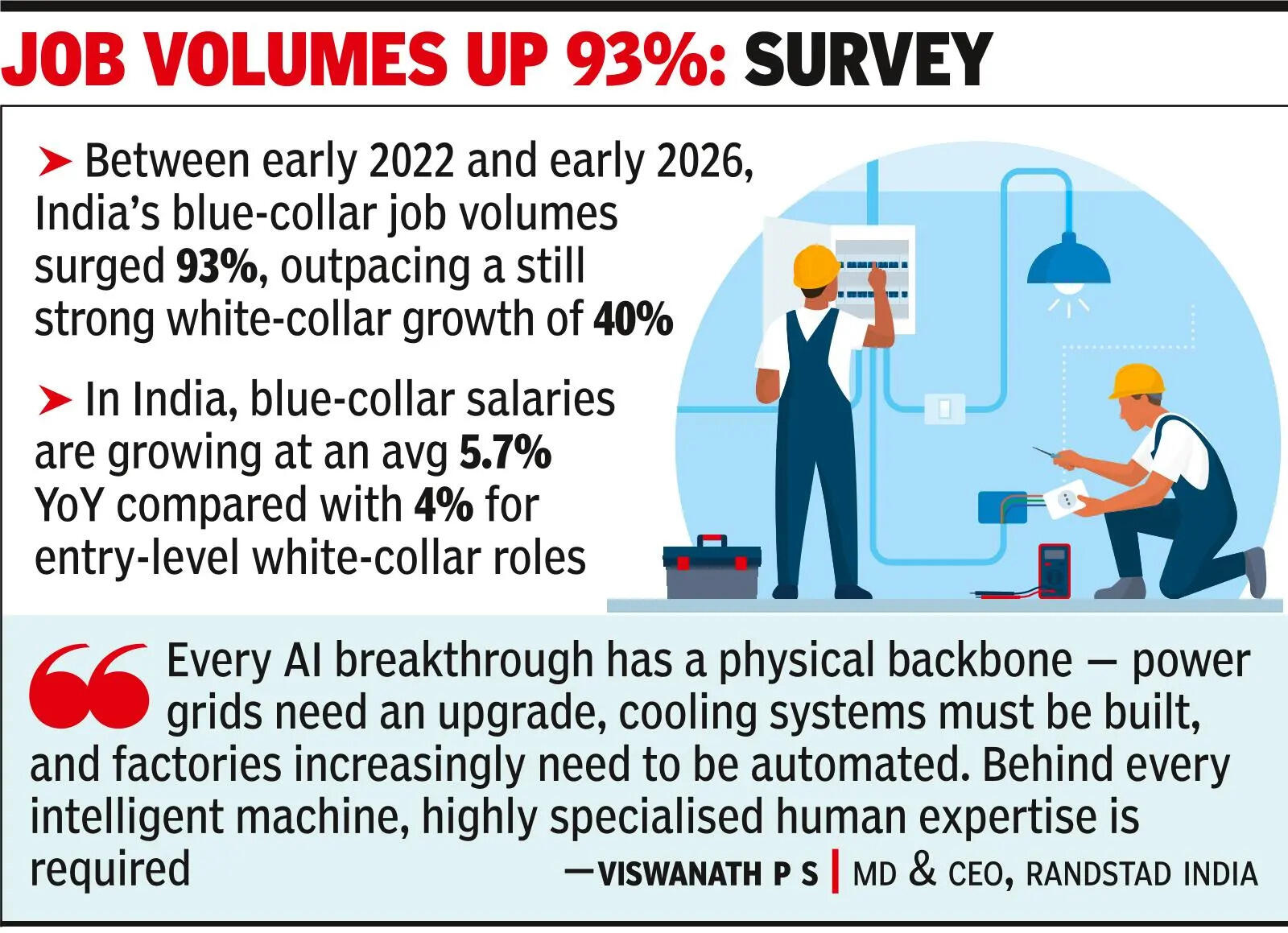
An analysis by talent firm Randstad of over 50 million job openings, shared exclusively with TOI, shows that demand in India has skyrocketed for electricians by 242%, HVAC technicians by 200%, and robotics technicians by more than 500%, in four years.“Every AI breakthrough has a physical backbone – power grids need to be upgraded, cooling systems need to be built, and factories increasingly need to be automated. Behind every intelligent machine, highly specialized human expertise is needed,” said Viswanath PS, MD and CEO, Randstad India.
He described this as a clear “labor fluctuation” and said that skilled technical trades were outperforming traditional entry-level professional roles.Skilled workers, classified as a blue-collar workforce, are those who hold an official certificate, diploma, or degree from a reputable institute, such as a certified welder or electrician.According to the analysis, the increase in demand for skilled trades is also reshaping compensation structures while narrowing the salary gap between skilled workers and entry-level managerial employees.
In India, average salaries for administrative staff increased by 5.7% year-on-year compared to 4% for entry-level administrative staff positions, the analysis said.The average blue collar salary here is $2,612, but some specialized roles can demand much more. For example, the annual wage in India for mechanics working in robotics and specialized maintenance is $9,106, while plant and machinery operators earn $7,815 and construction workers earn $5,420.
Electricians, which include HVAC installation/extension, are paid $3,296.In contrast, for basic white-collar jobs such as data entry operators and entry-level accounting roles, the bonus is about $2,711. Some of these roles are increasingly affected by automation and artificial intelligence.At the same time, employment trends also reflect this shift. The analysis says that the volume of labor jobs in India has risen by a staggering 93% in four years between 2022 and 2026, which is linked to the development of infrastructure and basic pillars related to artificial intelligence.
Interestingly, India represents a unique market with double-digit growth. “Unlike major Western economies that have seen sharp contractions in white-collar work, India’s labor market is expanding across the board.
“White collar jobs have also shown strong momentum, growing by over 40%,” says Viswanath.He added: “Some GCC countries are currently creating entry-level opportunities, such as payroll specialist roles. However, it remains to be seen how long these jobs will last in an AI-driven environment.”