Computer: Facebook (Ministry of Tourism and Antiquities)
Ancient stones rarely behaved like fixed objects in Egypt. In Luxor’s Karnak Temples, walls and gates tend to reappear in unexpected shapes, as if the past had been repeatedly folded and stitched together by different hands over the centuries.
Recent work north of the temple complex has done just that, revealing a portal associated with Ramesses III that had been buried in splinters and overgrowth for generations. What began as a meticulous restoration project has quietly transformed into something more layered, with hints of a Roman-era presence emerging beneath the sand. Among them is a carved stone tablet connected to the Emperor Tiberius, raising new questions about how sacred space was reused, rewritten and reimagined over time in ancient Egypt.
The Karnak Project in Egypt reveals hidden stone layers beneath the northern gate of Emperor Ramesses III
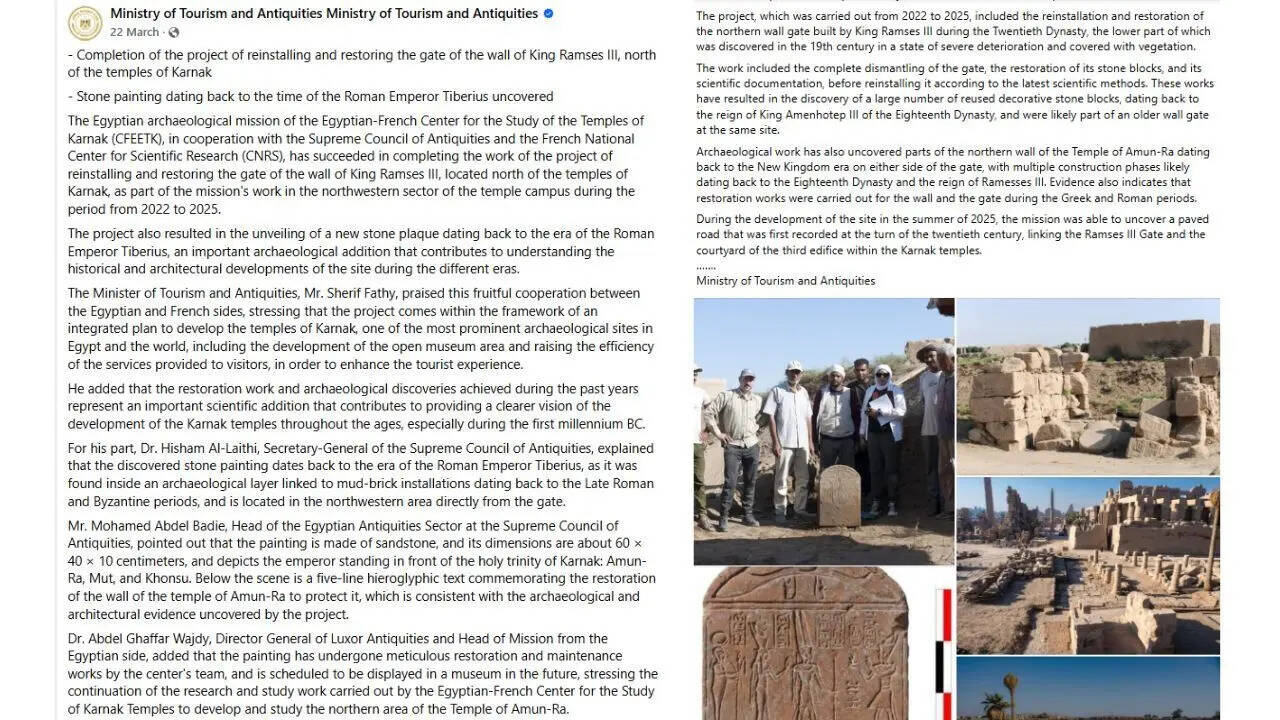
The northern wall gate associated with Ramesses III did not have an easy history. Built during the Twentieth Dynasty, it is said to have suffered extensive damage long before modern restoration began, as its lower sections were partially exposed and unstable when first documented in the 19th century. Plants took over, the stone blocks changed, and much of their original form is no longer readable in the landscape.According to a Facebook post by the Ministry of Tourism and Antiquities, between 2022 and 2025, an Egyptian-French archaeological team working inside the Karnak Temples undertook a slow reconstruction effort.
One by one, the blocks were dismantled, cleaned, recorded, and reassembled with scientific precision rather than guesswork. The goal was not to recreate a romantic version of the past, but rather to stabilize what remained and understand what the structure originally looked like.What makes the process unusual is what emerged during disassembly. Numerous reused stones, some bearing decorative elements from the reign of Amenhotep III, were incorporated within the later structure.
This suggests that the gate itself may have been built using materials from earlier ruins, turning the site into a kind of architectural archive housing layers from earlier dynasties.
Facebook (Ministry of Tourism and Antiquities)
What did the excavations of the North Karnak Wall reveal?
As work expanded around the gate, attention turned to the northern wall surrounding the Temple of Amun-Ra. Here, archaeologists seem to have encountered construction phases that do not belong to a single moment in time. Instead, the construction indicates repeated rebuilding, extending from the New Kingdom to the later Greek and Roman periods.A paved road was also identified during recent fieldwork, a road that had been partially recorded in surveys conducted in the early twentieth century but not fully understood. It connects the Gate of Ramesses III to a main court deeper within the Karnak complex, suggesting that movement through this part of the temple was more organized than previously assumed.Mudbrick constructions from later antiquity are located within the same area, adding another layer of occupation.
The picture that emerges is not a fixed sacred boundary, but rather a functioning religious landscape that continued to develop long after its original daughters had departed. Experts suggest that the area may have been repeatedly reused as political control shifted, especially during the Roman and Byzantine eras.
The Roman Emperor appears in the form of an Egyptian Pharaoh in Karnak Temple
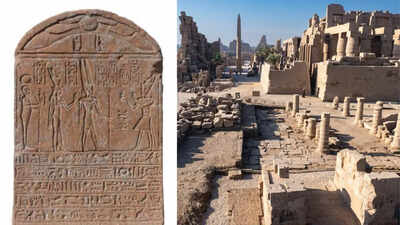
According to what the Ministry of Tourism and Antiquities posted on Facebook, the most surprising discovery is a sandstone plaque associated with Emperor Tiberius, measuring about 60 x 40 cm.
They were discovered during restoration work near the gate, and are located within an archaeological layer associated with later settlements.The sculpture shows the Roman Emperor displayed in traditional pharaonic style, standing before the Theban triad of Amun-Ra, Mut, and Khonsu. Instead of appearing as a foreign ruler, he is shown participating in a familiar religious act, offering recognition to the divine order of the temple.This visual language was not unusual in Roman Egypt. Emperors were often adapted to Egyptian religious frameworks when depicted in temples, even if their political identity remained Roman elsewhere. The stela also contains a short hieroglyphic inscription indicating restoration work on the temple structures, suggesting that it may have served as a memorial marker rather than just a purely decorative piece.Its presence within the Karnak complex indicates how Roman authority was absorbed into existing religious systems rather than directly replacing it. The images seem designed to align imperial power with local belief structures, and promote legitimacy through ritual rather than conquest alone.