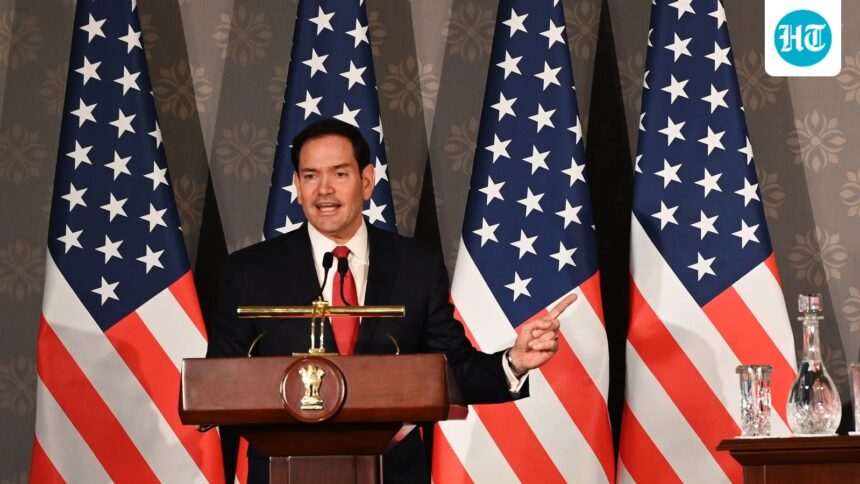
Speaking about the recent changes made to green card and visa policies as part of US President Donald Trump’s anti-immigration campaign, Secretary of State Marco Rubio said the reforms were not “targeted at India”.

The top US diplomat added, at a press conference in New Delhi, that the changes were made to “modernize the immigration system.”
“I accept the contribution that Indians have made to the American economy. Indian companies have invested more than $20 billion in the American economy. And we want that number to continue to increase… The changes that are happening now, or the modernization of our immigration system to the United States, are not specific to India,” Rubio said.
The foreign minister’s remarks also come after US President Donald Trump recently retweeted a social media post calling India a “hell hole.”
Read also | “Every country has stupid people”: A tense exchange between the American Rubio on the question of “racist statements” in a press meeting in Delhi
Rubio described immigration reform as “long overdue” and added that the system must be modified to fit the realities of the times in which she lives, after sharing the example of his parents who moved from Cuba to the United States and became permanent residents.
The US diplomat also said that any major changes, especially during the transition period, will cause some “points of friction”, adding that the changes are not targeting India, but are being implemented globally.
“But we are in a transition period, and like any transition period, there will be some bumps along the way,” Rubio said. “But we believe ultimately our destination will be a better system, a more efficient system, a system that works better than the system we had before and is more sustainable, by the way.”
Jaishankar raises visa concerns with Rubio
During the press conference in New Delhi, External Affairs Minister S Jaishankar said that visa concerns and issues faced by Indian travelers were raised in a meeting with Rubio.
“People-to-people ties are at the core of the (India-US) relationship. I briefed Secretary Rubio on the challenges faced by legitimate travelers regarding visa issuance,” Jaishankar said.
“While we cooperate to address illegal and irregular mobility, we expect that legal mobility will not be negatively affected as a result. Ultimately, this is very important for our cooperation in business, technology and research,” EAM added.
Read also | India raises concerns over US visa and immigration policies with Rubio
The United States reforms its green card and visa system
In the latest change, Washington announced that foreigners seeking a US green card will be required to apply from their home countries.
“From now on, an alien who is in the United States temporarily and wants to obtain a green card must return to his home country to apply, except in exceptional circumstances,” Zach Kahler, a spokesman for USCIS, said in a statement on Friday.
The new rules will apply to any alien who came to the United States on a temporary nonimmigrant visa, including students, employees on H-1B or L visas, and visitors.
Other changes made by the Trump administration include screening social media platforms for F, M, and J student/exchange visas, and H-1B and H-4 work visas.
Another major change was Trump’s presidential proclamation raising the fee for H-1b visa petitions to $100,000. Fees will apply to new applicants and sponsoring employers.
Furthermore, USCIS also announced an increase in premium processing fees for immigration benefits, which took effect in March of this year.
The premium processing fee, which allows applicants to get faster decisions on some work- and employment-related visas, has been increased from $2,805 to $2,965.