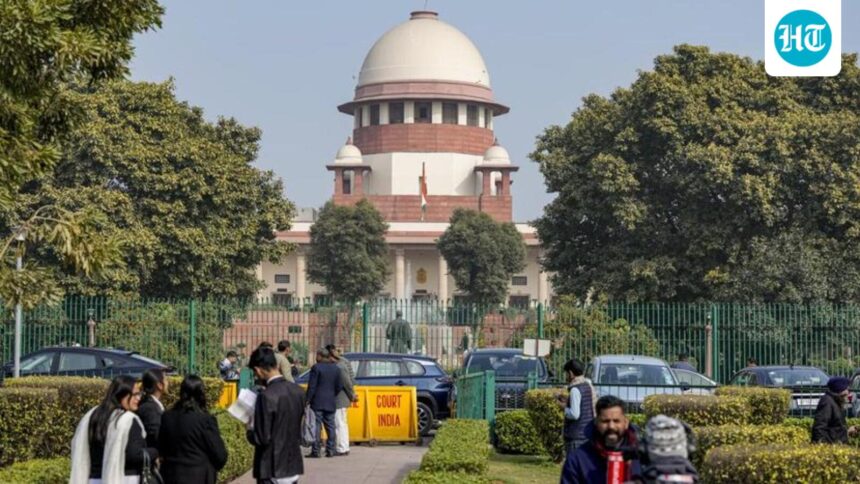
The Supreme Court on Wednesday refused to stay proceedings in the high-stakes Krishna Godavari (KG) Basin gas migration dispute between the Center and the Reliance Industries Ltd (RIL)-led consortium, even as the consortium informed the court that it intends to approach the Union government seeking conciliation or mediation in the matter.

After RIL’s legal team mentioned the matter before Chief Justice of India Surya Kant, the CJI said the hearing will continue unless both sides jointly inform the court that a decision has been reached.
The development came a day after the Center accused the consortium of committing a “theft” of state-run Oil and Natural Gas Corporation (ONGC)’s natural gas from adjacent offshore fields in the KG Basin off the coast of Andhra Pradesh.
The hearing began before a bench comprising the ICJ and Justices Joymalia Bagchi and Vipul M Pancholi.
“The petitioners will today approach the government…the petitioners will write to the central government to try for conciliation or mediation. This is an ongoing contract and we are still in a contractual relationship with them,” the consortium’s counsel, including advocates Sameer Parikh and Mahesh Agarwal, told the court.
Attorney General R Venkataramani, who represented the Centre, opposed any stay of proceedings and urged the court to continue hearing the appeals.
“Let us continue the session, my lords. If there is any further development in the meantime, we can always report it to the court. Why should the session be suspended?” The Attorney General submitted.
The Commission agreed with the Centre’s position.
The ICJ initially noted that “both parties must agree,” before adding: “Both parties must come to us and say there is a solution, and then we will dispose of the matter immediately. The petitioners have already begun. We can stop the hearing as soon as both parties tell us it is resolved… Let us listen and we can record that there is an attempt at mediation.”
The dispute centers on allegations that natural gas from ONGC’s offshore blocks moved to the adjacent KG-D6 block operated by the RIL-led consortium and was subsequently extracted between 2009 and 2013.
The Center on Tuesday alleged in court that the consortium illegally benefited from gas originating from ONGC’s fields. Addressing the court, Venkataramani said the consortium was responsible for extracting the gas that had naturally migrated across the reservoir boundary under the seabed.
“There were two blocks. ONGC had a block, and they had a block. The gas migrated. You practically committed the theft of my gas and you are responsible for that,” the prosecutor said.
However, the consortium strongly denied this claim, arguing that the migration of hydrocarbons through aquifers was a natural geological phenomenon that could not be prevented by artificial means.
Senior advocate Abhishek Manu Singhvi, appearing on behalf of the consortium, argued that the extraction could not be termed as deliberate extraction or theft.
“When you extract through a natural compression process, from the nearby offshore mass, some oil will always flow and migrate. This has nothing to do with voluntariness, deliberation, or intent. This becomes a concern for them to add to what they call stolen gas. There is nothing, it is a compression movement,” Singhvi said.
The lawsuit arises out of a production sharing contract entered into in 2000 between the Center and the RIL-led consortium to explore and extract natural gas in the KG Basin. Commercial production from the KG-D6 block adjacent to ONGC’s fields began in April 2009.
Meanwhile, RIL held a 60% participating stake in the block, while BP Plc and Niko Resources held 30% and 10% stakes, respectively.
This controversy came to light in 2013 when ONGC alleged that the consortium drilled wells close to border areas and extracted gas migrating from ONGC’s neighboring blocks, leading to what it described as “unfair enrichment”.
The Union government later sought to undo the gains from the consortium, demanding nearly $1.5 billion plus nearly $174 million in interest.
The consortium resorted to arbitration under the production sharing contract. In July 2018, an arbitration panel ruled in favor of the consortium, holding that the contract did not prohibit the extraction and sale of gas that had naturally migrated from nearby reservoirs.
While a single judge of the Delhi High Court upheld the arbitration award in May 2024, the bench on February 14, 2025 set aside the award and set aside the award, holding that it was inconsistent with well-established principles of law. The consortium appealed this ruling before the Supreme Court.