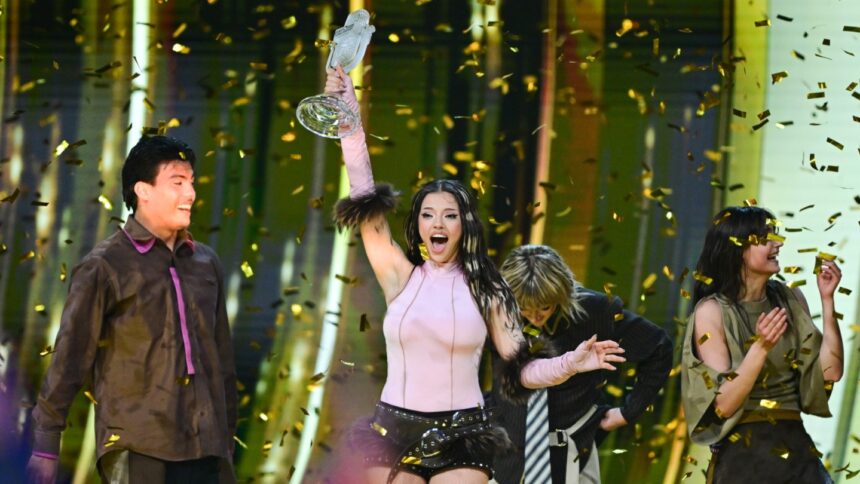
If nothing else, amid all the political storm and drift, Eurovision has been a stunning television success this year. Groups of characters, each with their own backstories, motivations, and aspirations, all collide in one place, after the thing that only one of them can have.
These dynamics have characterized modern entertainment from Traitors to game of thronesplaying them on Alan Cumming’s home streaming channel Peacock, with maximum musical showmanship and pyrotechnics, couldn’t help but leave viewers awestruck. (If you haven’t watched, you’re missing out.) That all the characters were countries forced further. A character far from Europe who never triumphed (Australia), against a character who, depending on your politics, stood as either a villain or a hero (Israel), against characters who don’t even exist because of an alleged evil hero (five boycotting countries), against a brave forgotten character that many couldn’t find on a map (Bulgaria). When the evil hero rose to the lead on the non-European coins, only to be overtaken at the last second by the fearless Forgotten One (who was trying to start a dance craze), you couldn’t turn away. It’s not for nothing that 160 million people tuned in, at a time when most shows couldn’t get a million people.
Reducing complex nations largely to single characters has been an enduring television tradition, dating back decades, from the Olympics and World Cup to Cold War news broadcasts. Of course, cheering on countries without considering the people they occupy also poses a moral danger. But we still do it, by objectifying and highlighting deep-rooted concerns as if they were no big deal.
Only in this case, the risk might be exactly why we stop doing it. Eurovision is in trouble, at the moment we really need it.
Born out of the post-war quest for unity – of the idea that something as common as music would cause everyone to put everything else aside – the competition has succeeded, in fits and starts, in building consensus on a continent that had seen it fractured for too long. The first group of European countries that met in 1956 would slowly add members over the years, and each year the union and reunion grew stronger. The competition eventually culminated in the participation of 42 countries in post-Soviet and post-Amsterdam Treaty Europe in the 2000s. You can read Francis Fukuyama End of history. Or you can watch Eurovision and get the same effect. Thus the competition became widespread and intense.
But in the next two decades, much has changed in the world. As individual countries define themselves against their neighbors through movements such as Brexit, Grexit, and America First; As the dominant use of media shifts from education to anger; With far-right politicians routinely railing against the melting pot; With technology companies dividing us on social media rather than legacy companies uniting us on traditional media.
On the one hand, this makes Eurovision and its offbeat philosophy of unity through spandex all the more relevant. Watching Eurovision 2026, you can feel waves of much-needed humanity – from the Greek rapper coping with 20 years of economic hardship with a cynical yearning for the joyful life to the titillation of a Romanian S&M song (of course) to the universal sentiment brought by Israel’s Noam Bitan who alternately crooning and crying about a toxic love affair with a woman named Michelle. We’ve all been in a bad relationship that we couldn’t escape, and what do constructs like liberal and conservative mean at face value?

However, more often than not, competition did not heal wounds, but rather reminded us of them. The roll call of countries to announce their votes in the jury sounded less like a technical assessment and more like an ideological scorecard — “Who gives Israel the points? Who abstains? What about Ukraine?” When Israel came out on top, you could hear alternating cheers of support and jeers in Vienna Square. (Host broadcaster ORF, choosing Full Truth, decided not to use anti-booing technology.) When Israel rose to second place, then was overtaken by Bulgaria, comments on YouTube raised eyebrows. The lion kingMysterious place – you should never go there.
And then, of course, there was the boycott. Spain, Slovenia, Ireland, Iceland and the Netherlands decided not to participate because Israel participated. The European Broadcasting Union, which runs the competition, dodged a bullet when Israel finished second; Had the country won, it would have been scheduled to host next year, which certainly led to more boycotts. But even as the competition approaches in an uneasy Bulgaria, the boycotting countries are unlikely to change their stance; Israel will not voluntarily remove itself from the competition (will it?); The drama of the previous event will return again, and may lead to the financial decline of the entire event.
Bulgaria has been in the midst of a five-year political crisis, witnessed the rise of the far-right Ennahda party, and had just elected a pro-Putin government.
The demise of Eurovision would be unfortunate, but not a surprise. This is the end point of algorithmic anger, politics as sport, and anti-immigrant fears. The singing competition doesn’t stand a chance.
Organizers hold out some hope for a shift in continental politics towards more moderate voices that might tone down the contest and return the contest to glory – and point to the stunning downfall of far-right populist Viktor Orbán in Hungary in April, or even Israeli elections later this year that could (perhaps) move the country back to the centre. Of course, what happens when the next country goes through the cycle – if France elects a far-right government in 2027, or Nigel Farage’s UK Reform Party continues to rise in Britain? Who stays and who boycotts? Democracy is not a way to manage competition.
This point may have already been made on stage. Because it turns out that the Israeli verse may not have been singing about a woman.
A growing number of online investigators have focused on how the artist’s break with Michele sounds a lot like his country’s break with Europe, as a small Middle Eastern nation that once looked to the West sings painfully about feeling let down by its patron — a Eurovision competitor who truthfully tells other countries it feels toxically betrayed, and those countries fight toxically over the right way to respond. It is difficult to imagine a more appropriate metaphor. You cannot hold a meeting when everyone comes to discuss.
This story appeared in the May 20 issue of The Hollywood Reporter magazine. Click here to subscribe.