

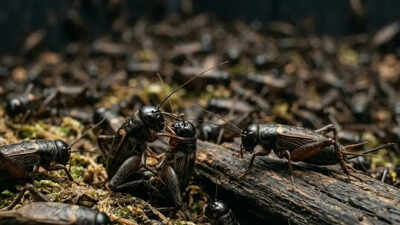
 This suggests that they may feel pain in a more complex way than we previously thought. As a result, there is now debate as to whether these insects have some form of consciousness, which leads us to consider how ethical it is for the industry to continue without proper legal guidelines for their welfare.
Research says that 370 billion people farm Ashita the domestic He may feel pain
Researchers have discovered that house cockroaches (Acheta localus) don’t just react to heat or infestation with immediate withdrawal; They display “flexible self-protection.” After infestation, cockroaches have been repeatedly observed cleaning and protecting the specific trauma site as reported in a study in the journal Proceedings of the Royal Society B. This behavior indicates that the insect’s nervous system processes the injury as a permanent negative state rather than a momentary reaction.
This distinction is crucial in animal consciousness research, because it suggests the existence of a felt experience of pain.
Why does cricket behavior suggest true consciousness?
Nociception simply involves detecting noxious stimuli. Pain, on the other hand, is how we experience this damage emotionally. Research indicates that cockroaches go beyond simply sensing danger; Their preventive measures change based on the situation. When scientists applied varying heat or mechanical stress, the cockroaches showed a preference for protecting injured limbs.
This behavior indicates a brain response similar to that of vertebrates.
It appears that cockroaches may process sensory details into a complex internal state that resembles suffering, as noted in a study in the journal Proceedings of the Royal Society B.
370 billion reasons to rethink animal welfare
According to the journal Insects as Food and Feed, 370 billion cockroaches are raised on farms each year, causing a great deal of suffering. Many farmers currently kill these insects by cutting, boiling, or freezing them slowly because they believe that cockroaches do not feel pain.
If cockroaches have the ability to feel pain, these methods could present an important animal welfare issue.
Therefore, research indicates the urgent need for the industry to devise humane methods to kill cockroaches and provide better living conditions. This approach should mirror standards applied to farm animals such as cows and pigs to reduce distress on a large scale.
Why are invertebrates left behind?
The discovery of insect pain creates a major regulatory vacuum. Most animal welfare laws around the world explicitly exclude invertebrates, leaving billions of sentient beings without legal protection. Ethicists are now calling for a precautionary principle approach: if there is a reasonable possibility that an animal might suffer, we should act as if it were suffering. This could lead to new international standards for housing, transporting and killing insects, radically changing the economics and operations of the global alternative protein market.