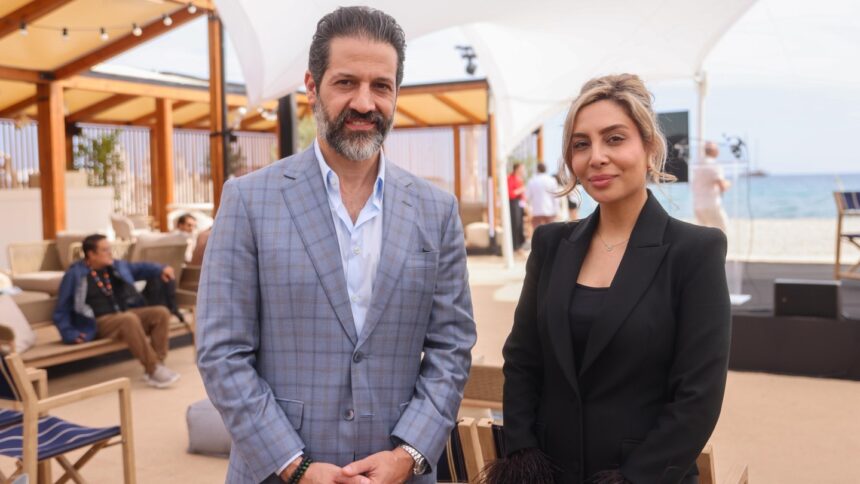
Last year saw the premiere of the Kurdistan Film Committee (initially known as the Sulaymaniyah Kurdistan Film Committee before expanding activities) at the World Cinema Theater in Cannes. The world’s largest film festival was a celebration of the exit of the small, semi-autonomous regional committee in northern Iraq under the office of Deputy Prime Minister Qubad Talabani, who is the head of the organization. This year, he, Pavi Yassin, founder and chair of the film committee, and her team returned to Cannes for another appearance.
The mission of the committee, located in the cultural hotspot of Sulaymaniyah, is to empower Kurdish creatives through training and support, bring foreign creatives to Kurdistan and establish it as a photography destination, and help bring the region’s stories to the world.
Staff recruitment in Sulaymaniyah, also known as Suli, and elsewhere, is well under way. For Cannes 2026, the team has also packed some financial news. After last year indicating plans to establish a fund, the Kurdistan Film Fund was officially unveiled during an event on Wednesday, titled “Owning Our Story,” at Cannes Marche. The value of the fund is $2 million annually.

Talabani highlighted the unifying power of storytelling at the event, saying: “We want to show the world that despite political differences, despite regional tensions or war, cinema can cross those borders, and storytelling can unite where politics divides. This fund is not just an opportunity for Kurdistan. It is a signal to the region that we see the momentum and that we want to be part of it, and that we are willing to invest in the relationships, collaborations and partnerships that make this region stronger.”
The region has always considered itself a link, not a divider. He told the crowd: “For centuries, Kurdistan has been a bridge between cultures, between civilizations, between worlds. This is our geography, and this is our history.” “We want to be a bridge, not a battlefield. We want to build, not destroy. We want to create industry, and opportunity where there is currently division.”
The Deputy Prime Minister also highlighted the importance of changing the rhetoric. “We decided today that Kurdistan’s stories will not be told by others on our behalf,” Talabani told the Cannes audience. “We will tell them ourselves, on our terms, with the depth and accuracy that only we can provide.”
The film and creative sector plays a major role here. “They are essential parts, because the way a nation tells its story determines how it is viewed, how it is understood, and how it attracts investment, talent and partnerships,” he said. “We are ready to be seen, to be understood, and to be part of the global conversation, not as persons, and certainly not as victims of history, but as participants.”

Yassin also emphasized the areas she focuses her work on. “Kurdish films have always relied on external support, without a solid system of their own. The fund is changing that by putting the Kurdish narrative at the center, wherever it is told in the world,” she told THR. “It’s not just about financing films – it’s about creating ownership, continuity and visibility for Kurdish stories internationally. At the same time, it is designed to open the door for global creators and producers to engage with Kurdish talent and stories through meaningful collaboration.”
The goal: “To create a structure that supports our narrative, while also encouraging international interest — and, ultimately, to begin bringing that interest back to Kurdistan itself.” The Fund’s evaluations will focus on artistic merit, but not only. “Projects are evaluated based on their international co-production potential, their ability to spread, and their connection to the local ecosystem,” says Yassin. “We are looking for films that can connect Kurdistan with global partners while also contributing to the development of the industry on the ground.”
Attracting film and television productions has cultural and economic benefits, both in the short and long term. “For Kurdistan, it’s about diversification,” Yassin says. “The audiovisual sector brings immediate economic activity – jobs, services, infrastructure – but beyond that, it builds long-term value. It shapes how a region is seen globally and opens the door to cultural tourism. When people see a place on screen, they connect with it. This connection creates curiosity and, over time, translates into a genuine interest in visiting and interacting with that place.”
But making Kurdistan attractive to filmmakers is multi-layered, she stresses: “It’s a combination of authenticity, accessibility, and cost-effectiveness.”

Keep in mind that the treasure trove of stories from the region has not been widely seen around the world. “There is a strong narrative identity,” Yassin asserts. “Kurdistan offers stories, locations, and cultural depth that have not been over-revealed.” “For the European and Asian partners, this represents authenticity – something the public has not seen frequently.”
Combine this authenticity with accessibility when it comes to exploring sites, and Kurdistan can offer something new. “We have had professionals reach out to us saying that they are tired of the overuse of sites that always represent other countries that they desperately need,” shares the head of the committee with THR. “Kurdistan is located in the Middle East and North Africa region, and is easily accessible, yet has four suitable seasons per year, and a wide range of diverse locations, from intense green spaces to dry lands, waterfalls, mountains, hills, rivers and urban cities. These locations can represent Syria, Afghanistan, Pakistan, Iran and many more.”
Even some experiences with surprise visitors caused laughter. Yassin, for example, remembers taking people to some areas, “and they said, ‘It looks just like Ireland!’” Can you believe it: In the heart of the Middle East and North Africa, there is a country with corners that resemble Ireland!
Money, of course, is also a major consideration for production. Yassin knows that “this industry is very expensive,” stressing that Kurdistan “provides a cost-effective filming environment.” She even sees opportunities to collaborate with producers within the region. “How many times have we seen Egyptian films searching for locations in Europe for their greenery and landscapes, and how much do they cost?” Yassin says THR. “They can find everything here.”
What about the efficiency argument? “With a very compact geography, production can reach a wide range of locations – urban, rural and mountainous – without the logistical complexity or costs found in many other countries,” she points out. “This has a direct impact on budgets and timelines.”

But there are also production supports and soft incentives, which she describes as “often underestimated”, given the traditional focus on cash discount rates. Yassin asserts that “what matters in practice is the total cost of production.” “In Kurdistan, facilitated permits, flexible coordination, access to sites, and generally low operational costs make it highly competitive – even without relying solely on deep discount schemes.”
To ensure that local talent gets what is needed, the Kurdistan Film Committee in Sulaymaniyah has, over the past year, undertaken all kinds of training, education and skills development initiatives. Among the events was a five-day Kurdistan Producers Lab for producers and directors, covering film budgeting, financing, financing applications, and marketing, in collaboration with European Audiovisual Entrepreneurs (EAVE). There was also a four-day workshop on site management and exploration, led by John Rakic, President of the Location Managers Guild International (LMGI), and Andrea Keener, LMGI Board Member and Senior Site Manager, who They worked in TV series such as: Cool condition and scandal And feature films such as Ant-Man, Captain Americaand Moonflower Killers.
The committee plans to continue and expand the training opportunities available to it. “This year, we will be working with leading professionals around the world, well-established institutions in the field of screenwriting and documentaries, and more focused professional training for crews, especially below the line,” says Yassin. THR. “We will also be starting our own Suli Screens programmes, which are free film screenings around the city.”
For productions looking to film in the area, the commission offers a database of locations, including the archaeological remains at Bazian, an ancient Christian site estimated to date back to the 6th century, the Red Prison Museum, a site once known for its brutality before it was abandoned and reopened in 2003 as a museum, and Toni Papa, a gorge known for its stunning scenery.
Yassin even has news about an international project to share. “We have a Canadian film production, Dawoodistan“Coming this year,” she says THR. Writer-director Ariel Nasr’s drama synopsis for Sinando reads as follows: “On the eve of Kabul’s fall to the Taliban, Afghan star runner Daud Ahmadi returns from a Canadian detention center to be reunited with his sister Taiba. Together they must confront a collapsing city and fight to reclaim their shattered dreams before everything they love is lost forever.”
Yassin mentions “More [projects] In preparation, but the unexpected war in the region affected production, not only in Kurdistan but throughout the entire MENA region. Yes, the war in Iran has been the elephant in the room in the region, raising concerns about the war in Gaza.
“I appreciate this question, because it goes beyond Kurdistan – it speaks to the reality of the entire region,” said the head of the film committee. “The truth is that many countries in our region are affected by conflicts that we are not directly part of. As Kurds, this is something we have lived with for decades. We often bear the consequences of wars that are not ours, and yet we absorb their impact – politically, economically and culturally. One of the first sectors to suffer is the film industry: production slows and, more importantly, the reputation of the region – something that takes years to build – can suffer almost overnight. But there is another reality that is often if you look at daily life in a place like Kurdistan, You will find that it is stable, practical and safe. There is a disconnect between perception and reality, and part of our role is to correct that.

That’s why being at Cannes is important. “Our presence is a statement: that we are open, that we are building, and that we are not waiting for perfect conditions to start,” Yassin says. “In times of conflict, supporting the arts is not secondary – it becomes essential. Culture is what maintains identity, what sustains people, and what allows a region to define itself rather than being defined by others.”
The Kurdistan Film Committee in Sulaymaniyah also brings filmmakers to Cannes to network and showcase their projects in the cinema market. It is organizing the first ever workshop for Kurdistan producers at its pavilion in the Cannes market. “We choose 10 projects,” Yassin explains. “They will have the opportunity to meet top producers and present their work in a focused environment. It’s not about being seen alone – it’s about creating real connections and opening doors. …More importantly, as we bring Kurdistan into the international industry, we are not limiting ourselves to the local market. We are selecting projects from all over the region, not just from Kurdistan. This is a deliberate choice. It reflects how we see our role: not just building locally, but also positioning Kurdistan as a platform for collaboration.”
Yassin concludes: “In the end, this is what we are doing – building bridges that did not exist before.”
She confirms that the committee has barely begun its work. “One year after the official establishment of our film committee, I don’t expect a mountain of productions to come our way,” says Yassin. “The fact that in less than a year, we have been contacted several times and thought about producing, gives me hope for what comes next.” THR. “Of course, welcoming foreign productions is also my top priority, but people still don’t know us yet! All they know are stories about grief, war, and politics. My main goal is to change people’s minds about the way they view us. Once they do that, trust me, they won’t be able to resist the beauty, the diverse location, and the tremendous cost-effectiveness.”