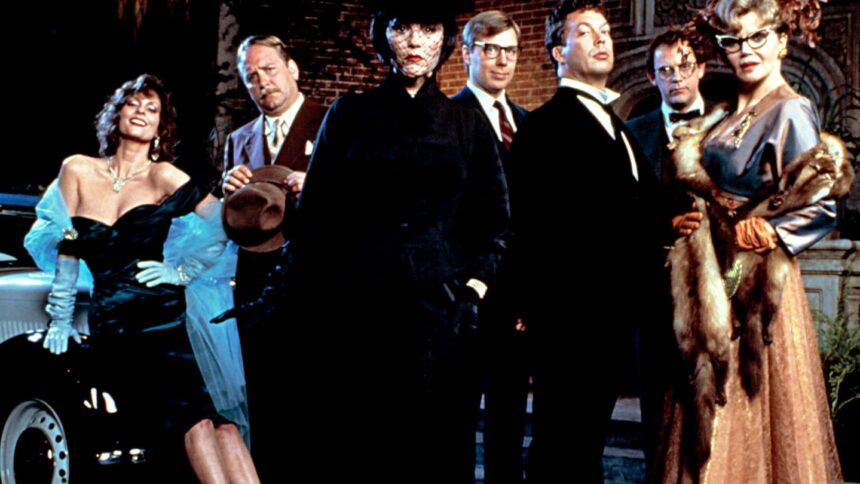
On December 13, 1985, Paramount revealed its board game adaptation of Clue in time for the holidays. The film, directed by writer-director Jonathan Lin, earned just $14 million in its initial theatrical release, but it gained cult status. The Hollywood Reporter’s original review is below:
an idea It’s hardly the perfect answer to a largely laugh-less Christmas movie season, but it at least offers some tasty comedic red herrings. This extremely silly release from Paramount features the first (but perhaps not the last) film based on a popular board game, features an expert cast of clowns and no less than three endings – an attempt to generate repeat business that will lead to some lucrative box office hits.
The setting is a dank New England mansion circa 1954. On the guest list for dinner are Mrs. Peacock (Eileen Brennan), Professor Plum (Christopher Lloyd), Mrs. White (Madeleine Kahn), Mr. Green (Michael McKean), Miss Scarlett (Lesley Ann Warren) and Colonel Mustard (Martin Moll) – all of them, as it turns out, are government employees who are blackmailed by the seedy Mr. Boddy (Li Feng), who suddenly begins to Living up to its name thanks to a gun, knife, wrench, lead pipe, knife or maybe a candlestick. After five murders, even the butler (Tim Curry) is unsure of the identity of the murderer.
Debut writer-director Jonathan Lin, working from a story he conceived with John Landis, has high comic intent for these shenanigans, staging the events at a frenetic tone that often suggests a live-action cartoon. Lane keeps the gags coming with restless energy, alternating elaborate gags and great one-liners with increasingly little breathing room, and succeeds particularly well with the satirical horror elements built into the story; There’s more than a little of the old William Castle spirit afoot here, right down to the triple-ending gimmick.
But like other similar delusions (Murder by death comes to my mind immediately), an idea It can’t always maintain a high level of invention, though, as it has a relatively short running time of 87 minutes. Lynn resorts to Three Stooges-style punitive humor, insults and cheap shots to elicit occasional laughs, and the resulting unevenness is exacerbated by Lynn’s unimaginative direction and Victor J. Kemper’s flat cinematography, which tend to spoil much of the inherently creepy atmosphere.
If the film ultimately fails to achieve its lofty comic goals, the impressively straight-faced cast still manages to deliver the goods, especially Brennan as the hysterical Peacock. Carrey brings plenty of life to the music hall as the butler, and Warren plays the sexy Miss Scarlett. Moll brings his usual deadpan to Colonel Mustard’s bull’s-eye, but he is uncharacteristically subdued and neither Lloyd nor McCain are given much to do. On the other hand, Colleen Camp shows a flair for light comedy as a seductive French maid, although the role often requires her to play second fiddle to her enhanced bosom.
Adding just the right gothic touch to this Debra Hill production are John Lloyd’s sets dripping with Victorian splendor and John Morris’s delightful music. Costume designer Michael Kaplan attracts as many laughs as the screenplay with his brilliantly tailored, character-appropriate costumes, and editors David Bretherton and Richard Hines maintain a dizzying pace that makes the hits outweigh the misses. It’s not Agatha Christie, but it certainly beats the movie version Trivial pursuit. — Kirk Ellis, originally published December 12, 1985.