

This article was written by Pavan Puri, Founder and Managing Director, Greencore Electronics.The days of wrestling with base steering and a manual gearbox in India are fast fading. The nation is racing straight into a high-tech, sensor-rich mobility revolution. Advanced driver assistance systems (ADAS) and premium car electronics used to belong exclusively to luxury showrooms.
Not anymore. Today, these smart technologies are being introduced as standard features in the everyday Indian car. This transformation means a lot more than just installing some new screens on the dashboard. It represents a complete overhaul of the driving experience. Drivers are completely changing how they interact with their cars and how they navigate road safety. Bringing this amazing technology to one of the most unpredictable traffic environments in the world is a huge and exciting challenge.
India doesn’t just update cars to look better.
The industry is overcoming this chaos, allowing vehicles to share the burden, and confidently stepping into an era of smarter and safer mobility.
Sensor revolution in Indian mobility
The emergence of advanced driver assistance systems (ADAS) signals a shift from reactive driving to proactive prevention. In an environment characterized by heavy and highly unpredictable traffic, microelectronics serve as an important safety net.
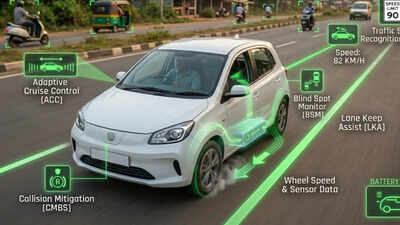
Radar, LiDAR and camera systems act like an extra pair of eyes, constantly scanning millions of data points every second to monitor lane discipline and vehicle proximity.
Together, these components create a real-time digital representation of the vehicle’s surroundings. Advanced cameras are tasked with recognizing traffic signs and assisting with lane keeping, while radar sensors manage adaptive cruise control, ensuring a constant distance even when highway speeds fluctuate. This interconnected system acts as a protective “cocoon” capable of detecting pedestrians in low light and anticipating collisions before the driver has a chance to react. By converting the surrounding physical environment into actionable data, these technologies significantly reduce the potential for human error. As a result, this reduces mental stress on the driver during long journeys, making long journeys considerably easier.Intelligent intervention and active safetyOne of the most important developments in the Indian movement is the shift towards “active intervention.” Some features, such as automatic emergency braking (AEB) and forward collision warnings, move from being optional extras to standard requirements. With advanced driver assistance systems expected to be in place for heavy commercial vehicles by late 2026, the focus is expanding to include vulnerable road users, such as cyclists and pedestrians.
This regulatory change is generating huge demand for advanced sensor technologies across the logistics and trucking industries in India.
He watches
New Lamborghini Temerario Tour: V8 Hybrid Beast | Toi Auto
Today’s electronic stability programs and anti-lock brakes are paired with intelligent programs to stop skidding during sudden turns. This technology also monitors the driver, using internal infrared sensors, and the systems can flag signs of drowsiness or distraction and use vibration or sound to return the driver’s focus to the road.
These tools are a game-changer for commercial drivers who are hard-pressed to meet delivery goals during arduous interstate trips.
era Software-defined vehicles
Modern cars have essentially become “computers on wheels.” The average Indian car now relies on electronic control units (ECUs) and high-performance chips to power everything from the engine to the dashboard. Because of these advancements, cars can now be improved through over-the-air (OTA) updates.
A car’s safety or performance algorithms can be fine-tuned long after it leaves the dealership, ensuring it stays up to date with the latest security software.
This software-first approach also allows for predictive maintenance. Cloud-connected sensors can now report a mechanical error or sensor misalignment before it causes a failure. For the Indian buyer, this means more transparency and fewer hassles down the road.
The car is no longer a static machine; It is a dynamic platform that improves over time. This also opens the doors to new data-driven services, such as insurance policies based on how you actually drive.
Navigating the urban jungle
Driving in major metros in India has become easier thanks to 360-degree cameras and automated parking. In tight city centers where every inch of space is important, ultrasonic sensors help drivers squeeze into spots without the risk of minor dings.
This technology is a big help for new drivers and helps maintain traffic flow in tight parking lots in tier-I cities. In addition, the growth of the electric vehicle market increases the need for more advanced electronics. Since electric cars rely more on electronic power management than conventional engines, a partnership between electric cars and advanced driver assistance systems is a natural fit. The result is a quieter, cleaner and safer road network.
As domestic manufacturing of chips and sensors increases in speed, these technologies will become less expensive.
By keeping up with these changes, the Indian automobile sector is entering an era where technology does more than just provide convenience – it saves lives. The invisible network of circuits and sensors is quietly changing the pulse of Indian roads, making every journey safer and more predictable.Disclaimer: The views and opinions expressed in this article are solely those of the original author and do not represent any of the Times Group or its employees.