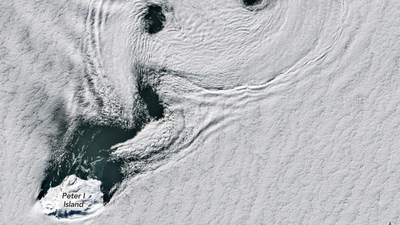
An exceptional aerial image captured by NASA on its Earth Observatory website shows the development of a “sea of swirling clouds” in the area around Antarctica as a result of strong winds, forming a phenomenon called von Kármán vortex streets.
NASA captured this stunning image using Landsat 8 over Peter I Island in the Bellingshausen Sea, depicting an extraordinary view of swirling clouds generated above the frigid seas of Antarctica. These impressive weather phenomena, referred to as Antarctic cloud vortices or von Kármán vortex streets, provide a unique example of wind effects on isolated terrain features in the polar regions.
What are the rotating clouds seen by NASA?
These cloud formations are formed as a result of an atmospheric process referred to as the von Kármán vortex street effect.
This process involves the creation of opposing spiral vortices by airflow upon collision with obstacles such as mountains or islands.According to NASA’s Earth Observatory, this cloud pattern occurred behind Peter I Island, a volcanic island located along the west coast of Antarctica. This image was taken by the Operational Earth Imager installed on the Landsat 8 spacecraft on February 11, 2026.NASA described the cause of these anti-rotational spirals as “airflow deflects, slows down and swirls.”
Peter I Island and strong winds in Antarctica
The strange cloud formation appeared near Peter I Island, a remote volcano located in the Southern Ocean. The area is known for its strong winds, and sailors throughout history have called it the “Roaring Forties,” “Furious Fifties,” and “Roaring Sixties.”According to NASA, winds in this region can travel “relatively unhindered across land,” allowing weather events to form clearly over water.Experts believe that the wind must remain within certain speed limits for the vortices to maintain their shape.
Otherwise, once the wind reaches excessive speeds, the vortex structure will collapse.
Why are the streets of the Von Kármán Vortex important in science?
Despite their impressive visual impact, these clouds provide useful scientific insight into atmospheric processes. For example, von Kármán vortices give scientists insight into atmospheric flows, turbulence, and meteorology in various fields, including extraterrestrial environments.This process is named after a physicist named Theodor von Kármán.
This scientist studied the fluid dynamics around objects that were moving in the air.As for NASA, its observations of von Kármán vortices provide scientists with additional information for research into Antarctica’s climate. Indeed, NASA conducted a study of Peter I Island during Operation IceBridge, which measured ice coverage in polar regions between satellite campaigns.
how Satellite images Helps scientists understand the Earth
Satellites like Landsat 8 provide researchers with the ability to see weather and climate conditions from outer space with an incredible level of accuracy.
Besides being eye-catching, these images are also very useful in monitoring changes in the environment.Scientists have used satellite images to develop better models of climate and wind currents and to understand the responses of remote areas to changes in the atmosphere. Satellite images are particularly useful in remote areas of Antarctica, where direct measurements cannot be made.
A stunning reminder of the Earth’s natural patterns
The “Ocean of Swirling Clouds” published by NASA is not just a stunning image captured from outer space. Rather, it is an example of how the Earth’s atmosphere is never static and always creates amazing patterns that are not visible from below.Cloud formations over ice-covered Antarctica and the stormy waters of the Southern Ocean show the beauty of the laws of nature at work. In addition, it also serves as proof that there are still amazing discoveries waiting to be made through satellite science.