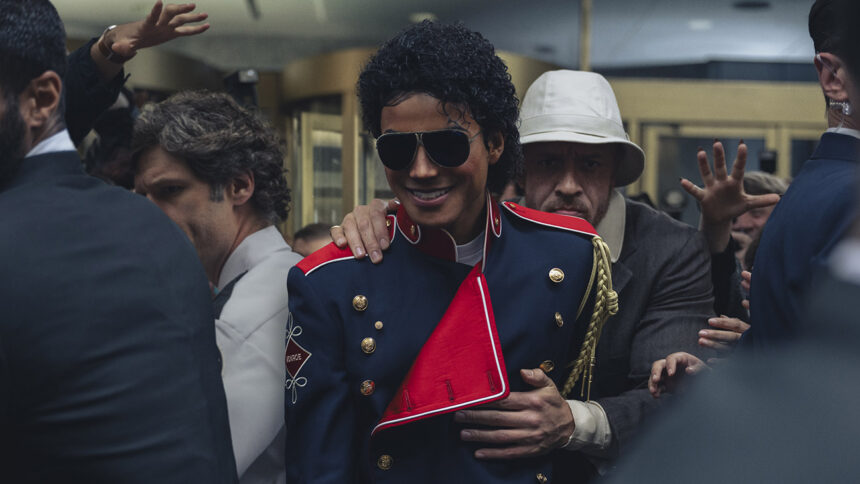
As talk of a second Michael Jackson biopic grows, fans of the star continue to hit back at some professional critics about the way the current Lionsgate film makes them feel.
Director Antoine Fuqua Michael The film was an instant hit upon its theatrical opening on April 24, with its $97 million domestic gross marking the biggest opening weekend for a biopic on its way to a current worldwide cume of over $423 million. The nephew of the late pop star Jafar Jackson plays the lead role, alongside Colman Domingo, Nia Long, Miles Teller, Laura Harrier, and Larenz Tate.
Michael It has a 97 percent fan approval rating on Rotten Tomatoes, but its critical score is only 38 percent. Among the numerous social media posts on the subject was a viral tweet criticizing reviewers who had “legitimately lost the plot” and declaring that “there needs to be a major shift in criticism.” (Needless to say, memes ensued.) Social media users attributed this disparity to critics taking note Michael It was intended to be a feature film covering the star’s entire life, including child abuse allegations and other scandals, but the third act was retooled due to legal issues. Instead, the film concluded its story in 1988, with a follow-up feature in active development from Lionsgate.
“I think the critical response seems a little disingenuous, just in comparison to the other biopic series we’ve seen,” said Joe Vogel, author of the 2011 biography Man in musicHe tells Hollywood Reporter About the top Rotten Tomatoes critic scores for musical films like bohemian rhapsody, Rocket man and Facebookall of which sparked debate about whether they appear overly sterile. “They all follow a pretty similar outline, so it seems to me that Michael The film is notable, in some ways, for what is not in the film, as opposed to what was actually in it. In essence, Michael It’s about introducing it to new audiences. It’s disingenuous for critics to expect this two-hour biopic from the late 1980s to do it all.
THR He gave the film a generally positive review, calling it “surprisingly moving” while adding: “The film leaves itself open to accusations of saintising Michael, which will not appeal to canceled audiences.” Michael The film revolves around Jackson’s early years as part of his family’s band, the Jackson 5, and the release of his first solo albums.

“Filmmakers have the right to make the films they choose, with the subjects they choose,” says Mark Anthony Neal, a professor at Duke University who teaches a course on Jackson. “That’s why critics are important.” “The last thing we want is critics who are essentially signing off on what the artist does, whether or not we’re talking about a musical artist, a filmmaker, an author. That’s not the critic’s job. It’s the publicist’s job, and we can’t turn critics and journalists into art publicists. That’s not their job.”
Inherent in the controversy over the varying reactions to the film is the awareness that Jackson’s family was involved in the making of the film. Michael He has a great interest in portraying the artist in a positive light. Analysts see CV as a key way for those who oversee an artists’ music catalog to boost song sales and streaming numbers.
“Expecting a banned biopic to present an unvarnished truth misunderstands the dynamics: the property is the gatekeeper, and the film is a catalog activation strategy — a two-hour ad designed to send audiences straight to streaming platforms to rediscover the back catalog,” says attorney James Sammataro. His law firm, Pryor Cashman, represents Sony Music, which owns a stake in Jackson’s catalog.
Fogel, whose book credits also include biographies of Prince and James Baldwin, notes that “there are always some tensions” when dealing with a public figure’s property. “There was some volatility, I think, because she was so protective,” Vogel recalls as he worked on his Jackson book. He points out that his book had an overall smooth run because of his decision not to focus too much on the controversies: “In my case, since the whole point of my book was to focus on the artist, there weren’t a lot of issues.”
certainly, Michael It’s not the first musical biopic to see critics and audiences debating whether the full story will make it to the big screen. Given that the unsavory headlines surrounding Jackson generally came after the events depicted in the first film, it’s possible that controversy surrounding the second film will increase, depending on how the scandals are handled.
“The surrounding controversy Michael Nothing new: bohemian rhapsody “It was a real estate-sanctioned score-settling session that grossed $900 million despite the critical reception,” Sammataro says of Queen’s Oscar-winning film Freddie Mercury. “A slew of musical biographies followed her way. Bob Marley: One Loveproduced and endorsed by Marley’s estate, depicts Marley as a beautiful figure moving effortlessly through a world rife with conflict — same brilliant template, different icon. The pattern is structural rather than accidental.
Despite their tendency to stoke controversy, not to mention the lukewarm critical and commercial response to the events of the past year Springsteen: Save me from nowhere – There are still plenty of Hollywood music biopics in the works, most notably Sony’s four-film project about the Beatles that has garnered a signature from the band and its label. While some observers hope for an ideal world where independent films can tell grittier stories about major musical figures while also including hit songs, there’s still an argument to be made that sharing real estate doesn’t necessarily prevent a studio biopic from retaining value for audiences.
“Just because a biopic serves the catalog doesn’t mean it’s letting the audience down,” Sammataro says. “Even imperfect biopics do something that streaming algorithms can’t: They restore context. They remind audiences that songs were written by real people, at specific moments in time, often under extraordinary circumstances. For a younger viewer who encounters Jackson’s catalog through a playlist, a film — even if flawed and protective — can be the thing that turns a familiar hook into an artist worth understanding. That’s a real cultural function, even when it’s also a commercial one.”