Early in my television writing career, I was sent to attend a public meeting. Generals are like blind dates that can go one of two ways. One way is to meet an executive with whom you have a real connection which will restore your confidence in the business and actually lead to getting a job. The other kind is where you meet an executive, and you tell them rehearsed anecdotes about your life that are meant to spark warmth and laughter, and they tell you that they want to find something to work on together, something like the script you sent them that got you that meeting, but not that script because they have nothing to do with it, and in order for them to care about something, they have to pee on it and feel a sense of ownership. Then they give you validation for your parking instead of your business and you never hear from them again. This particular public meeting falls into the latter category. It went like this:
EXECUTIVE: Well, Brian, I’m literally obsessed with you????!!!
I: . . . My name is Rayyan. . .
The executive blinked without calculating the correction.
Executive: I like your voice. Very singular. But have you thought about writing a procedural?
Me: Like Law and order? Oh my God, I don’t know. It’s not really my wheelhouse. . .
Executive: Command room! It reminds me that Jen Aniston is a good friend of mine. . . . She loves houses. . .
I: . . . Yes . . . I love Jennifer Aniston too?
Executive: She’s my sister. It’s my fucking family. Kind of like how you and I would be best friends. So. What kind of things do you want to make?
What a great question. At this particular juncture, I was writing to embarrassedBut what I really wanted to do was make a show about a disabled gay person. She looked confused and frightened by this revelation, as if she had just missed the freeway exit and Waze didn’t know how to redirect her. She said, “Um, that’s—that’s cool. Hey! What about gay zombies? We’re really excited to explore that space. . . .”
“What exactly is the gay zombie space?” You asked, suddenly feeling the specific fatigue you get from being around people who don’t understand you and never will. I stopped. Silence fell over the room. Then she leaned over and said, “You know… I really thought you’d be more interesting…”
“What do you mean?”
“Your clients said I should meet you, and that you are just a tornado of energy.”
That’s a crazy thing to say to someone. However, I was disappointed in myself because I did not give her the offer I had promised. I don’t want to be a liberal arts girl, but, as a disabled person like myself, my “on” switch doesn’t have the luxury of turning it off. I’m there to make everyone laugh and feel comfortable about my physical presentation. Most of the time I enjoy it. At least I think I do. I like my personality, although a lot of it seems to be a coping mechanism for having cerebral palsy. But sometimes, when I feel like I’m not being understood in a business meeting, it’s like being on a bad date where I just can’t do it. I don’t have the ability to impress them because their essence makes me feel depressed.
The entire conversation with that CEO seemed like a parody of my industry. But to work in this business, sometimes you have to experience little insults like that. If I didn’t have this laser ambition to show a disabled gay person on TV, I don’t know if I would have been able to pull it off. I started writing for television and film with the specific goal of making things that would serve as a balm for my younger self. So I treated everyone who was disruptive as villains in the game. Just defeat them and continue.
Fortunately, my first stroke of luck in Hollywood was when my memoir was optioned. For a week, I was courted by powerful producers who wanted to help turn my life story into a TV show. It was incredibly meaningful, especially after spending the first two years overlooking the strange undead. Ultimately, I chose the production company of actor Jim Parsons and his husband, Todd Spiewak, to adapt my book.
But when I first went to Jim and Todd’s house in Los Feliz to meet them, I was terrified. After two years working as a TV writer in Los Angeles, I’d known my fair share of actors, and my instinct was to stay away (unless I got paid). Of course, there are many great actors who are curious and ask you questions about yourself and are naturals, but many of them have been struggling with the energy of the main character in the long run and don’t have the magnetic personality to compensate for their narcissism. I sympathize. Later, when she went to the lead role privateI get that there is a whole ecosystem created to support the actor’s needs, which of course leads to coddling and childish behavior. The industry helps turn them into monsters and then criticizes them when they act brutally.
To my relief, Jim and Todd ended up being obsessed with the gentle angels, and I knew right away that I wanted to do the show with them. I couldn’t believe I was about to work with Jim, one of the biggest TV stars on the planet. No, sorry, that’s dishonest. I can believe it. Making it in Hollywood as a limp gay man was so unlikely when I first came to town that I had to tell myself lies every day to pursue it. There was no backup plan. Just plan Cray. When I first got into the industry, I really thought I was going to meet people like Jim and do TV shows and get everything I wanted. Why doubt yourself when society already does? I didn’t need negative self-talk when I could walk out and be treated like a bad person by a stranger.
In 2015, it was common for a TV project to be taken to networks like ABC, NBC, and Fox first, and then, if everyone was successful, to move to cable. But I was terrified of having a network do a neutral version of my TV show. I’ve heard a lot of horror stories about a major network that bought a left-of-center show because oh my god, it’s edgy, wow, what a hook, but then, through the feedback process, the executives would start freaking out and get rid of everything that made it unique. Suddenly, she was a sweet spot and then they killed her. The thing that corporate bigwigs don’t always realize is that the more specific you are in your business, the more global it becomes. By smoothing out the edges to make it more palatable, it has no point of view, and so no one can see themselves in it.
I wanted to explore sexuality in private. The society that kept me penisless had caused me so much pain that I was determined to provide something honest and sexually fulfilling that would ease the heartache. So we bypassed the networks and took it private to cable and streaming in the summer of 2015. It was the golden age of television, which meant executives were vulnerable to taking major creative swings. Thank God because private The pitch was, as my younger self was lovingly told, psychotic. I shit on a guy’s penis during sex in the pilot. Remember, you are usually promoting regular people at these meetings. Occasionally, you’ll find what my friend Gil calls a “gay in the basement,” aka a gay CEO who’s a junior and has no authority, but otherwise it’s a different vibe. However, with the exception of Johnny Knoxville’s No. 1 fan, every throw I’ve made has gone well. I’ll walk away thinking, wow. I think we sold it! But then the flagpole would be sent to the HOWGIC (the old white man’s boss), and the HOWGIC would say no.
It was overwhelming. A year of development and unpaid work, and then it was all over. Without a buyer, we didn’t have the money or anywhere to broadcast the show. Fortunately, my producer, Eric, was a stubborn actor in the Oscar campaign, and he wasn’t satisfied until the show sold. Phase 13, a digital subsidiary of Warner Bros. Which was an incubator for diverse talent and, as of this writing, collapsed because Hollywood didn’t care publicly about diversity anymore. They eventually said they would commission me to write eight 15-minute episodes. Creating an entire season of television on my own with only fifteen minutes of real estate per episode was… . . Humility. Not only was I relatively new to television writing when I started drafting A For a season, I was also working on problems related to cerebral palsy in real time—problems that I naively thought I had already dealt with in my memoir. I didn’t understand that being honest about who you are is just the first step. I also had to reckon with the psychological implications of keeping my disability secret.
“I don’t understand this episode,” Eric told me in his usual gruff way when he read one of my drafts. “Ryan goes to a pool party and nothing really happens? How does cerebral palsy affect him?”
“Well, it doesn’t. Being disabled isn’t his whole personality…” I said defensively.
“So, you go to a pool party full of gay men and never once feel your disability?”
I racked my brain for an answer, afraid of what I might find. machine. Did I really suppress that much? “Okay, look,” I said, shifting into Virgo problem-solving mode. “I will keep a diary and write every time cerebral palsy directly or indirectly affects me. Maybe it will help me.”
For the research, I went to Palm Springs—a place that tries to make up for its bad food by offering gay orgies on demand—and spent the day lounging by the hotel pool, waiting for something to happen involving my cerebral palsy. Actually, “hanging out” is not the right word. “I was overcome with anxiety because people were sitting on the edges of the pool and I couldn’t find a way to get into the water safely, so I kept baking in the sun and getting burned because I was too disabled to apply sunscreen myself, and oh my God, my cerebral palsy actually determines everything?!” It is more accurate.
Now that I had my little mission, I was noticing everything. When I checked into the hotel, they gave me an ADA room, which, thanks to my inner faculties, I found offensive.
Okay, write that down. I considered joining Grindr, but I didn’t want to deal with explaining my limp to a stranger. Yes, this happens too. The Communist Party was suddenly at center stage, dictating every decision. Was my life always so small and claustrophobic, and I didn’t even realize it because it was all I knew?
Inspired, I furiously wrote the next few episodes of private While continuing to keep notes.
Once the scripts were finished, we sent them to Netflix, which was experiencing a creative renaissance, making outliers like the Maria Bamford film. Lady Dynamite. They read the scripts and greenlit the show. If all of this sounds anticlimactic, that’s because it was. I had no idea Eric even sent the scripts to Netflix. I got a call while I was in gay purgatory (aka StairMaster), telling me Netflix was going to make it private.
“Oh, by the way,” Eric said. “You get to star in it.”
***
Celebrity culture is like cotton candy: a few bites are delicious, but then, before you know it, you end up with a severe stomach ache. Being part of this world costs a lot. Not only spiritually, but financially. First, you have your own publicist ($6,000 a month), whose job is to promote you to trivial listings like diverse“10 Virgos Under 30 to Watch.” diverse People don’t just come up with it on their own. A PR woman named Emily was pushing hard to make this happen.
Hence, you often pay a hairdresser when you have to attend events. If you’re promoting your TV show or movie, the network will usually pay half the amount. It usually costs $1,200 per event for a top-notch stylist to dress you in an outfit that you have to return. Then you get hair and makeup: $500. I can’t do the math (gay), but I guess that means it costs influencers/celebrities several thousand dollars to come out and attend something like a Tillamook Cheddar Young Hollywood party. Of course, you don’t need a hairdresser. You don’t need hair and makeup. But when everyone gets it, there’s pressure to play the game. If you pay enough money to tell the world that you’re important, then, mantra, you will be.
Just as press to private We almost died, we were nominated for an Emmy. I found out at the gym (why do I keep getting big news there?) and I was visibly emotional, because getting that kind of recognition lends legitimacy, but more importantly, I knew this meant we’d be renewed for a second season. I’ve been babbling to the press about how fifteen-minute episodes weren’t my idea, and that I’d only consider doing half-hour episodes for season two. I wasn’t trying to be naughty. I just wanted the property to tell a complete story.
I listened to Netflix. They called to tell me that my contract had been renewed and that I would be getting half-hour episodes. Then, before I had time to say “hello,” they told me that Season 2 would be the final season. Which means the special offer was renewed and canceled in the same phone call. Paraphrased. It wasn’t the news I had on my vision board, but I appreciated the nudges because in Season 2, I was able to finish the story the way I wanted. (Also worth noting: Netflix supported me 100 percent creatively and let me do what I wanted. That’s rare and doesn’t happen often in this business!)
With Season 2 officially underway, I now have two jobs: making another season of TV and campaigning for an Emmy. I had no idea how to make prize sausages, and after trying them myself, I became a vegetarian. Essentially, you can transfer thousands of dollars of your own money to the rewards campaign. Hello again, publicists and designers. And Sonia, the amazing hair and makeup artist, who was at my house almost every day took me from “alcoholic body” to “I think I’ve found where your chin ends and your neck begins.” One time, while I was wearing a face mask, Sonia energized me, and I leaned back in my chair in ecstasy and thought, huh. My life is kind of different now. For a long time, my dream was to be Nora Ephron, not Meg Ryan. But suddenly I was a public-facing person, paying someone to hold something over my face while they realigned my chakras. In the back of my mind, I kept thinking, This period will end. I owe it to the era of failure.
It came, eventually. Not yet the Emmy, although I didn’t win. Not even after that private wrapped. Because it is from privateI wrote a novel, sold two TV shows, and wrote and starred in a movie reboot Strange as the folk are. The treadmill was still going very fast. While filming Strange as the folk areI wrote the film adaptation of my novel that was allegedly filmed afterwards Strange as the folk are out. My life was planned a year in advance, which everyone dreams of because it means guaranteed work.
Then everything went kablooey. Strange as the folk are And my novel came out. Unfortunately, I got sick with Covid on the day my novel was released. (I found this out right before I showed up CBS Good morningwhen we were all auditioned in the studio. Gayle King also had Covid. She called me later at my hotel and said she was really looking forward to asking me about the bussiness job.) My press tour had to be cancelled. Not like that would help much.
Strange as the folk are It received a mixed reception and was not renewed for another season. (I could join Sarah Lawrence and write a thesis on why.) Funding to edit my novel has been withdrawn. Everything I had just happened. . . He died. My calendar was wide open for the first time in years.
Everyone talks about how they felt like failure before they achieved it. No one talks about the failure that people still experience after success. Maybe because of insecurity. You want to display an image that says, “All is well. You’ve got the keys to the castle and now one light is turning green.” But the lack of discussion about the ebbs and flows of any long-term career made things seem particularly painful. Were you the only person who once had a TV show and now can’t get a crew? Maybe I should have played the game more and gone to the Tillamook Cheddar Young Hollywood party. Maybe I should have accepted the invitation to attend Fashion Week Milano when I was writing the second season of Special. Maybe I should have done a better job of performing my identity.
The most valuable thing money can buy is time, and the upside of working a lot was that I had a significant amount of money saved which allowed me to think about my next steps.
I spent the next year separating my self-worth from my productivity. I spent what medical professionals call a queer time in New York — a place with more texture than a company city like Los Angeles — sleeping with the boys, making new friends, and actively participating in my life, rather than just watching from afar while I interviewed Queerty about bottoming. I started writing the bare bones of these articles. I had finally taken care of my personal garden and it was thriving. Now, look: I think my work will always be, on some level, intimate. I can’t imagine writing generic workplace comedy (although I wouldn’t get mad if I did, Mama’s got a mortgage). However, I felt like I owed people my shock when ordering, like a soft-serve station. I needed to make a living, maintain my status as a marginalized person in this business, and that meant constantly delving into my pain (for free) so that Hollywood could give itself a pat on the back for letting me in. But this is not healthy or sustainable. I don’t owe anyone anything.
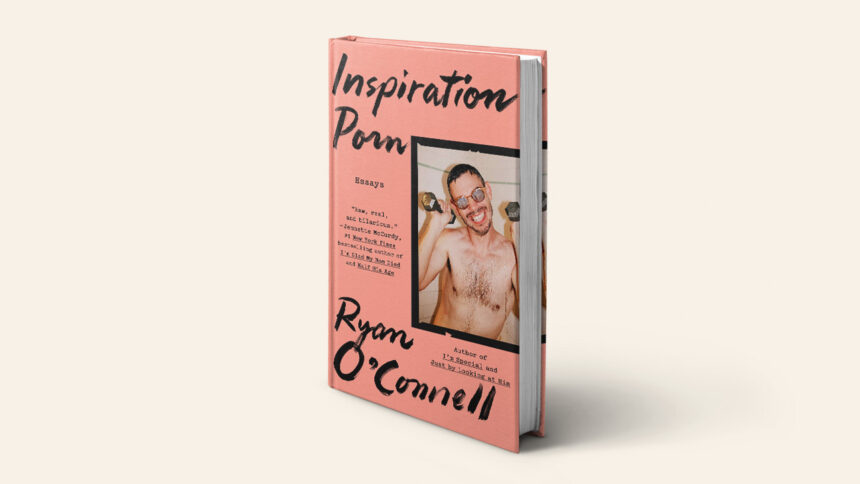
From the movie INSPIRATION PORN, written by Ryan O’Connell. Copyright © 2026 by the author, reprinted with permission of St. Martin’s Publishing Group.