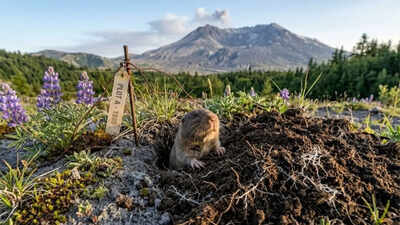
When Mount St. Helens erupted in 1980, the once vibrant green landscape was reduced to desolate ash and gray wasteland. But, inside this gray, barren place, scientists conducted a brave 24-hour study: they placed pocket animals in the blast zone.
More than 40 years later, this brief intervention has produced amazing results, and the rodent is credited with reviving the ecological recovery. By moving the volcanic crust, subterranean rodents pushed much-needed nutrients and symbiotic fungi to the surface. These ecosystem engineers are now being given credit for accelerating the process of restoring the forest from the barren moonscape it once was to the life-rich habitat it is today.
The secret to their success lies in the collaboration between animal behavior and soil microbiology.
Scientists released gophers on Mount St. Helens 43 years ago to rebuild the devastated ecosystem
According to the UC Riverside College of Natural and Agricultural Sciences, in 1980, researchers, such as Dr. Charlie Crisafulli and Dr. James McMahon, airlifted the northern pocket gopher (Thomomys talpoides) to the pumice plain. For just 24 hours, the researchers kept the pocket gophers in enclosures where their digging behaviors were observed.
By moving old, nutrient-rich soil through and over new, sterile volcanic soil, the pocket gophers helped “reinoculate” the sterile substrate with beneficial organisms. After six years of intervention, plots with gophers were home to more than 40,000 plants, while plots that were untouched and had no gopher activity had almost none.
role Mycorrhizal fungi In volcanic Soil fertility
The reason pocket animals are so successful at creating habitat for plants is due to their role as vectors for mycorrhizal fungi. Mycorrhizal fungi have mutualistic associations with the roots of more than 90% of plants, but most plants would struggle to grow in an alpine habitat without this organism to help facilitate the uptake of nutrients and water in the environment, as reported in a journal article published in the journal Frontiers. The explosion from the eruption buried the soil beneath the tephra (ash and volcanic rock), but the excavation of gopher pockets allowed fungal spores, as well as beneficial bacteria, to reach the surface, where they could influence vegetation growth. In 2024, studies analyzing this long-term experiment reported that areas affected by pocket gophers had a better network of fungi 43 years after their introduction than similar sites untouched by pocket gophers.
How Burroughs reconstructs soil structure
Pocket animals are a prime example of “ecosystem engineers,” organisms that manipulate their surroundings to benefit others. Pocket gophers create burrows that provide suitable conditions for other species and also help increase aeration and water infiltration in volcanic soil. Data collected over the years show how short-term biological intervention can determine habitat structure for nearly half a century.
Their activity created well-established and complex plant communities much faster than natural processes.