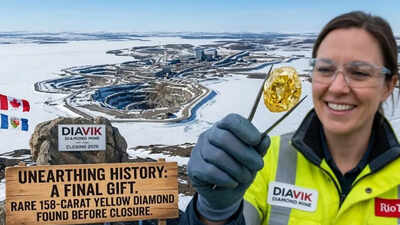
The Diavik Diamond Mine in Canada recently unearthed a stunning 158.20 carat yellow diamond, marking the conclusion of the mine’s 20-year history and the creation of one of five diamonds of this size.
This unique discovery occurred in April 2026, shortly after the mine had completed its operational life. Located about 200 kilometers north of the Arctic Circle in the Northwest Territories (NT), the mine has played a major role in northern Canada’s industrial economy, producing more than 150 million carats of diamonds since its first production in 2003, said the Gem and Jewelery Export Promotion Council (GJEPC). This beautiful yellow diamond is a symbol of the success of the operation, representing the innovations of modern Arctic scientific design and modern partnerships in natural resource management, and celebrating a transformative period for the global diamond industry.
amazing 158 carat yellow diamond Discovery in Canada
According to the Gem and Jewelery Export Promotion Council (GJEPC), this 158.20-carat yellow gem is an exceptional find for the Diavik site, which has produced primarily high-quality white diamonds.
Yellow diamonds represent less than 1 percent of the mine’s total historical production. This is the fifth time a yellow stone weighing more than 100 carats has been discovered at the facility, highlighting the rare geological conditions of kimberlite pipes beneath Lac de Gras.
Diavik’s two decades of mining in the Arctic
According to the government of the Northwest Territories, since commencing commercial production in 2003, Diavik has operated as a joint venture, becoming one of the most productive mining operations in North America.
By the time production stopped in April 2026, the mine had extracted more than 150 million carats of diamonds. The operation is known for its engineering flexibility in the sub-Arctic region, using complex dams for water management and integrated wind and diesel systems.
Indigenous partnerships in site restoration
Following the completion of the extraction process, the site is now in the formal closure and reclamation phase, which is expected to continue until at least 2029. This process is subject to a closure plan developed in consultation with local Indigenous stakeholders and regulatory bodies to ensure the land is returned to a self-sustaining ecosystem.