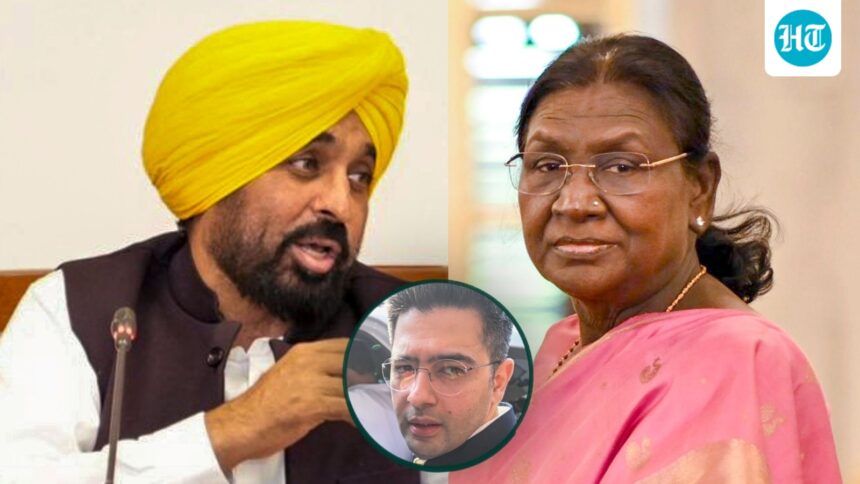
Chandigarh: President Draupadi Murmu gave appointment to Punjab Chief Minister Bhagwant Mann on May 5 after seven members of the Aam Aadmi Party (AAP) Rajya Sabha party defected to the Bharatiya Janata Party (BJP).

Sharing this information, Mann said the President responded to his request for a meeting and scheduled it for 12 noon on Tuesday. He sought appointment with the president to formally demand the “recall” of six of the rebel representatives elected from the state. Seven MPs, making up two-thirds of its total strength of 10 in the Senate, defected to the BJP on April 24, dealing a serious blow to the AAP.
Those who changed sides are Raghav Chadha, Sandeep Pathak, Ashok Kumar Mittal, Harbhajan Singh, Rajender Gupta, Vikramjit Singh Sahni (all from Punjab), and Swati Maliwal (Delhi).
What are AAP’s plans?
On April 25, Mann sought time to meet the President as soon as possible, stating that he planned to meet her along with a delegation of AAP MLAs from Punjab to present his stand on recalling these MPs.
At a press conference in Chandigarh on Wednesday where the Prime Minister shared information about the President’s acceptance of his request for appointment, he did not clarify whether party MLAs would accompany him.
There is no legal text
The Constitution does not provide for the removal of any elected representative. Legal experts say that the idea of “summoning” is foreign to the Constitution. “No confidence clause is not available in the Constitution under any timeline. There is no scope for no confidence,” said Ashok Agarwal, a former Solicitor General of Punjab.
Read also | Chadda’s anti-defection bill that would have stopped its switch between AAP and BJP, wants a law against ‘heinous crossing’
While the Prime Minister’s move is seen in party circles as a “show of strength”, the opposition Shiromani Akali Dal rejected it as “political theatre”. Senior Akali leader Daljit Singh Cheema said that under the Tenth Schedule of the Constitution, taking action against MPs is the prerogative of Parliament and not the prerogative of the President.