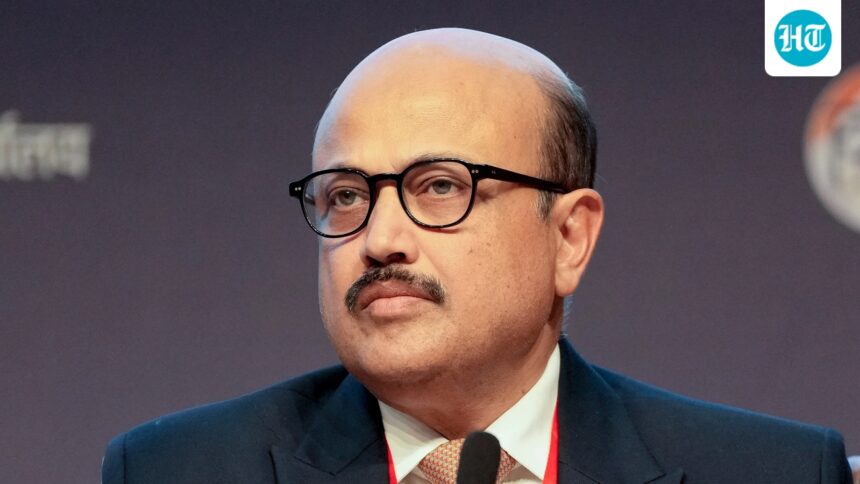
A team of Indian officials led by chief negotiator Darpan Jain will visit the US for three days starting April 20 to strengthen bilateral trade talks under the February 7 framework, with necessary changes to make them legally viable and to ensure relative benefits for both sides, the officials said.

While the two sides have remained engaged virtually, this will be the first in-person meeting of negotiating teams in two or three months, said the officials, who requested anonymity.
Commerce Minister Rajesh Agrawal confirmed the visit. “We look forward to finalizing the legal agreement, which is a logical follow-up to the joint statement issued on February 7. Further discussions and follow-up engagement are needed to move this forward,” he said.
Read also | China overtakes US as India’s largest trading partner in FY26; The trade gap has ballooned to $112 billion
What will be discussed?
The joint statement set out a framework for a temporary, mutual and mutually beneficial trade agreement. The discussions will cover all pending issues, including the recent investigations launched by the US Trade Representative (USTR) against several countries, including India, officials said. “The two sides will sit together and discuss how to address these issues,” an official said, adding that timelines and next steps would be finalized as part of the engagement.
HT reported on April 10 that India is likely to seek preferential market access for its exports under the new US tariff framework, aiming to gain an edge over rival countries.
The visit comes as the two sides try to rebuild a proposed bilateral trade agreement after the US Supreme Court on February 20 invalidated the sweeping global tariffs imposed by President Donald Trump, ruling that they exceeded his legal authority.
Read also | Trump warns against changing UK trade terms and criticizes Starmer’s policies: report
The resolution invalidated the proposed 18% tariff on Indian goods, forcing negotiators to reconsider the framework. Further complicating matters, Washington has launched new Section 301 investigations against multiple economies, including India, as part of efforts to reframe the tariff measures through alternative legal routes. Officials said that the ongoing talks are expected to address these investigations.
India faces two such investigations – one relating to alleged industrial overcapacity in sectors such as solar modules, and the other relating to the use of forced labour.
India backs down from US trade investigations
India has since submitted its response, strongly rejecting the allegations and asking the US Trade Representative to end the investigations. New Delhi said in its report that the investigation into “structural excess capacity” lacks any “rationale” or prima facie evidence and is based on broad macroeconomic indicators without identifying specific policies that could be considered discriminatory. India also objected to a separate investigation into the alleged failure to reduce forced labour, arguing that it did not meet the legal threshold under Article 301.
India added that any trade concerns should be addressed through ongoing bilateral trade negotiations rather than unilateral measures. Despite the doubts, India is considered to be in a relatively better position, having already negotiated a framework for an interim agreement.
The February 7 framework followed a period of heightened trade tensions, when India faced a 25% reciprocal tariff and an additional 25% punitive tariff linked to purchases of Russian crude. The joint statement removed the punitive element on the condition that India restrict such imports, leaving in place the reciprocal tariff, which was later negotiated lower to 18%.
With that structure now invalidated, the Trump administration invoked Section 122 of the Trade Act of 1974 to impose a temporary 10% tariff on imports from all countries, with the law allowing rates of up to 15% on imports. The measure is in effect for 150 days and is scheduled to expire in July, creating a narrow window for negotiators to reach a legally sustainable arrangement.