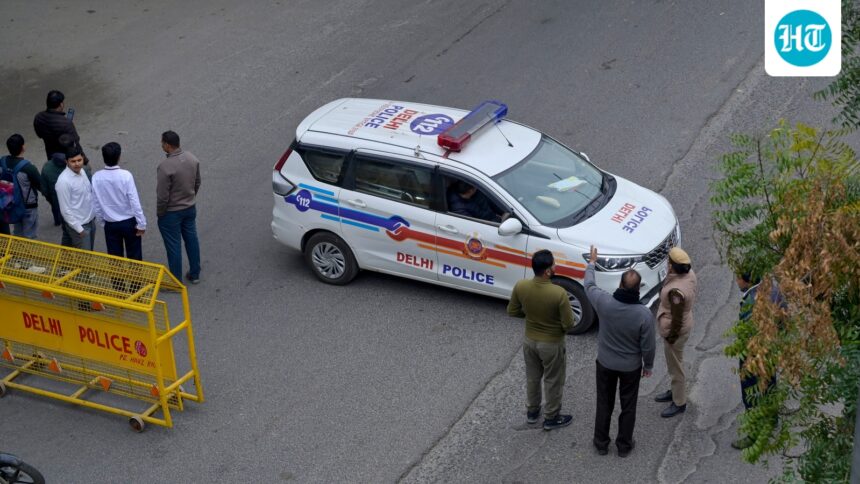
The Delhi Police Control Room (PCR) unit plans to equip all its 857 patrol vehicles with dashboard cameras and equip each responsible truck with a body camera, in a move aimed at filling evidence gaps at crime scenes, speeding up investigations and protecting individuals from false accusations, senior officers said.

In the first phase, the unit sent a proposal to the Supply and Logistics Department — Delhi Police’s wing to issue bids, finalize vendors, and procure equipment — for 300 dash cameras and a similar number of body-worn cameras, at least two officers said on condition of anonymity.
“As part of our pilot project, we are initially procuring 300 dashboards and 300 body-mounted cameras. The remaining 557 patrol trucks, known as PCR trucks, and their handlers will be equipped with similar cameras, either in a single-stage or two-stage manner,” an officer said.
Since PCR vans and the personnel deployed in them are the first responders to crime scenes, accidents and other emergencies, the cameras will help capture evidence in the first phase of a police response – a phase officers described as crucial to any investigation.
The initiative comes under the new criminal laws, especially the Bharatiya Nagarik Suraksha Sanhita (BNSS) Act, which makes audio and video recording of crime scenes by police mandatory in crimes punishable by imprisonment of seven years or more. Officers said videotaping to collect forensic evidence also ensures greater transparency and accountability in evidence collection, and acts as a safeguard against irregularities and tampering.
Under Delhi’s current police system, an emergency call or distress call received at the control room is first transferred to PCR trucks closest to the caller’s location. The call is then transferred to the relevant police station, which sends an Investigating Officer (IO). The IO usually arrives at the scene 10 to 15 minutes after the PCR truck and makes an audio and video recording of the scene as part of digital evidence collection, the second officer said.
“There have been instances of destruction of evidence and tampering with crime scenes due to delayed arrival of information and forensic teams. In such a scenario, CCTV cameras will record the events unfolding at the scene while body worn cameras will capture real-time interactions. It will also ensure that important details are not lost in the chaos of the initial response,” the second officer said.
Officers said the recordings will generate a reliable real-time visual record to be used as evidence in court, helping to deliver fair and speedy justice.
The cameras are also expected to act as a deterrent against misconduct — by the public as well as police personnel — and enhance accountability and public trust, officials said. For officers, the footage will serve as collateral, enabling them to prove their version of events and prove their innocence when accusations are made against them by individuals or members of the public.
Another officer said, “There are frequent allegations against employees of misconduct, coercion, corruption or biased action. Sometimes, it becomes difficult for senior officers to verify some of the accusations. But with the video evidence produced by dashboard and body cameras, there will be clarity and fairness in such situations.”
Former IPS officer Ashok Chand, who retired from Delhi Police as Additional Commissioner, supported the plan as he said digital documentation is crucial evidence in the criminal justice system. “But dash and body-worn cameras have advantages and disadvantages. A dash camera secures the scene but often misses context outside its narrow field, can be obstructed, and does not capture verbal exchanges. A body-worn camera can bring transparency to interactions, but it depends on the officer being activated and positioned correctly, and can be selective in what it ultimately records.”