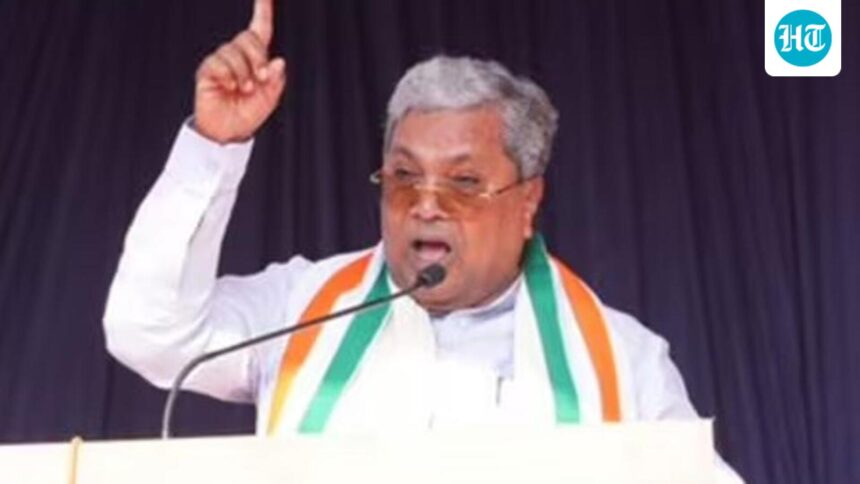
The Enforcement Directorate (ED) has moved the Karnataka High Court challenging the closure of the corruption case against Karnataka Chief Minister (CM) Siddaramaiah, his wife PM Parvathi and two others in the alleged land allotment case to Mysore Urban Development Authority (MUDA).

In its petition on Monday, the ED has challenged the trial court’s decision to accept the final ‘B’ report submitted by the Lokayukta police in the MUDA land allotment case involving Siddaramaiah and his family.
It had opposed the January 28 order of a special court in Bengaluru, which had accepted the closure report and terminated the proceedings against Siddaramaiah, Parvathi, Mallikarjuna Swamy’s brother-in-law, and landowner J Devaraj.
In its plea, the central agency claimed that the special court’s order was “internally inconsistent and legally indefensible”. She said the court could not have accepted Report B which exonerates the four accused, including the Prime Minister and his wife, while at the same time allowing further investigations to be conducted against MUDA officials over the same alleged illegal allotment of 1,045 sites.
According to the CEO, Siddaramaiah, Parvathy, Swamy and Devaraj are the “main beneficiaries” of the alleged “proceeds of crime”, with one of them acquiring 14 high-value websites worth approx. $56 Crores.
If the allotments are illegal, the beneficiaries cannot be exonerated while only the officials who made the allotments remain under investigation, the ED said in its petition.
Read also:HC issues notice to Siddaramaiah on petition challenging closure of MUDA case
The central agency further said that the roles of “donors” and “takers” were inseparable, especially when beneficiaries were alleged to have exercised influence over officials.
It further said that “the crime of conspiracy necessarily includes both sides of the deal and cannot be divided” in the way the Special Court did.
According to the petition, the Lokayukta police also ignored the physical evidence shared by the ED under Section 66(2) of the Prevention of Money Laundering Act (PMLA). This evidence includes satellite images indicating development activity on the land as early as 2003, before its expected classification as agricultural land, and WhatsApp communications allegedly showing undue influence on MUDA officials, the ED said.
It also relied on statements attributed to former MUDA commissioner GT Dinesh Kumar, who allegedly admitted that he had acted beyond the agenda of the MUDA board for the benefit of the chief minister’s wife.
According to the ED, it shared with the Lokayukta police, five categories of evidence between November 30, 2024 and January 24, 2025. Despite this, the latter filed a ‘B’ report saying it did not find enough material to prove the alleged irregularities in the case, which the trial court accepted.
The Special Court’s admission of such a Class B report, the ED said in its petition, reflects a “lack of application of reason” and violates well-established principles of law.
Accordingly, the CEO sought quashing of the special court’s January order and the Lokayukta ‘B’ report. It also urged the Supreme Court to continue the direct investigation against all the accused, including the Prime Minister and his family.
Read also: Emergency manager summons wife of Siddaramaiah, Minister of State in Muda case
The case relates to allegations that MUDA illegally allotted 14 compensatory sites to Parvathi after identifying and transferring more than three acres of land in Kesari village. The complaint alleges that the amount of compensation rose from a few thousand in 1997 to approx $56 crore in 2021.
On March 25 this year, a single bench of the Karnataka High Court issued notice on a separate petition filed by RTI activist and original complainant in the alleged MUDA scam case, Snehamai Krishna. In his petition, Krishna also challenged the January 28 order accepting the Lokayukta closure report.
Krishna said the special court treated the matter as a routine dispute and failed to independently evaluate the serious allegations of abuse of power. He also sought the transfer of the investigation to an independent agency and a court-supervised investigation.
The ED’s petition is yet to be heard by the Supreme Court.