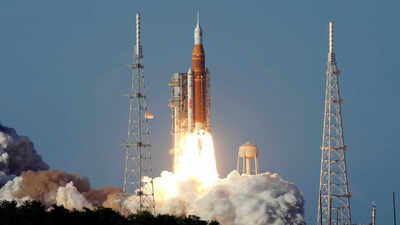
BENGALURU: At 3.35 am on Thursday (IST), a 322-feet-long rocket lit up the Florida sky and carried four astronauts away from Earth’s orbit – the first humans to make the journey in 54 years.NASA’s Artemis 2 mission is now in flight mode, and the moon is six days away.The SLS rocket and Orion spacecraft — named “Integrity” by its crew — lifted off from Launch Complex 39B at Kennedy Space Center at 6:35 p.m. EDT on April 1. The rocket’s dual solid boosters were fired first, providing more than 75% of the thrust needed to lift the 5.75 million-pound rocket from the pad. Their combined power, along with the four fully operational RS-25 engines, generated 8.8 million pounds of force at liftoff.
Cheers erupted through the control room as the vehicle cleared the tower.The first minutes of the trip passed by the book. The two solid rocket boosters separated safely, and Orion’s launch abort system separated soon after, exposing the spacecraft to the vacuum of space for the first time. About 50 minutes after liftoff, the temporary cryogenic propulsion stage fired its main engine for the first time, raising the low point of the orbit to a safe distance of 115 miles.
About two hours after liftoff, the upper stage engine fired again for about 18 minutes, raising the highest point in orbit to 43,760 miles.Orion’s four solar array wings were then deployed, with flight controllers in Houston confirming that all four wings had deployed as planned, locked into place and begun drawing power.The crew now has work to do before they can head toward the moon. They will spend their first 24 hours in space orbiting Earth and performing checks on the Orion capsule – communications, navigation, propulsion, maneuvering and life support systems – while staying close enough to Earth to return quickly if any major problem occurs. Once all the systems have passed muster, they will fire an engine combustion that sends them coasting for four days to the moon.Senior NASA officials did not downplay the importance of this moment. “Aboard Orion are four amazing explorers preparing for the first crewed flight of this rocket and spacecraft, a true test mission that will take them farther and faster than any human in a generation,” said NASA Administrator Jared Isaacman. “Artemis II is the beginning of something bigger than any one mission.
It marks our return to the Moon, not just to visit, but to eventually stay at our lunar base, and lays the foundation for the next giant leaps forward.Assistant Director Amit Kshatriya added: “Over the next 10 days, Reed, Victor, Christina and Jeremy will put Orion through its paces so that the crew following them can go to the lunar surface with confidence. We are one mission in a long campaign, and the work ahead of us is greater than the work behind us.”If all goes well, the mission is expected to reach its peak on April 6, when the crew will reach its closest approach to the Moon. During the planned, several-hour lunar voyage, the astronauts will photograph and observe the lunar surface as the first people to lay eyes on some of the areas from the far side. After the flyby, the crew will take a circular, figure-eight path back to Earth, ending with a landing in the Pacific Ocean, expected on April 10.