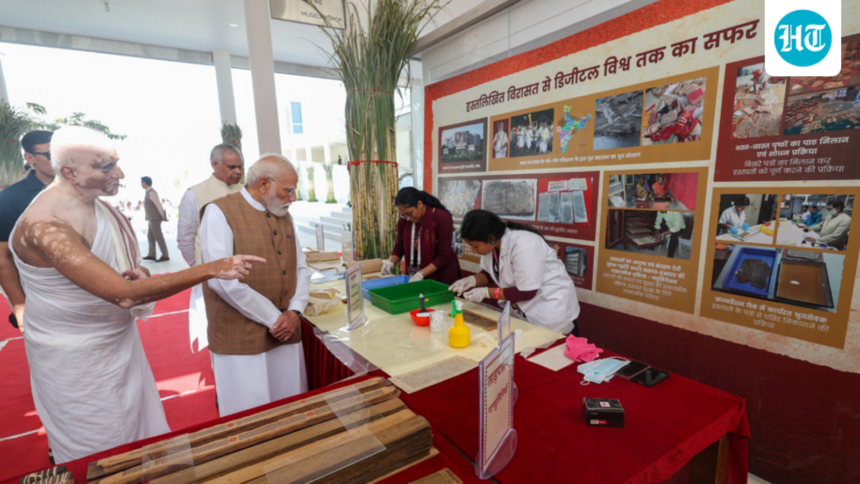
Prime Minister Narendra Modi on Tuesday criticized previous governments for neglecting India’s manuscript heritage for political reasons when he inaugurated the Samrat Samprati Museum at Koppa Tirth in Gandhinagar, which houses over 2,000 rare objects tracing the development of Jainism. The museum is dedicated to Samrat Samprati Maharaj (224-215 BC), a preacher of non-violence.

“After independence, searching for and preserving…manuscripts was a national responsibility. But unfortunately, due to the colonial mentality, this matter was not taken care of,” Modi, who is on a one-day visit to Gujarat, said.
“Previously, such work was done through a political lens. How to define the narrative of one political family, how to frame things based on vote bank calculations, everything revolves around that. We have ended that mentality.”
He referred to the government’s initiative to digitize manuscripts, the Gyan Bharatam Mission, and saints like Jainacharya Shri Padmasagar Sureshwarji Maharaj Sahib, who spent 60 years traveling the country to find manuscripts. He said: “More than three hundred thousand manuscripts, written on palm leaves and birch bark, which are hundreds of years old, are today safely preserved and collected in Cuba. This is a great service to India’s past, India’s present, and our future.”
Modi drew parallels between the Samrat Samprathi era and the idea of value-based governance. “While some rulers used violence as a weapon of rule, Samrat Samprathi sat on the throne and spread the message of non-violence.” He said the museum’s message is relevant outside India. “With the way the world is burning in the fire of instability and turmoil, the message of this museum is important not just for India, but for all of humanity.”
Earlier on Tuesday, Modi conveyed his greetings on the birth anniversary of Bhagwan Mahavir. Saying that his life and teachings illuminate the path of truth, nonviolence and compassion.
Modi was scheduled to travel to Sanand to inaugurate the Cainz Semicon plant, marking the start of commercial production at the semiconductor facility, according to a government statement. The factory, which will have a production capacity of 6.33 million units per day, was established with investments of approximately $3,300 crore under the Indian Semiconductor (ISM) Mission.
The statement said that the opening of the factory will be a major step within the framework of ISM. “The second semiconductor facility, after Micron Technology, will be among the projects approved under the program to start commercial production.”
In Banaskantha, Modi will lay the foundation stone and inaugurate development projects worth more than that $Rs 20,000 crore covers roads, railways, power, urban development, health, tourism, water supply, tribal development and rural infrastructure. It will inaugurate the Ahmedabad-Dholera Expressway, which was built at a cost of over $2,000 $5,100 Crores.
Modi will lay the foundation stone for Sabarmati riverfront expansion projects $1000 crore in Gandhinagar and opening a hostel in Ahmedabad for tribal students pursuing higher education.