The Gujarat Assembly on Tuesday passed the Gujarat Uniform Civil Code Bill, making it the second state in independent India after Uttarakhand to codify a common set of personal laws.

The legislation, which was passed after an eight-hour debate, exempts Scheduled Tribe (ST) residents of the state.
UCC aims to replace laws based on religious texts or traditions, and focuses on gender equality, the right to equality and the prevention of discrimination. This law applies to marriage, divorce, inheritance, adoption, guardianship, and division of land and assets for all citizens, regardless of their beliefs.
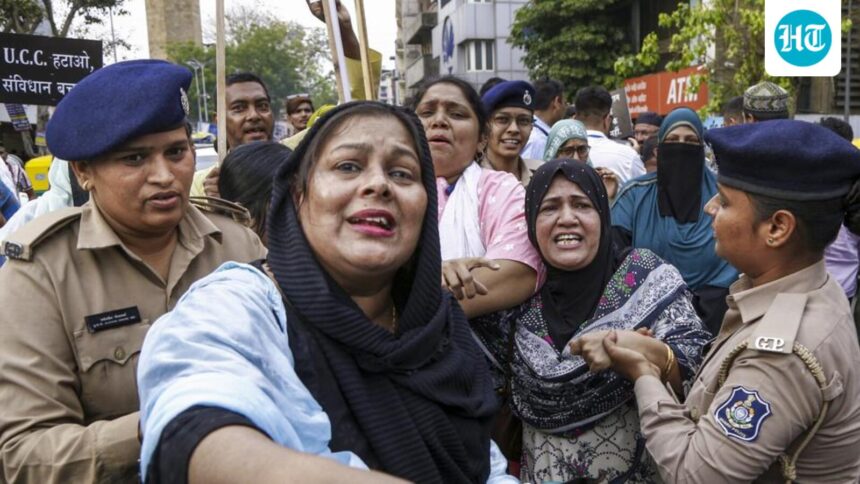
The ruling Bharatiya Janata Party has defended the legislation as a step towards equality, and the opposition Congress Party has raised objections to its implementation and questioned the speed with which the bill was drafted, enacted and passed.
Prime Minister Bhupendra Patel described the bill as a step towards “national unity and gender justice”.
“This is not against any religion, this is about equality before the law,” Patel told the House of Representatives. He said that the law would finally grant Muslim women equal rights to ancestral property and provide them with legal protection on an equal basis with women from other communities.
He said that UCC is not just a legal exercise but a step towards equality, justice and national unity. “This is not just a legal process, but our firm resolve to strengthen the national commitment to equality, justice and unity,” he said.
The UCC is the third of the three core agendas that the ruling Bharatiya Janata Party has championed since its inception, the other two being the construction of a Ram temple in Ayodhya and the abrogation of Article 370 that gives special status to Jammu and Kashmir.
Patel said the draft law includes provisions related to mandatory marriage registration, registration of direct relationships, uniform rules for divorce, equal inheritance rights for sons and daughters, and penalties for violating the provisions. He said mandatory marriage registration would help protect the rights of women and children, prevent fraud and false matrimonial claims, and ensure legal recognition of marriage.
Like the Uttarakhand law, the bill makes registration of marriage, divorce and cohabiting relationships mandatory and bars people of any religion or community, except STs, from having more than one spouse. Violation of this provision results in a prison sentence of up to seven years. The same penalty applies to anyone who marries by concealing his identity or committing fraud. Failure to register the direct relationship may result in imprisonment for up to three months.
“If individuals are between 18 and 21 years of age, their parents will be informed. There is a strict penalty for coercion or fraud. POCSO provisions apply in cases involving minors, and strict penalties apply if a married person enters into a live-in relationship,” he said.
CM Patel said the draft law was prepared after public consultations, judicial rulings and study of laws in other countries and other Indian states. A committee headed by retired Justice Ranjana Desai drafted the bill.
Deputy Prime Minister and Law Minister Harsh Sanghvi said criminal law already applies equally to all citizens and civil law should do the same. “The criminal law is the same for everyone in India. If someone commits theft or murder, the punishment is the same regardless of religion. So why is religion asked about when it comes to marriage, divorce, alimony or a daughter’s property rights?” He said.
Sanghvi said the bill is based on four principles: gender equality, legal uniformity, simplification of laws, and constitutional ethics. He traced the idea of a unified civil code to the colonial era, when British authorities made criminal laws unified but deliberately left personal status laws separate. He said that Dr BR Ambedkar had included Article 44 in the Directive Principles specifically to guide future governments towards a uniform civil code, but successive governments had failed to act on it.
“This bill is not against any religion, creed or way of worship. It is not intended to remove customs and traditions. This bill aims to wipe away the tears of thousands of daughters and mothers who have suffered injustice due to unequal laws,” Sanghvi said.
On the issue of religious freedom, he said that the law would govern only civil matters and that protection under Article 25 of the Constitution would remain intact. He also noted that many Muslim-majority countries, including Türkiye, Azerbaijan and the United Arab Emirates, do not have separate personal status laws.
“All scheduled tribes will be completely exempted from the proposed Uniform Civil Code. Their customs, marriage, divorce and inheritance practices will not be affected,” Sanghvi said.
Justice Ranjana Prakash Desai’s committee, which drafted the bill, received nearly 20,000 public submissions through mail, email and web portal. Sanghvi said that suggestions were taken from every district and from all religions, communities and political parties in the state, and the majority of participants supported uniform laws on marriage, divorce, maintenance and property rights.
Congress opposed the bill. Senior leader Amit Chavda objected to the haste with which it was introduced, saying the government had not made the Desai Commission report public or tabled it in the state assembly and was pushing the legislation for electoral benefit without giving lawmakers time to study the proposals.
“The people of Gujarat will not wait for the so-called right time for Congress. The time for equality is now,” Sanghvi said.
He said Goa operated under a uniform civil code before independence, and people there lived for decades under the same civil code in peace, harmony and equality.
Imran Khudawala, Congress MLA from Ahmedabad’s Jamalpur Khadia seat and the only Muslim member of the Gujarat Assembly, opposed the Uniform Civil Code Bill. He said that the law targets the minority and stated that he would burn the bill outside the House of Representatives.
Congress MLA Shailesh Parmar said there was a lack of legal clarity on its applicability.
He said it was not clear whether the law would apply only to citizens of Gujarat or to all persons residing in Gujarat. He pointed out that thousands of people from other states live in Gujarat and many people from Gujarat live outside the state, and the bill did not clearly clarify the legal position in such cases.
Parmar said the law should not affect neighboring countries and that there should be legal clarity on the jurisdiction and implementation of the law.