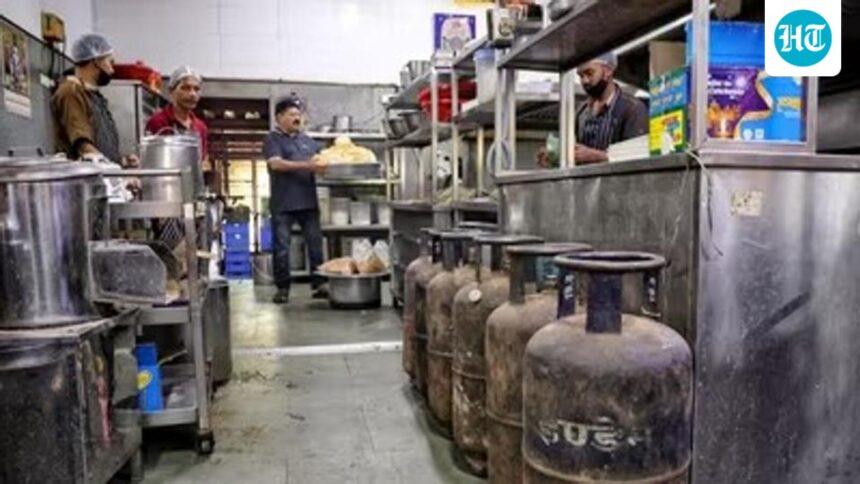
The West Bengal government on Thursday rolled out standard operating procedures (SOP) to address the shortage of liquefied petroleum gas (LPG), even as state-run schools, temples, community kitchens, restaurants and hospitals are already feeling the heat amid the ongoing conflict in West Asia, which has disrupted LNG shipments through the Strait of Hormuz.

The SOP includes setting up a 24×7 LPG control room at the state secretariat, a committee headed by the state chief secretary to review the situation and stabilize the supply chain, strengthening logistics to ensure uninterrupted supply, designated public helplines, alternative fuel support, and a real-time monitoring board.
“This SOP has been issued to guide coordinated monitoring and stabilization of supplies and facilitate prompt redressal of public grievances. It is intended to ensure continuity of vital public services such as cooked mid-day meals in schools, Integrated Child Development Services (ICDS), hospital meals and essential household consumption,” the SOP said.
Read also: Fishing trips in Goa have been halted due to LPG shortage hitting fishing vessels amid conflict in West Asia
This came a day after Chief Minister Mamata Banerjee held an emergency meeting with oil manufacturers and senior officials of the state administration and police on Wednesday.
The control room numbers are 1070, 033-22143526 and 8697981070. The general helpline numbers are 033-49506101, 033-35026214 and 033-24874400.
Meanwhile, midday meals have been affected in many schools across the state.
“In the current global situation, many schools are facing acute shortage of LPG cylinders under PM POSHAN (Pradhan Mantri Poshan Shakti Nirman) scheme. It has been observed that some LPG distributors are not supplying cylinders in time and creating a crisis in the supply chain. Due to this irregular and inadequate supply of LPG cylinders, cooking of mid-day meals in schools is seriously hampered,” said the officer in charge of PM Poshan Scheme in the district. Hooghly wrote in a letter to the project director in West Bengal.
While some schools have reduced the menu and started serving only khichdi to children for midday meals, others have started cooking in clay ovens using firewood.
“Since yesterday, we have made an earthen oven inside the school compound where cooking is done. We are using wood. The gas cylinder has become almost empty and we don’t know when it will be refilled,” Roop Bhattacharya, a teacher at Banachorwa High School in Bankura, which has about 800 students, told HT.
Midday meals are provided daily to around 7.5 million schoolchildren in West Bengal.
Read also: The Essential Commodities Act has been invoked to prioritize LPG production for domestic use
Some of the best and famous restaurants in Kolkata have also arranged to use wood and charcoal as an alternative to LPG.
“Distributors are unable to supply. We have arranged two commercial LPG cylinders at exorbitant prices. We are cooking biryani on a charcoal oven instead of an LPG oven. Earlier we used to cook biryani in a small handi (50 dishes in a small handi) on LPG ovens. But since a charcoal and firewood oven takes much longer, we cook biryani in a big handi and prepare 80-90 dishes in one go,” said the manager of a popular restaurant. The biryani restaurant chain in Kolkata said.
“Non-availability of commercial gas has started affecting the tourism industry in Darjeeling Hills. Since most of the hotels do not maintain adequate stock of gas, we will have to limit our menu unless normalcy is restored,” Darjeeling Hotel Owners’ Association Joint Secretary Saship Pradhan said.
As the wedding season begins, caterers are asking customers to reduce the menu.
“I received an order on Thursday from a wedding house to cook food for about 280 guests. I have one cylinder full and one half full. As a precaution, I kept some wood and a makeshift clay oven ready. I managed the cylinders from a friend and promised to return both within a week. For the next few orders over the next few days, I have asked the customers to reduce the menu,” said Ashish Debnath, who runs a catering business in east Kolkata.
Chefs working in the kitchen of RG Kar Medical College and Hospital, a state-run hospital in Kolkata, said that with supplies of commercial LPG cylinders declining, they are now managing the crisis using local cylinders.
“Around 1,200-1,250 meals are cooked, mostly for patients, three times a day – breakfast, lunch and dinner. But we don’t get commercial cylinders. We are now relying on local cylinders. We need at least 20 commercial cylinders every week. The next delivery date is Friday. We don’t know what will happen, hence we have arranged some local cylinders,” said an employee.
Tarapith Temple Committee authorities said that if the crisis is not resolved soon, the distribution of bhog to devotees may be affected.
“There is no longer enough LPG. We have started using wood, charcoal and cow dung cakes. But this will cause huge losses in the bhandaras (free kitchens). We will have to stop them,” Taramoy Mukherjee, a temple committee official, told the media.
Maa Canteens, the Trinamool government’s subsidized community kitchen service for the poor, was affected in some locations.
“At least 300 people come here every day to have lunch $5. We told the local municipal authorities that we do not have LPG cylinders. “We had to close our kitchen on Thursday morning,” said Sunanda Pujari, supervisor of a canteen in Basirhat in North 24 Parganas district.