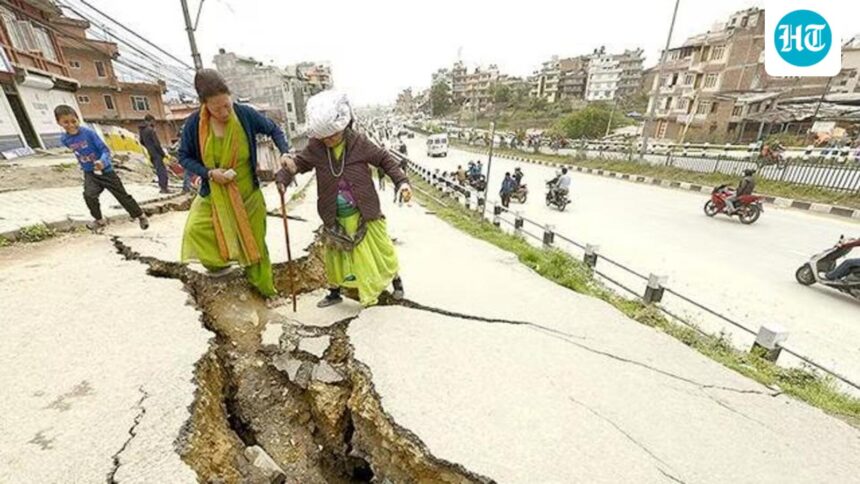
The state government on Thursday informed the Assembly that 169 sensors have been installed across the state under the Earthquake Early Warning System (EEWS) to detect earthquakes and issue early warnings.

However, due to the state’s difficult terrain and the remote location of many sensors, power outages sometimes cause temporary signal outages, resulting in some sensors being disconnected, the government said on the fourth day of the budget session in Jersey.
Responding to Qazi Nizamuddin on whether there was any alternative power supply arrangement to keep these sensors operational, Parliamentary Affairs Minister Subodh Unial said: “Alternative power supply arrangements are everywhere. At present, there are 128 sensors operational, while 41 are non-functional. They are constantly being repaired, so the number of operational sensors keeps increasing or decreasing.”
In a written reply, the government said a technical team from the Indian Institute of Technology, Roorkee, is continuously working to address these issues.
Read also:About 11% of food samples fail safety tests in Uttarakhand in 3 years: Govt
“amount $“Rs 115 crore has been incurred to install these sensors,” Onyal said.
The government also said it plans to increase the number of sensors to 500 under the National Earthquake Risk Mitigation Program (NERMP).
“Under the National Earthquake Risk Mitigation Program (NERMP), the state government plans to increase the number of sensors to 500. They will be installed on priority basis in major fault zones such as Himalayan Front Fault (HFT), Main Boundary Thrust (MBT), Main Central Thrust (MCT), as well as other sensitive areas including the Uttarakhand-Nepal border and the Himachal Pradesh-Uttarakhand border.” The government said.
According to the government’s response, the exact locations of the sensors will be determined after geological surveys are conducted after the project receives approval.
Responding to a query from Pritam Singh, Onyal said that a project to install additional sensors has been proposed. “amount $It is expected that Rs 153.44 crore will be incurred on the project, with financing in the ratio of 90:10.
Uttarakhand has been listed in Seismic Zone 6 as per Indian Standard IS 1893:2025, indicating high seismicity, according to officials.
In February, the Uttarakhand state government formed a 14-member committee to amend building codes after the state was reclassified to a higher earthquake risk category.
Disaster Management Minister Vinod Kumar Soman said the state government’s aim is not only to amend regulations but to promote a broader culture of safe construction.