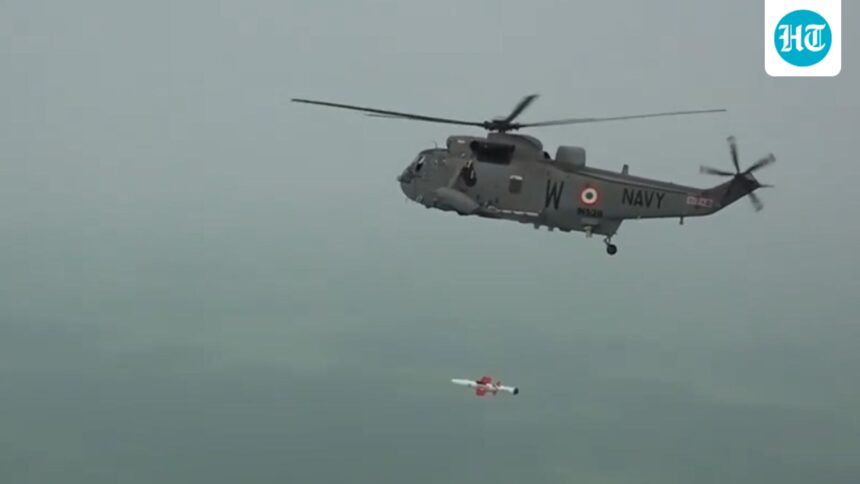
The Defense Research and Development Organization (DRDO) and the Indian Navy successfully conducted the maiden launch of a Naval Short-Range Anti-Ship Missile (NASM-SR) from the Indian Navy’s helicopter pad, off the coast of the Bay of Bengal in Odisha.

During the test, two missiles were fired in quick succession from the same helicopter, making it the first launch of an advanced air-launched anti-ship missile system.
Earlier on Saturday, in a major boost to India’s indigenous naval capabilities, DRDO and the Indian Navy successfully completed the advanced hydrodynamic performance evaluation and prototype testing of the Frontline Warship project.
The work, led by the Naval Science and Technology Laboratory (NSTL) in collaboration with the Navy’s Warship Design Office, demonstrated cutting-edge capabilities in hull hydrodynamics, CFD simulation, and pilot testing, consistent with leading international standards for accuracy and reliability.
DRDO posted on
“Comprehensive capabilities were demonstrated in Hull hydrodynamic simulation, CFD-based simulation and experimental model testing, covering critical parameters such as resistance, propulsion, sea keeping and maneuverability. The results were measured against leading international standards, achieving parity in accuracy, reliability and technical depth,” he added.
The project deliverables were formally handed over by Sameer Kamat, Secretary, DDRDO and Chairman, DRDO, to Sanjay Sadhu, Controller, Warship Production and Acquisition, in the presence of senior DRDO scientists and Indian Navy officials.
Earlier in the day, advanced armored platforms (tracked and wheeled), designed and developed by the Vehicle Research and Development Establishment, were unveiled by Defense Minister (R&D) and DRDO Chief Dr Sameer Kamat at the DRDO Laboratory headquarters in Ahilyanagar, Maharashtra.
According to the Ministry of Defence, the platforms have been developed to meet the emerging operational requirements of the Defense Forces.
Both platforms are integrated with an indigenously designed and developed 30 mm unmanned turret, with advanced features to meet mobility, firepower and protection requirements. Integrated with a high-power engine and automatic transmission, these platforms have a high power-to-weight ratio, higher speed capabilities, the ability to negotiate slopes and obstacles, and STANAG level 4 and 5 protection with blast protection and ballistic protection modules throughout. Amphibious with improved ability to cross water obstacles through the incorporation of seaplanes provides operational flexibility.
According to the ministry, the 30mm unmanned turret, along with the 7.62mm PKT cannon, is configured to fire anti-tank guided missiles as well. The basic design has capabilities that can be configured for multiple roles. The percentage of original content is 65%, with plans to increase it to 90%.